
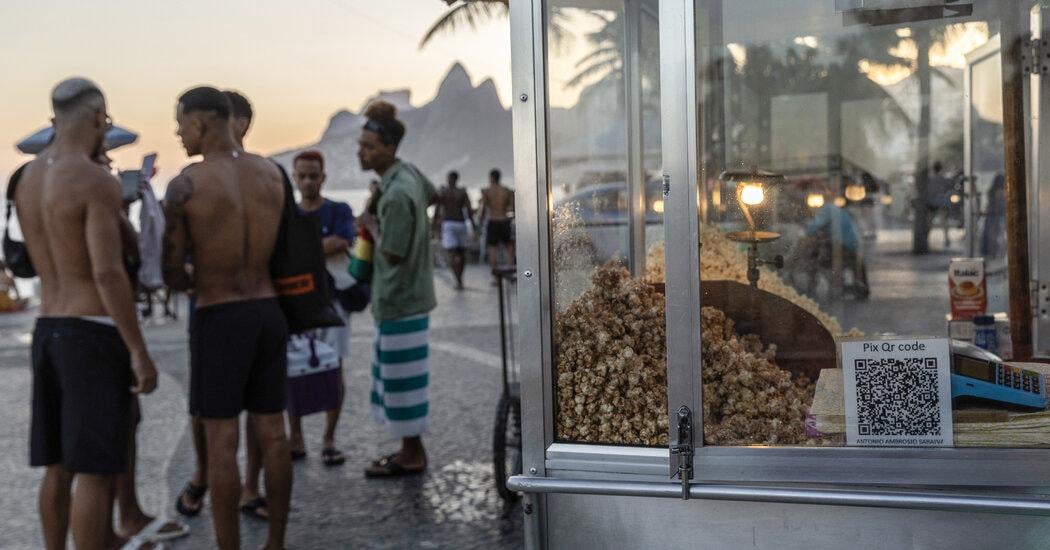
The payment of choice in Latin America’s largest nation is often PIX, a fast and free digital system Brazilians use every day to shop, pay bills, settle bar tabs and buy snacks on the beach.
The payment method has become immensely popular, adopted by more than 80 percent of Brazil’s population. Outside the country, it has drawn praise from leading economists, who have gone as far as to call it the future of money.
Yet its success has also set off blowback: The Trump administration, as part of its aggressive economic and political campaign against Brazil, is investigating PIX, accusing the payment system of unfairly undercutting U.S. financial and technology companies like Visa and Apple.
The standoff over PIX has intensified the diplomatic crisis between Brazil and President Trump, who has also imposed steep tariffs and sanctions in an effort to prevent former President Jair Bolsonaro, his political ally, from being found guilty of plotting a coup.
U.S. criticism of the payment method has hit a nerve in Brazil, which has cast it as another attack on its sovereignty. “PIX belongs to Brazil and the Brazilian people!” the government declared in a social media campaign that has gone viral.
In its speed and ease, PIX is similar to Zelle, the payment system run by a consortium of U.S. banks. But unlike other similar digital services, like PayPal, Pix carries no fees for individuals and small businesses.
The Office of the U.S. Trade Representative is investigating PIX, claiming that Brazil has given an unfair advantage to the digital payments system by requiring all banks to offer it.
U.S. trade authorities also say that, by protecting consumer data that PIX collects, the Brazilian government is hurting American companies that use such information to make business decisions and develop new products.
PIX is also a monetary blueprint for the BRICS alliance of developing economies, which includes Brazil, Russia, India, China and South Africa, as it seeks to create an international payment platform aimed at reducing reliance on the U.S. dollar. Mr. Trump has threatened the bloc with tariffs if it tries to create a rival currency.
Posted by John3262005
2 Comments
The US’ digital payments infrastructure is one of the worst in the world. China, India and parts of Africa are ahead too. For normal transfers between bank accounts, even the glacial EU has better tooling.
What saves US credit cards from competition is high rewards, which are often paid for by the merchant in as fees you rarely see. The super expensive, high points card can have transaction fees near 3%, so while you might not want to pay it, it’s what many a consumer will want to use. And the US isn’t going to try to regulate rewards programs, even though they push us towards a far worse equilibrium than just cheap payments.
Yeah they tried to do this to India. We have our own card payment, Rupay and an instant payment system – UPI. Both visa and Mastercard whined to the US government about this. Which means Brazil is doing something right.
https://www.reuters.com/business/finance/exclusive-visa-complains-us-govt-about-india-backing-local-rival-rupay-2021-11-28/