Our healthcare system is “for profit”, but it’s definitely not free market.
AmbitiousLake on
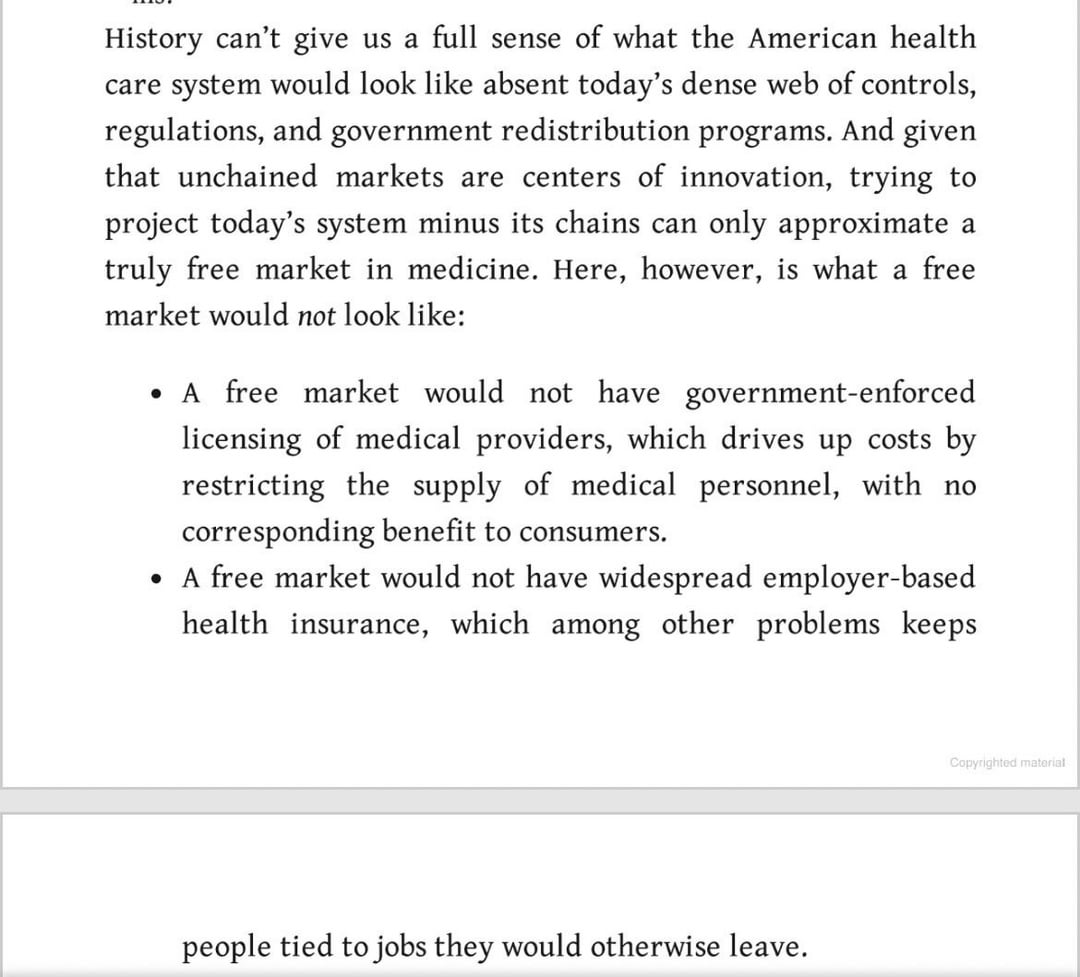
There is a huge amount of bloat in healthcare but this is so overly optimistic re:licensing
Serpico2 on
I’m pretty open minded and humble about this, because it’s an area I know very little about.
Perhaps someone with more historical knowledge could enlighten us about what healthcare looked like for average people in like the 1940s and 50s before the big healthcare entitlements, and before the employer mandate? That’s an imperfect metaphor because it also doesn’t reflect the astounding costs of modern medicine, but it might help us frame what something like that would look like today.
PolyrythmicSynthJaz on
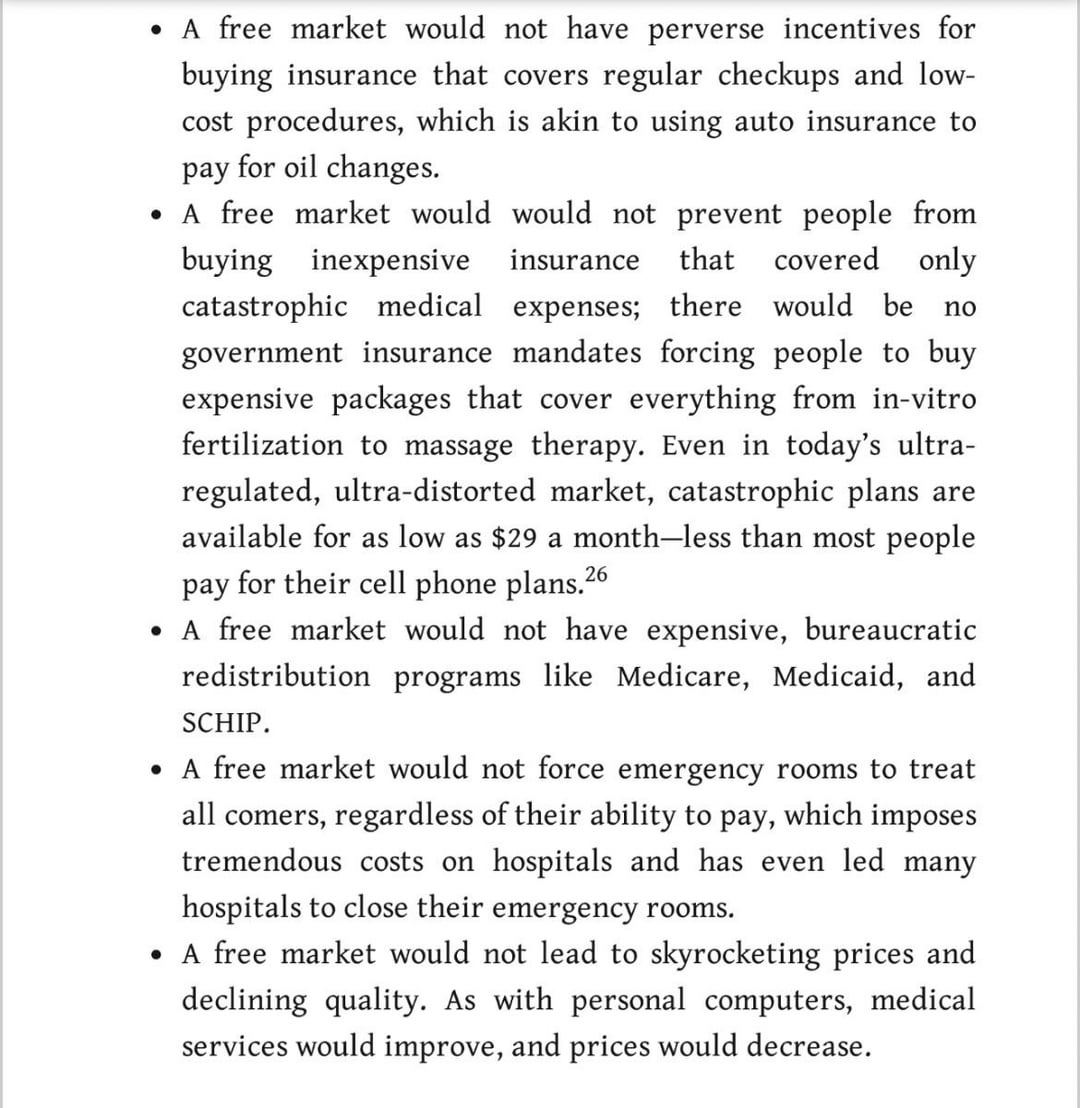
>A free market would not have expensive, bureaucratic
redistribution programs like Medicare, Medicaid, and
SCHIP.
Some of these are good planks, some of them (for example: this one) are terrible.
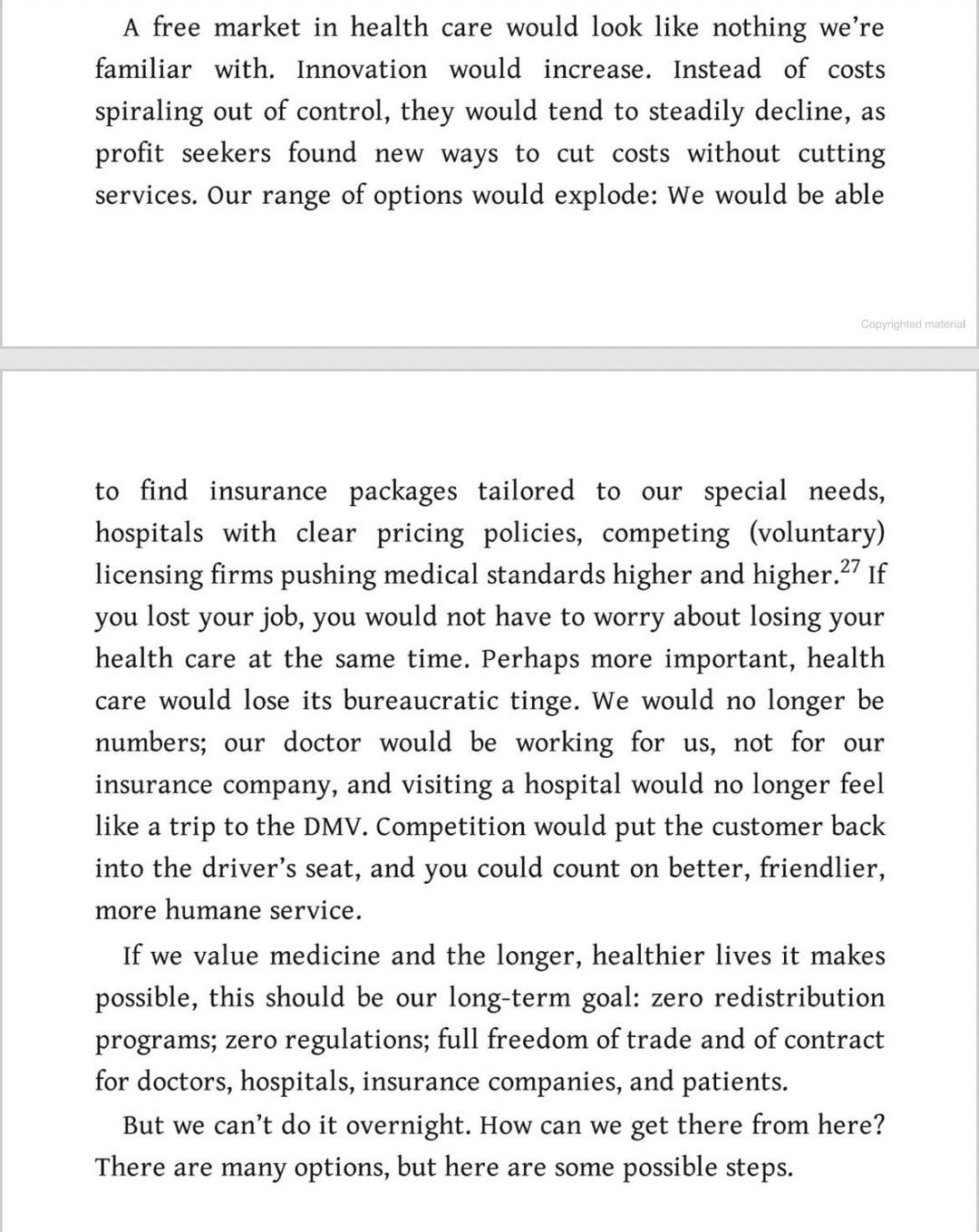
>If we value medicine and the longer, healthier lives it makes
possible, this should be our long-term goal: zero redistribution
programs; zero regulations; full freedom of trade and of contract
for doctors, hospitals, insurance companies, and patients,
Hold up, “zero redistribution,” “zero regulations?”
>Yaron Brook (Hebrew: ירון ברוק; born May 23, 1961[1]) is an Israeli-American Objectivist writer who is the current chairman of the board at the Ayn Rand Institute (ARI), where he was executive director from 2000 to 2017. Prior to joining ARI, he was a finance professor at Santa Clara University, where he taught for seven years.[2]
Yeah, I’m not really interested in healthcare policy by an Objectivist from the Ayn Rand Institute.
affnn on
I guess if your main problem with health care is that it’s too effective at not killing or maiming patients this would be a good way to accomplish your goals.
ThrowMeABoner69420 on
Masturbatory capitalism.
It’s gross when the commies masturbate to marx, its gross when we masturbate to the “free market”
hibikir_40k on
I think he is missing why we get into this kind of issues, and few places have really free markets for healthcare.
A free market is at its best when the goods are close to interchangeable, the quality differences are easy to observe, and it’s not hard to comparison shop. The harder those things are, the worse the market is: See, for instance, how the new car market is much better than the used car market. We see this kinds of problems in other high-cost items, like house repairs/contracting. Am I getting what I think I am getting? Why are there such differences in price between providers? Any home owner understands how much worse that entire market is than, say, buying food at a supermarket, even though the issues with getting a plumber have little to do with regulatory pressures.
Healthcare is ultimately much higher stakes home repairs. So getting a very efficient market there is very difficult. There’s less discoverability in skill of the people you hire, of understanding what they are actually doing, and there’s also a significant sales component to the transaction. It’s also harder to put blame on many mistakes from previous healthcare interventions: The human body is far harder than a plumbing job.
A fully free healthcare market is probably more reasonable than what we have today in the US, but it’d still not be very good, barring specific procedures that have very high repeatability. And since people do not like something so important in a system that shitty, they want some regulation to try to improve it. The US system is bad at it, but a low regulation, free-for-all free market is unlikely to be what the public wants, anywhere.
oywiththepoodles96 on
How would the goverment cover people with rare diseases that have extremely expensive medications ? A close family member medication costs around 10k per month . Which free market insurance would cover that ?

8 Comments
Based.
Our healthcare system is “for profit”, but it’s definitely not free market.
There is a huge amount of bloat in healthcare but this is so overly optimistic re:licensing
I’m pretty open minded and humble about this, because it’s an area I know very little about.
Perhaps someone with more historical knowledge could enlighten us about what healthcare looked like for average people in like the 1940s and 50s before the big healthcare entitlements, and before the employer mandate? That’s an imperfect metaphor because it also doesn’t reflect the astounding costs of modern medicine, but it might help us frame what something like that would look like today.
>A free market would not have expensive, bureaucratic
redistribution programs like Medicare, Medicaid, and
SCHIP.
Some of these are good planks, some of them (for example: this one) are terrible.
>If we value medicine and the longer, healthier lives it makes
possible, this should be our long-term goal: zero redistribution
programs; zero regulations; full freedom of trade and of contract
for doctors, hospitals, insurance companies, and patients,
Hold up, “zero redistribution,” “zero regulations?”
>Yaron Brook (Hebrew: ירון ברוק; born May 23, 1961[1]) is an Israeli-American Objectivist writer who is the current chairman of the board at the Ayn Rand Institute (ARI), where he was executive director from 2000 to 2017. Prior to joining ARI, he was a finance professor at Santa Clara University, where he taught for seven years.[2]
Yeah, I’m not really interested in healthcare policy by an Objectivist from the Ayn Rand Institute.
I guess if your main problem with health care is that it’s too effective at not killing or maiming patients this would be a good way to accomplish your goals.
Masturbatory capitalism.
It’s gross when the commies masturbate to marx, its gross when we masturbate to the “free market”
I think he is missing why we get into this kind of issues, and few places have really free markets for healthcare.
A free market is at its best when the goods are close to interchangeable, the quality differences are easy to observe, and it’s not hard to comparison shop. The harder those things are, the worse the market is: See, for instance, how the new car market is much better than the used car market. We see this kinds of problems in other high-cost items, like house repairs/contracting. Am I getting what I think I am getting? Why are there such differences in price between providers? Any home owner understands how much worse that entire market is than, say, buying food at a supermarket, even though the issues with getting a plumber have little to do with regulatory pressures.
Healthcare is ultimately much higher stakes home repairs. So getting a very efficient market there is very difficult. There’s less discoverability in skill of the people you hire, of understanding what they are actually doing, and there’s also a significant sales component to the transaction. It’s also harder to put blame on many mistakes from previous healthcare interventions: The human body is far harder than a plumbing job.
A fully free healthcare market is probably more reasonable than what we have today in the US, but it’d still not be very good, barring specific procedures that have very high repeatability. And since people do not like something so important in a system that shitty, they want some regulation to try to improve it. The US system is bad at it, but a low regulation, free-for-all free market is unlikely to be what the public wants, anywhere.
How would the goverment cover people with rare diseases that have extremely expensive medications ? A close family member medication costs around 10k per month . Which free market insurance would cover that ?