
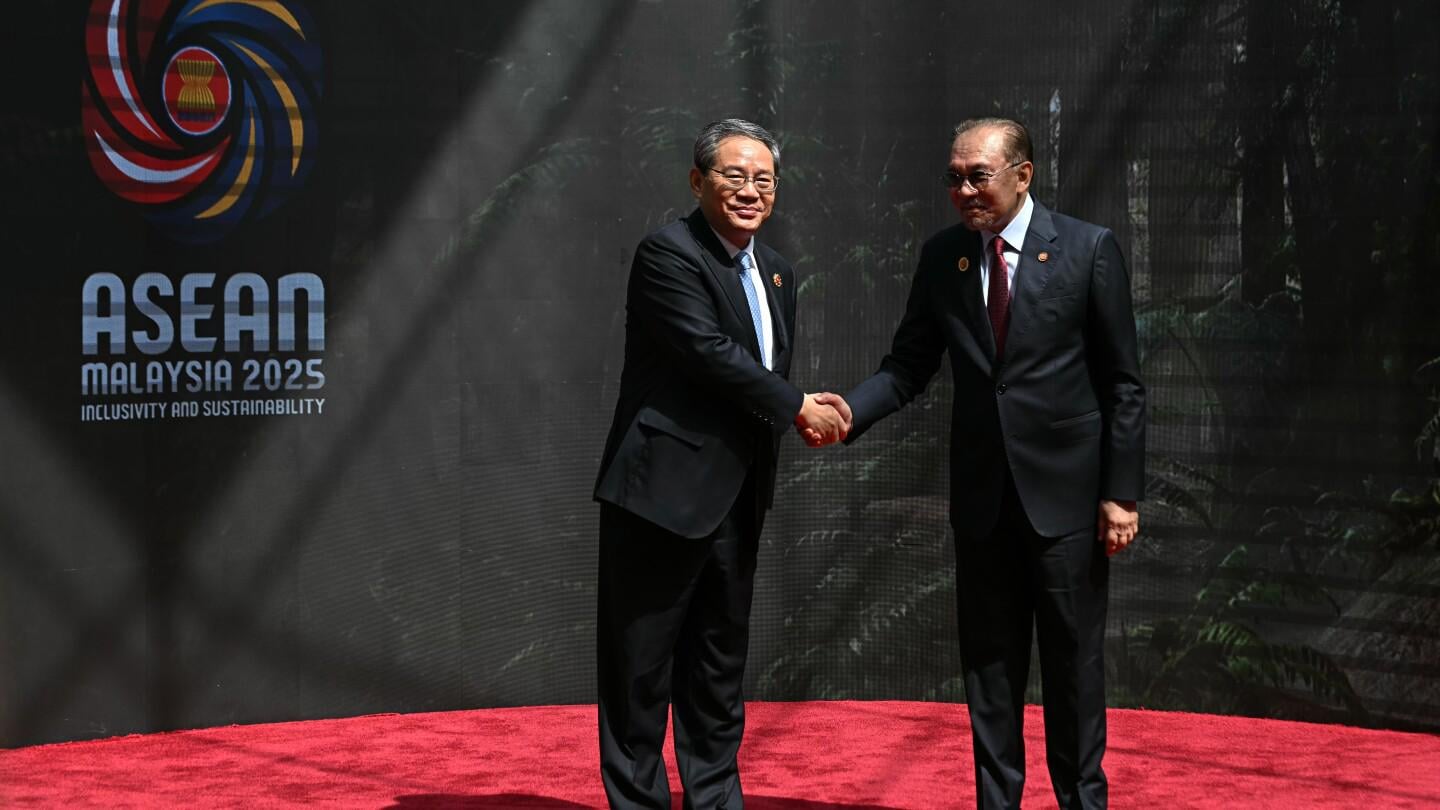
China signed an expanded version of a free trade agreement Tuesday with the Association of Southeast Asian Nations, with Chinese Premier Li Qiang pitching expanded economic ties with his country as an alternative to the protectionist policies of U.S. President Donald Trump.
Li Qiang told an ASEAN-China summit meeting after the signing that closer cooperation could help overcome global economic uncertainties. He said “pursuing confrontation instead of solidarity brings no benefit” in the face of economic coercion and bullying, in a swipe at the U.S.
The signing of the ASEAN-China Free Trade Area 3.0 came on the final day of the annual ASEAN summit and related meetings and was witnessed by Li Qiang and Malaysian Prime Minister Anwar Ibrahim, who is serving as ASEAN chair this year.
It’s the third revision of the long-standing agreement, which was first signed in 2002 and came into force in 2010. The free trade area covers a combined market of more than 2 billion people and lowers tariffs on goods and boosting flows of services and investment.
Southeast Asian political analyst Bridget Welsh said the upgraded pact would benefit both sides, especially in the areas of supply chains and sustainability.
Trump at the ASEAN summit on Sunday announced new economic details with Cambodia, Malaysia, Thailand and Vietnam, though all countries are still subject to new tariffs he has brought in. Anwar stressed at the ASEAN meeting with China that the bloc seeks friendly relations with all countries.
Officials said the ASEAN-China Free Trade Area 3.0 is expected to broaden integration across the region by covering new areas such as digital trade, the green economy, sustainability and support for small and medium-sized enterprises, which make up the majority of ASEAN businesses. The agreement is designed to make trade benefits more accessible, improve market entry for smaller players, streamline non-tariff procedures and lower regulatory barriers.
Philippine President Ferdinand Marcos Jr. said it was “regrettable” that Philippine vessels and aircraft continue to face “dangerous actions and harassment” in the South China Sea. He reiterated Manila’s objections to Beijing’s plan to establish a “nature reserve” over a hotly disputed shoal in the area. Marcos has vowed to accelerate the conclusion of a Code of Conduct to govern behavior in the disputed waters when the Philippines assumes the ASEAN chairmanship next year.
Posted by John3262005
2 Comments
How? Are they gonna replace American consumption? lol. Hard doubt. China runs a significant trade surplus with SEA. China is not an alternative to US protectionism.
this + rumors of de-escalation in the US-China trade war means China is officially coming for the crown.