
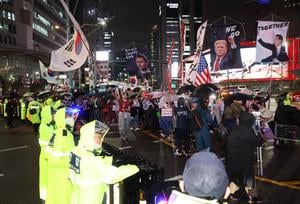
Ahead of the Asia-Pacific Economic Cooperation (APEC) summit to be held on the 31st, the Korean National Police Agency (KNPA) has decided to strengthen its monitoring and control of Sinophobic demonstrations.
According to a report titled “Current Status of Hate Demonstrations and Plans to Strengthen Oversight” submitted by the KNPA to Democratic Party lawmaker Yang Bu-nam on the 28th, the police intend to actively investigate and penalize violations of the Assembly and Demonstration Act as well as hate speech ahead of the summit.
The police believe that several groups began organizing Sinophobic protests following the election of the Lee Jae-myung administration, claiming Chinese interference in South Korea’s elections.
Reports indicate that such protests, which started in Myeongdong in July, led the Chinese Embassy to lodge a formal complaint, and by August, damages to tourists and merchants had turned the issue into a national controversy.
The protests have since spread beyond Myeongdong, including Daerim-dong, the Konkuk University area, Gwanghwamun, and provincial city centers.
The police expressed concern that the demonstrations could have adverse effects on South Korea’s social, economic, and diplomatic standing.
Chinese tourists, tourism businesses, and local merchants have all reported losses due to the protests.
The KNPA stated:
“With high expectations that President Xi Jinping’s attendance at the Gyeongju APEC summit will help improve bilateral exchange and trade issues, the Chinese Embassy has repeatedly expressed concern over Sinophobic protests and requested countermeasures. These demonstrations risk damaging South Korea–China relations, tarnishing the nation’s image, and could even lead to anti-Korean protests in China, resulting in harm to Korean citizens.”
Since visa-free entry for Chinese tourists resumed on September 29, the police have warned that Sinophobic protests could negatively impact both tourism and domestic consumption.
They plan to mobilize all available legal tools to address the issue, including:
-
Judicial action against hate speech and disinformation
-
Enhanced on-site monitoring of protests and rallies
-
Prompt investigations of Assembly and Demonstration Act violations
-
Active use of photographic and video evidence to prosecute assaults on police or embassy intrusions
Repeat or major offenders—including those leading illegal acts or assaulting officers—will face arrest and detention investigations.
To this end, Namdaemun Police Station’s intelligence unit has been designated as the lead investigative team, supported by the Seoul Metropolitan Police Agency’s Investigation Review Division and Digital Forensics Unit.
The police also plan to respond actively to merchant complaints about financial losses caused by Sinophobic protests.
Where demonstrators use dangerous objects or instigate collective obstruction of business, arrest will be the principle measure.
Even when merchants decline to testify or seek punishment, CCTV footage will be used to ensure enforcement.
Since June, two dedicated teams at Namdaemun Police Station have been conducting field investigations and interviews regarding such damages.
On October 14, the police launched a Task Force for Combating the Spread of False Information, headed by a cyber investigation commissioner (senior superintendent general).
The team monitors malicious distortions of facts and fabricated narratives that go beyond the limits of free expression.
However, the police acknowledged legal limitations:
Platforms such as YouTube often do not share subscriber information, making it difficult to identify individuals responsible for spreading false content.
Although the Information and Communications Network Act allows for the deletion or blocking of false information, the police lack direct authority to enforce such measures, causing procedural delays.
The KNPA stressed that public discussion and legal reform are needed to establish effective regulatory mechanisms.
The police plan to systematically manage Sinophobic assemblies according to their methods and degree of illegality.
They also intend to examine foreign legislative precedents and consider new legal frameworks to restrict hate speech—particularly in cases where freedom of assembly is abused to justify xenophobic acts targeting foreigners.
Posted by Freewhale98
3 Comments
Is that a trump flag?
Charlie Kirk???
lol
South Korea’s far right believes that the Chinese government interfered in South Korea’s elections and that the current South Korean government is a puppet of the Chinese government.
To be honest, no one on the Chinese Internet thought that the Chinese government was so capable.
[ context ]
Bunch of Korean far-right inspired by Charlie Kirk and Donald Trump are causing rampage in Korean streets such as attacking foreign tourists in tourist hotspots and damaging properties of businesses serving foreign tourists.There is a rising fear that these xenophobic protesters would attack foreign dignitaries during APEC so the police is stepping up security.
https://preview.redd.it/w0b5ewllnuxf1.jpeg?width=527&format=pjpg&auto=webp&s=833873e243db628fc003ce1a1d92eed3a8f7d37c