
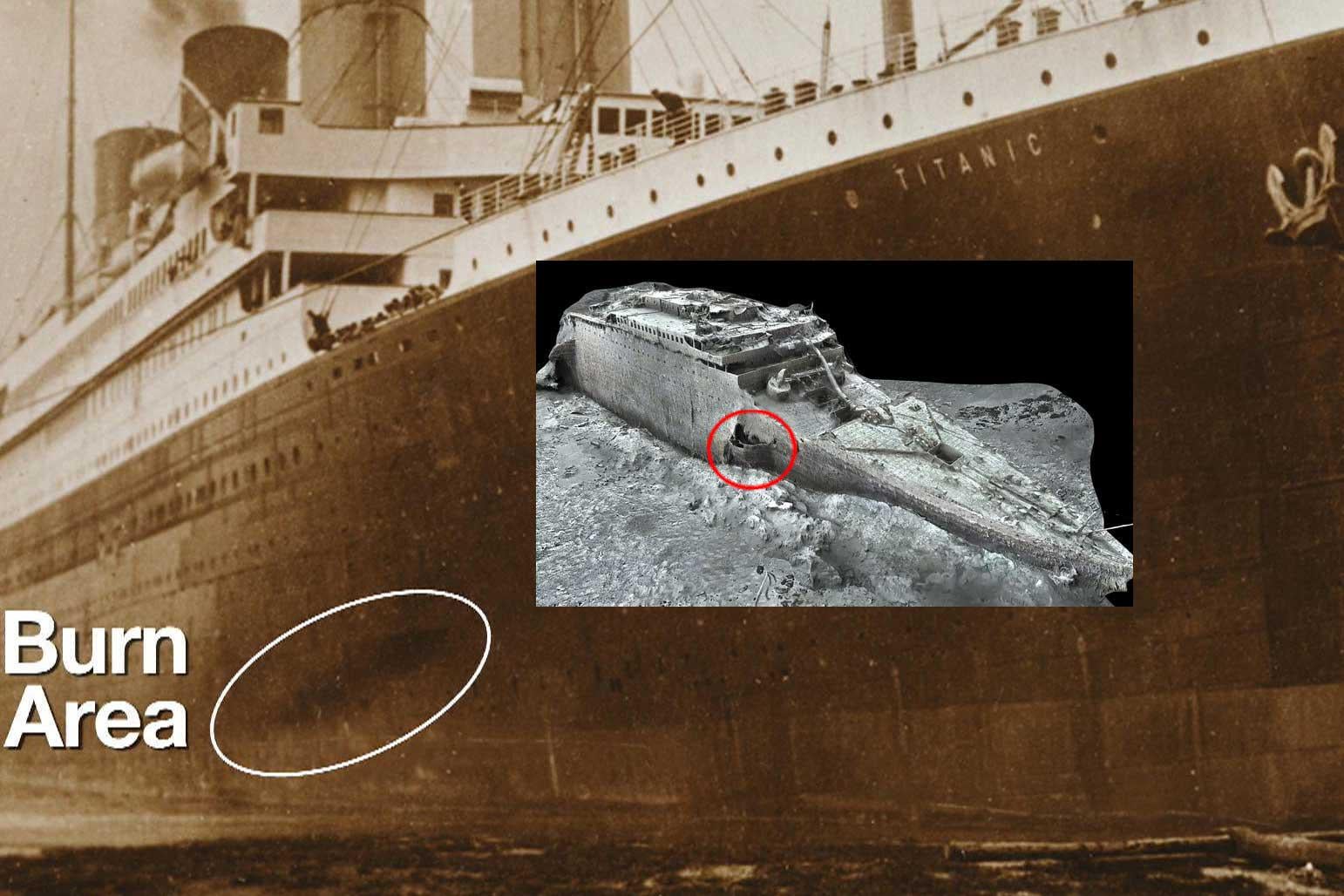
The burn mark seen on the port side of the ship (circled in the image) suggests there was damage or weakening of the hull structure before the ship's fateful voyage.
In the 3D scan of the wreck, the red circled area highlights significant damage to the hull, near the waterline, in a similar position to where the burn mark is noted on the Titanic's hull in the historical image.
Several crew members, including J. Dilley, a stoker on the ship, reported that there was a fire burning in one of the coal bunkers before the Titanic left Southampton. Dilley later gave an account saying the fire had been burning for days and was known to the ship’s officers.
The steel industry, in which Morgan invested and which he helped to consolidate, would have empirically understood that temperature affects the workability, strength, and durability of steel. For example, steelworkers knew about quenching and tempering processes, which involve heating and cooling steel to alter its properties.
Several wealthy and influential figures were aboard the Titanic, some of these individuals had been opponents of the creation of the Federal Reserve, which was being discussed at the time:
John Jacob Astor IV: One of the richest men in the world at the time. Astor opposed centralized banking control.
Isidor Straus: Co-owner of Macy’s Department Store, Straus was also skeptical of centralized banking efforts.
Benjamin Guggenheim: A wealthy industrialist who also had reservations about the Federal Reserve.
Key moment in the takeover of America.
Posted by a_human-being
2 Comments
Her namn is Britannic ,one on the world’s largest insurers fraud
fire was burning for 10 days before it sank
*A massive fire raged in the ship’s bowels in the days leading up to the disaster, potentially weakening the hull.*
*Around March 31st 1912, 10 days before Titanic embarked on its maiden voyage, a fire broke out in Coal Bunker 6. Fires like this were common in the steamship era and often occurred due to spontaneous combustion. As strange as it sounds, the protocol was not to extinguish the fires, but to shovel the burning coal out and feed it into the ship’s boilers. This is exactly what the crew of the Titanic did and the fire continued to burn right up until April 14th – just one day before the ship sank. Did the fire have anything to do with the hull breach? Maybe. Smouldering coal can reach temperatures of up to 1000℃ — and steel exposed to such heat can lose 40% or more of its strength, which could explain how the iceberg was able to tear through Titanic’s hull so easily.*
were (at least) 9 other contributiing factors/causes – https://www.bbc.co.uk/programmes/articles/106HNdgRR6yXZqwRqjVHghm/10-mistakes-that-led-to-the-titanic-disaster