Individual donations have been limited in size, while corporate and union money has been banned in most jurisdictions. Why, then, is the Ontario government of Conservative Premier Doug Ford proposing to go in the opposite direction?
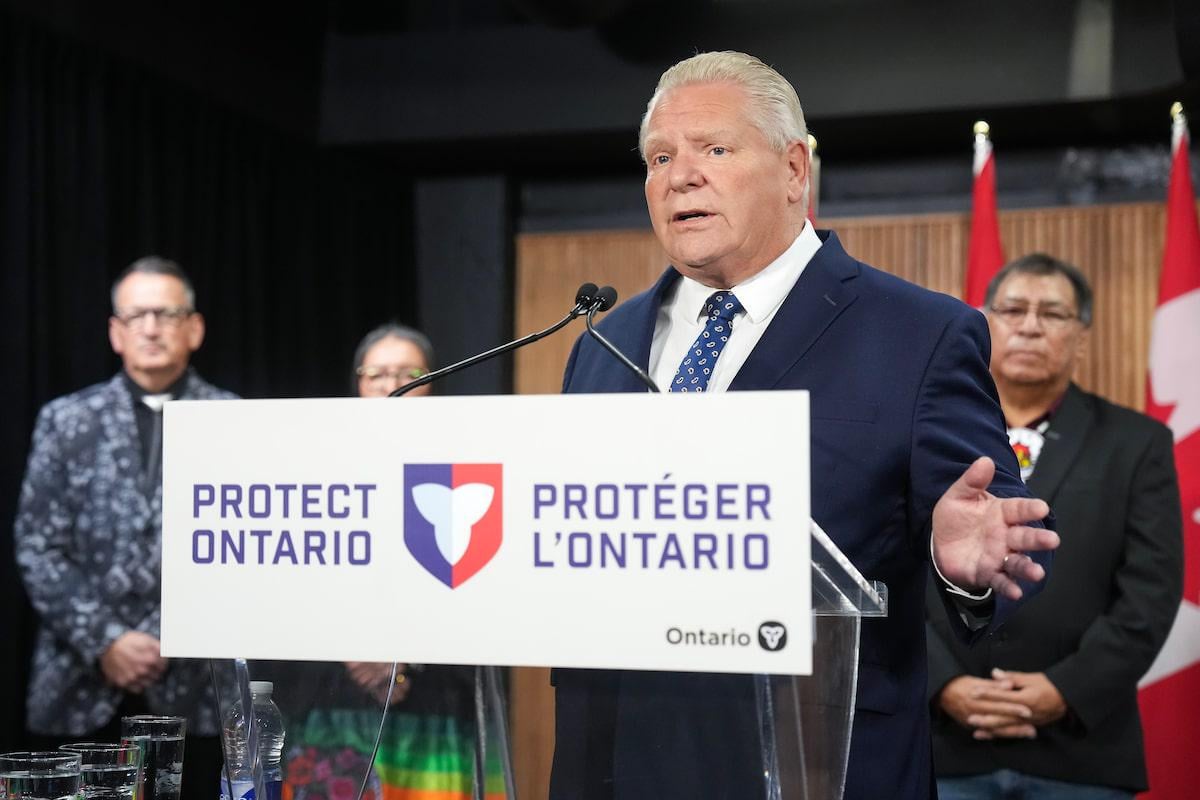
The Premier has unveiled legislation containing several proposed amendments to the province’s election laws. They include:
* Repealing the current law requiring elections to be held on a fixed four-year schedule, returning the province to the days when the premier alone decided when elections should be held.
* Increasing the ceiling on individual contributions to political parties, now set at about $3,400 annually, to $5,000.
* Making the current $2.54 per-vote subsidy the parties receive out of public funds – conceived as a temporary stopgap to compensate them for the loss of corporate and union donations, banned by the Liberals under Kathleen Wynne in 2016 – permanent.
Each of these is a bad idea on its own. Together they add up to a hideous step backward for the ideal of fair elections. Who, indeed, was asking for any of this? Who thinks that the problem with politics in this country is the absence of big money – that we aren’t spending nearly enough money on attack ads and push polls and the rest of the arsenal of political weaponry with which the parties seek to divide and confuse us? Whose complaint about current election law is that well-heeled donors have too *little* influence on the parties? Who was demanding that the Premier be given absolute latitude to call an election at a time calculated to maximize his political advantage?
Of course, fixed-date election laws, in Ontario as elsewhere, are more honoured in the breach than the observance, their framers having in every case taken care to insert a provision stipulating that they do not bind the royal prerogative, or the discretion of the governor-general or provincial lieutenant-governors to call elections whenever they like (within the five-year limit prescribed under the Constitution).
And since the King’s representative acts only on the advice of his or her first minister in such matters, the law cannot bind them either. Which is why first ministers, including Mr. Ford, have continued to call snap elections whenever it suits them, undeterred by the law that supposedly forbade them to do so.
[…]
But as for the rest: The mind reels. It takes, it must be said, a certain cheek to call for loosening the limits on campaign contributions, at the very moment when the Ford government is embroiled in a massive scandal over, among other things, dodgy campaign contributions.
First the province’s Auditor-General found irregularities in the Skills Development Fund, a Ford government program that doles out money to businesses to train their workers. Some applicants had been approved at the political level, though they had received a low rating from the civil servants administering the program, while others, more highly rated, were denied grants.
Then it emerged, in reporting by The Trillium, that over $100-million in SDF grants had gone to clients of the lobbying firm run by the Premier’s adviser and campaign manager, Kory Teneycke. Then it was reported by Global News that at some firms that had received millions of dollars in grants, executives and their family members had made multiple donations to the Ontario PC Party, in some cases totalling tens of thousands of dollars.
Call it pay to play, or call it a coincidence, but it seems a peculiar time to announce a 47-per-cent increase in contribution limits. Indeed, Ontario’s campaign finance laws are lax enough as it is. The $3,400 limit, for example – nearly three times what it was when the Wynne reforms were first introduced – applies only to contributions to a political party. Donors can give another $3,400, in total, to the same party’s candidates, constituency associations and nomination contestants, plus a further $3,400, total, to contestants in a party leadership race.
All told, that’s in excess of $10,000 that an individual seeking favour with a party can potentially donate, each and every year. And they can give the same amounts to any number of parties. That’s a level of largesse attainable by only a small fraction of the population.
What is more, they can give unlimited amounts to third-party campaigns – as can corporations and unions – who can spend up to $125,700 provincewide during a campaign (or $5,028 in any riding) to support or oppose candidates or parties. A further, considerably higher limit used to apply in the 12 months prior to a campaign, until the Supreme Court struck it down earlier this year.
But again, there is no limit on the number of duplicate third-party campaigns a person, corporation or union can donate to, each entitled to spend the $125,700 maximum. So long as they do not co-ordinate their activities with each other or the party – insert rolled-eye emoji here – it’s all legal.
jinhuiliuzhao on
Doug Ford has gone insane this year:
– First, it was the war on the bikes lanes (nonsensical, though panders to drivers who hate cyclists. I’m also sure shutting down the entire road to rip out bike infrastructure will for a few years will certainly improve traffic…)
– Then there was the war on speed cameras (not sure if a majority of drivers support this one) claiming that it was just a cash grab (brings in less than 1% of most municipalities’ budgets and he also passed the law allowing them in the first place…)
– Now he wants to increase donation limits by almost 50%?
Why is he doing all of this? He has a supermajority until 2029, and I don’t think it’s even particularly likely he’ll win again – 11 years in power is long enough for Canadians in general to kick politicians out of office.
I really don’t understand the motivations, unless he’s being puppeted by some Miller-type, and this is the agenda they want
Arguably the only good thing he’s done is play Captain Canada for the conservative crowd (when PP was and still is mostly absent), but even that is starting to sour as many cons blame him for sabotaging trade talks (as if Trump was really going to reach a deal…)

2 Comments
Newsstream link: [https://www.proquest.com/canadiannews/docview/3267243793/F844642F08BA48AAPQ/1](https://www.proquest.com/canadiannews/docview/3267243793/F844642F08BA48AAPQ/1)
Individual donations have been limited in size, while corporate and union money has been banned in most jurisdictions. Why, then, is the Ontario government of Conservative Premier Doug Ford proposing to go in the opposite direction?
The Premier has unveiled legislation containing several proposed amendments to the province’s election laws. They include:
* Repealing the current law requiring elections to be held on a fixed four-year schedule, returning the province to the days when the premier alone decided when elections should be held.
* Increasing the ceiling on individual contributions to political parties, now set at about $3,400 annually, to $5,000.
* Making the current $2.54 per-vote subsidy the parties receive out of public funds – conceived as a temporary stopgap to compensate them for the loss of corporate and union donations, banned by the Liberals under Kathleen Wynne in 2016 – permanent.
Each of these is a bad idea on its own. Together they add up to a hideous step backward for the ideal of fair elections. Who, indeed, was asking for any of this? Who thinks that the problem with politics in this country is the absence of big money – that we aren’t spending nearly enough money on attack ads and push polls and the rest of the arsenal of political weaponry with which the parties seek to divide and confuse us? Whose complaint about current election law is that well-heeled donors have too *little* influence on the parties? Who was demanding that the Premier be given absolute latitude to call an election at a time calculated to maximize his political advantage?
Of course, fixed-date election laws, in Ontario as elsewhere, are more honoured in the breach than the observance, their framers having in every case taken care to insert a provision stipulating that they do not bind the royal prerogative, or the discretion of the governor-general or provincial lieutenant-governors to call elections whenever they like (within the five-year limit prescribed under the Constitution).
And since the King’s representative acts only on the advice of his or her first minister in such matters, the law cannot bind them either. Which is why first ministers, including Mr. Ford, have continued to call snap elections whenever it suits them, undeterred by the law that supposedly forbade them to do so.
[…]
But as for the rest: The mind reels. It takes, it must be said, a certain cheek to call for loosening the limits on campaign contributions, at the very moment when the Ford government is embroiled in a massive scandal over, among other things, dodgy campaign contributions.
First the province’s Auditor-General found irregularities in the Skills Development Fund, a Ford government program that doles out money to businesses to train their workers. Some applicants had been approved at the political level, though they had received a low rating from the civil servants administering the program, while others, more highly rated, were denied grants.
Then it emerged, in reporting by The Trillium, that over $100-million in SDF grants had gone to clients of the lobbying firm run by the Premier’s adviser and campaign manager, Kory Teneycke. Then it was reported by Global News that at some firms that had received millions of dollars in grants, executives and their family members had made multiple donations to the Ontario PC Party, in some cases totalling tens of thousands of dollars.
Call it pay to play, or call it a coincidence, but it seems a peculiar time to announce a 47-per-cent increase in contribution limits. Indeed, Ontario’s campaign finance laws are lax enough as it is. The $3,400 limit, for example – nearly three times what it was when the Wynne reforms were first introduced – applies only to contributions to a political party. Donors can give another $3,400, in total, to the same party’s candidates, constituency associations and nomination contestants, plus a further $3,400, total, to contestants in a party leadership race.
All told, that’s in excess of $10,000 that an individual seeking favour with a party can potentially donate, each and every year. And they can give the same amounts to any number of parties. That’s a level of largesse attainable by only a small fraction of the population.
What is more, they can give unlimited amounts to third-party campaigns – as can corporations and unions – who can spend up to $125,700 provincewide during a campaign (or $5,028 in any riding) to support or oppose candidates or parties. A further, considerably higher limit used to apply in the 12 months prior to a campaign, until the Supreme Court struck it down earlier this year.
But again, there is no limit on the number of duplicate third-party campaigns a person, corporation or union can donate to, each entitled to spend the $125,700 maximum. So long as they do not co-ordinate their activities with each other or the party – insert rolled-eye emoji here – it’s all legal.
Doug Ford has gone insane this year:
– First, it was the war on the bikes lanes (nonsensical, though panders to drivers who hate cyclists. I’m also sure shutting down the entire road to rip out bike infrastructure will for a few years will certainly improve traffic…)
– Then there was the war on speed cameras (not sure if a majority of drivers support this one) claiming that it was just a cash grab (brings in less than 1% of most municipalities’ budgets and he also passed the law allowing them in the first place…)
– Now he wants to increase donation limits by almost 50%?
Why is he doing all of this? He has a supermajority until 2029, and I don’t think it’s even particularly likely he’ll win again – 11 years in power is long enough for Canadians in general to kick politicians out of office.
I really don’t understand the motivations, unless he’s being puppeted by some Miller-type, and this is the agenda they want
Arguably the only good thing he’s done is play Captain Canada for the conservative crowd (when PP was and still is mostly absent), but even that is starting to sour as many cons blame him for sabotaging trade talks (as if Trump was really going to reach a deal…)