
A good overview of a potential Federal housing bill that might be coming down the pike in Congress in the coming years. I suggest reading or listening to the whole thing. But a few choice excerpts:
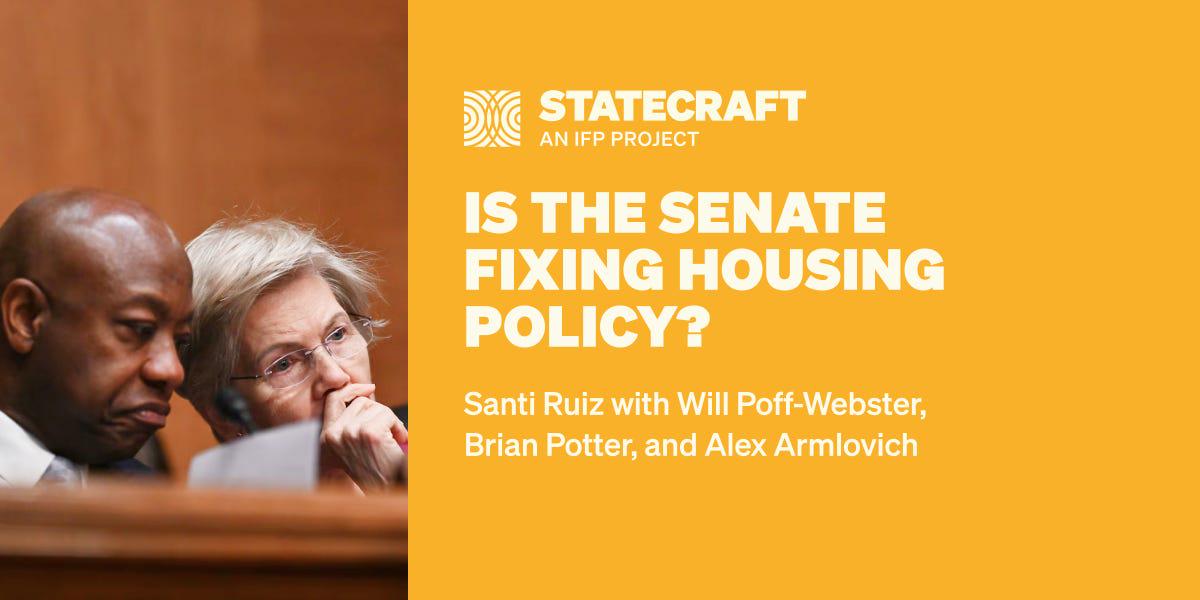
Today we’re talking about housing. The ROAD to Housing Act passed the Senate Banking, Housing, and Urban Affairs Committee 24-0 in late July. Last week — despite the shutdown — it cleared the Senate. It’s a package of 27 pieces of legislation to boost housing supply, improve affordability, reduce regulatory roadblocks, and reduce homelessness.
When you zoom out a bit, what’s happened here is pretty surprising. The chair of the committee, Republican Tim Scott, and the Ranking Member, Elizabeth Warren, a Democrat, co-sponsored the bill. The bill is the committee’s first bipartisan housing markup in over a decade. Passing through committee unanimously doesn’t happen often for serious bills of this sort. I wanted to understand how this bill happened, and came to have a serious shot at passing. And I also wanted to get a better sense of what’s actually in the bill, and why it matters for housing. If you’re like me, most of the debates you hear about housing policy focus on zoning, which is a local issue — very little federal say. So what are all these pieces of legislation? Do they matter?
Joining me is an unorthodox trio:
Will Poff-Webster was legislative counsel for Senator Brian Schatz, a Democrat from Hawaii. He’s our inside guy today: he worked on the bill within the Senate. Now, he covers housing policy at IFP!
Alex Armlovich is Senior Housing Policy Analyst at the Niskanen Center. He has been working on housing issues for a long time, and his fingerprints are on parts of this bill package. He’s my advocate from the outside.
Brian Potter is Senior Infrastructure Fellow at IFP and author of Construction Physics, which I very much enjoy editing. If I can make one newsletter recommendation to you besides Statecraft, it’s Construction Physics. He has a background in private-sector home building. And has written about several of the proposals in this package.
*-*-*-*
Give me an example of where that might come into play. This bill passes: who needs the technical assistance?
Alex: The Housing Supply Frameworks Act sub-component of the bill is the marquee technical-assistance one, because it’s convening a national commission to — for the first time since Herbert Hoover — rewrite federal model codes for state and local governments. That would guide HUD staff in the future when they’re applying incentives — they can check, “What does it mean to be pro-housing? There’s a list that we publish.” Parts of HUD are not full of land-use experts, so they themselves might need some technical assistance. It’s also for helping state and local governments understand good law rather than bad.
….Over 100 years ago, when Herbert Hoover, future president, was Secretary of Commerce, the Department of Commerce published these model codes. When you say you want to update those, is there a model code now, from 100 years ago, that states and localities look at to understand what the feds think they should do on housing?
Alex: It will shock you, Santi, to see how many states are still using Herbert Hoover’s State Zoning Enabling Act. They had 19 states using it within just a couple years of the model code passing. There’s dozens still using it today.
Question two: What’s in this big package that got through committee 24-0? It’s spending more money. You’d expect some fights.
Will: Maybe it’s helpful to talk through a couple of examples. One is the Build Now Act. It takes a large federal pot of money: the Community Development Block Grant (CDBG) — that’s over $3 billion dollars distributed every year to local grantees. It says, “If you’re an expensive jurisdiction, we’re going to compare how much housing you’re building to other expensive cities. If you build more than average, you’re going to get a bonus from CDBG dollars. If you build less than average, you’re going to get a cut, and the money will be distributed to places that are doing the right thing.” It’s not all their grant — it’s only 10% — but it is significant. That money is flexible: a jurisdiction can spend it on infrastructure to support new housing, or on the cost of services, to help accommodate the growth we need in high-cost urban areas.
What I like about the focus on the high-cost places is, if you’re in a high-cost place where people want to move, your problem is zoning. You’re not building enough housing to meet the needs of your population. We rank you on, “What is your housing production over time?” Not assuming that anywhere that builds a lot now is great, but looking at improvement over time. “Did you go from being a place that didn’t build to building more — or from building a decent amount to building as much as the demand?” A place like Jersey City is doing amazing on this. Do that comparison, and you get more money if you’re doing a good job. But you don’t get money out of the general fund, you get money reallocated, which was important to Republicans — to have it be a transfer of funds rather than a new expenditure.
*-*-*-*
If you’re an urban YIMBY — I’m speaking for myself here — I’ve got a good sense of, “We need to let people build more single-stair buildings and ADUs in the backyard.” Then we get to the housing-subsidy side. What role does it play in the housing problem?
Alex: The parts of the bill that reform the housing finance system are not designed to change the political economy at the state or local level, but they’re direct action. One is the rule tweak for small-dollar mortgages. Dodd-Frank set fee caps on mortgages, but also raised the cost of underwriting, by requiring you to document more. We wanted to eliminate so-called NINJA mortgages: No Income, No Job, No Assets. Many of the documentation changes are important and bipartisan — but we did raise the cost of underwriting loans. So small-dollar mortgages — mortgages under $100,000 — aren’t made all that much any more. If it costs you several thousand dollars to underwrite a loan, but you face a fee cap on the underwriting, there’s a certain mortgage size that pencils, that’s worth underwriting. That’s an important community-development thing in places that have lower home prices. If you’re in the Rust Belt and the median home price is $100K, small-dollar mortgage access is important. The bill directs the Consumer Financial Protection Bureau to look at the rule.
*-*-*-*
I want to bring in our expert on manufactured housing, Brian Potter, who has written more on manufactured housing than — well, I don’t know how to end that sentence, but he’s written a lot. Section 301, the Housing Supply Expansion Act, is a chassis-reform act. It gets rid of a Nixon-era requirement that prefab homes have to be built on a permanent chassis so that you can move them around. Does getting rid of that requirement matter for home building?
Brian: Manufactured homes subject to this specific HUD Code are required to have a chassis. You can build a prefab home that doesn’t have a chassis; it just has to meet the requirements of the regular building code. It’s a little bit easier to meet the requirements of the HUD code.
The argument from the industry is that the vast majority of manufactured homes do not ever get moved. Once they’re installed, they’re permanent. The chassis is adding unnecessary cost, because you have to attach this big, expensive steel framework. That steel is not a trivial cost — it’s 10-15% of the entire house. By eliminating this requirement, you can reduce their cost quite a bit. It’s potentially a big deal, depending on how much demand will go up, how much price is a binding factor, and how many of them can get built. Even if it doesn’t increase the number of homes, it should make them more affordable.
Alex: We’ve got that [cost] at around $5,000 per module. These things ship for about $90,000 per module, including shipping costs but excluding land. For a single-module two-bed, one-bath starter home, $5,000 off $90,000 is significant. At $120,000 for a two-module, $10,000 off is still pretty good.
Posted by Watchung
2 Comments
This bill would do wonders for expanding access to housing and even building equity through a prefab/manufactured home.
Right now as they said in the interview, these homes need a chassis, that giant steel frame hidden by a metal sheet. And that’s only there because it’s mandated by federal regulations in HUD in case someone wants to move it around like a motorhome.
But I never heard of a manufactured home being moved around like that. It’s an added cost with no benefit and prevents people from building equity because manufactured homes then get treated like motor homes: Where you still pay rent on the land instead of also owning the plot of land. Because the chassis implies that it’s not a permanent housing structure. And that prevents access to financing a modular home as most banks don’t want to put out a loan for a temporary structure even if it ends up sitting on the same piece of land for 40 – 50 years.
Are any of the relevant house committee chairs on the record about this bill? Is it likely to get a vote in the house