In Shreve, Crump & Low, a jewellery store in Greenwich, Connecticut, a Laurent Ferrier “Grand Sport Tourbillon” watch can set you back as much as $210,000. Business is brisk.
“We’re very blessed in Greenwich,” said managing partner Bradford Walker. The Swiss luxury watches, natural diamonds, sapphires and emeralds the shop specialises in are all selling well. “Demand has actually increased over the past six months.”
In the city of Bridgeport, a 30-minute drive away, demand is also rising — but for a different kind of product. People here are flocking to the city’s food pantries and soup kitchens as the high cost of living bears down on lower-income families.
“I’m living day by day,” said Jamaica-born Roselyn Macdonald, as she picked up eggs from a food bank in The Hollow, a poor immigrant neighbourhood of Bridgeport. Macdonald is unemployed and struggling to pay her bills.
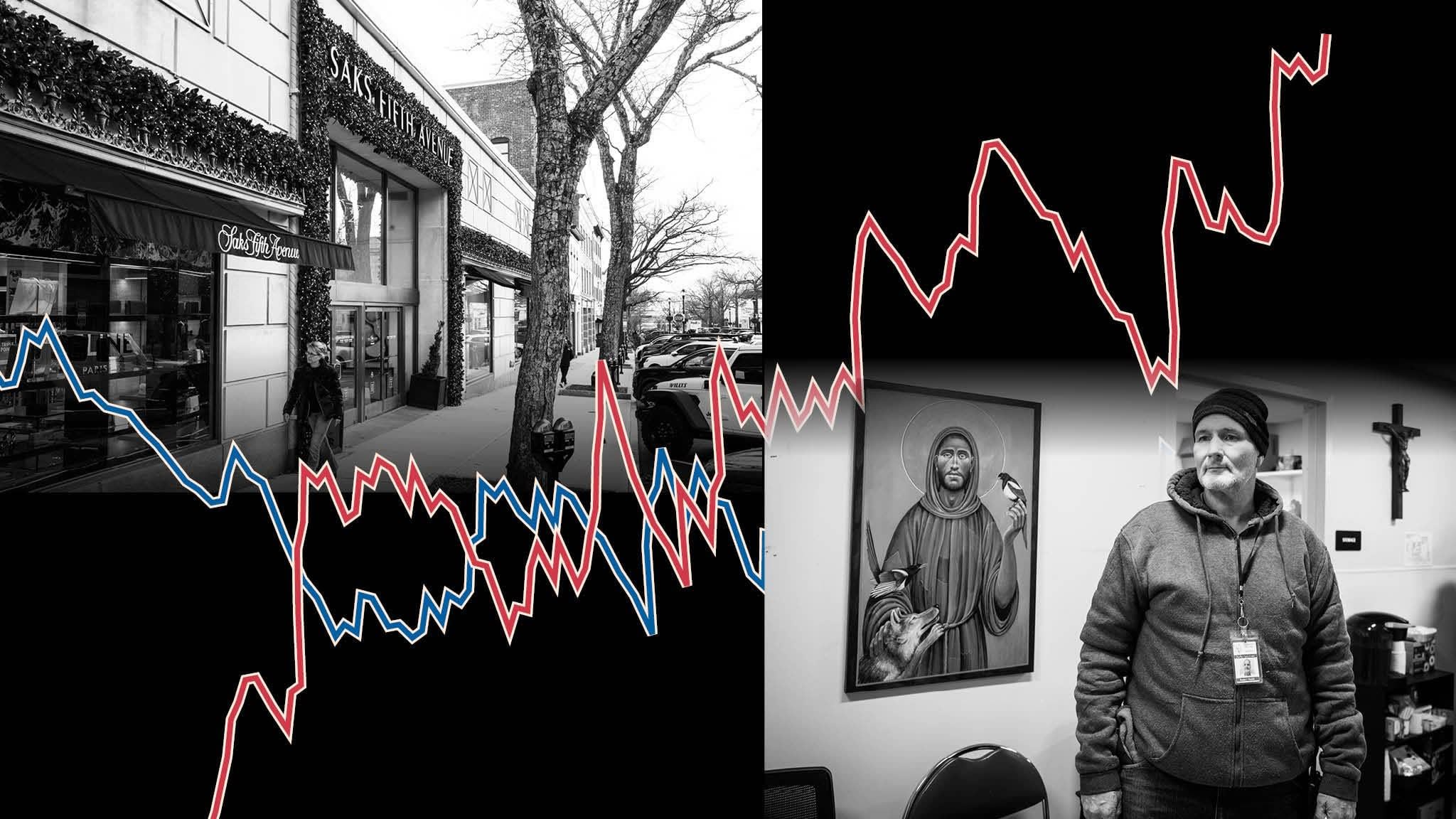
This is the tale of two cities — a pair of communities just 30 miles apart that have experienced such contrasting fortunes they could be in different countries.
Together, they symbolise America’s K-shaped [economy](https://www.ft.com/us-economy) — a split screen where asset-owning classes have become ever wealthier while lower-income households have seen their living standards stagnate or decline.
This bifurcation has pushed the issue of affordability to the [top of the US political agenda](https://www.ft.com/content/81c27328-9a08-4e58-a0bc-db180462f192), threatening the Republican party’s prospects in next year’s midterm elections and weighing on Donald Trump’s presidency.
Fairfield County, where Greenwich and Bridgeport are situated, is one of the most K-shaped regions in America. In Greenwich, home to hedge funds including AQR, Viking Global Investors and Lone Pine Capital, the average gross income per tax return was $687,000 in 2023. In Bridgeport it was a tenth of that — just $70,500.
Those disparities have got worse in recent years. “The gap is widening, not narrowing,” said David Rabin, head of Greenwich United Way, a local non-profit organisation.
The Republicans’ signature legislative achievement this year, the “big beautiful bill”, has in some cases made families’ situations worse. The legislation, which Trump signed in July, has delivered tax cuts for the rich while reducing federal funding for Medicaid, the taxpayer-funded health insurance programme for low-income Americans, and food stamps known as Snap.
According to the Congressional Budget Office, a non-partisan agency, households in the bottom decile of income distribution will lose about $1,600 per year as a result of the law, while those in the top 10 per cent will see a $12,000 annual gain.
National surveys underscore the divergence. The University of Michigan’s consumer sentiment index shows that people with investment portfolios feel significantly better about the economy than those who do not own stocks, with sentiment among non-stockholders sinking to its lowest point since the university began collecting such data in 1998.

7 Comments
In Shreve, Crump & Low, a jewellery store in Greenwich, Connecticut, a Laurent Ferrier “Grand Sport Tourbillon” watch can set you back as much as $210,000. Business is brisk.
“We’re very blessed in Greenwich,” said managing partner Bradford Walker. The Swiss luxury watches, natural diamonds, sapphires and emeralds the shop specialises in are all selling well. “Demand has actually increased over the past six months.”
In the city of Bridgeport, a 30-minute drive away, demand is also rising — but for a different kind of product. People here are flocking to the city’s food pantries and soup kitchens as the high cost of living bears down on lower-income families.
“I’m living day by day,” said Jamaica-born Roselyn Macdonald, as she picked up eggs from a food bank in The Hollow, a poor immigrant neighbourhood of Bridgeport. Macdonald is unemployed and struggling to pay her bills.
This is the tale of two cities — a pair of communities just 30 miles apart that have experienced such contrasting fortunes they could be in different countries.
Together, they symbolise America’s K-shaped [economy](https://www.ft.com/us-economy) — a split screen where asset-owning classes have become ever wealthier while lower-income households have seen their living standards stagnate or decline.
This bifurcation has pushed the issue of affordability to the [top of the US political agenda](https://www.ft.com/content/81c27328-9a08-4e58-a0bc-db180462f192), threatening the Republican party’s prospects in next year’s midterm elections and weighing on Donald Trump’s presidency.
Fairfield County, where Greenwich and Bridgeport are situated, is one of the most K-shaped regions in America. In Greenwich, home to hedge funds including AQR, Viking Global Investors and Lone Pine Capital, the average gross income per tax return was $687,000 in 2023. In Bridgeport it was a tenth of that — just $70,500.
Those disparities have got worse in recent years. “The gap is widening, not narrowing,” said David Rabin, head of Greenwich United Way, a local non-profit organisation.
The Republicans’ signature legislative achievement this year, the “big beautiful bill”, has in some cases made families’ situations worse. The legislation, which Trump signed in July, has delivered tax cuts for the rich while reducing federal funding for Medicaid, the taxpayer-funded health insurance programme for low-income Americans, and food stamps known as Snap.
According to the Congressional Budget Office, a non-partisan agency, households in the bottom decile of income distribution will lose about $1,600 per year as a result of the law, while those in the top 10 per cent will see a $12,000 annual gain.
National surveys underscore the divergence. The University of Michigan’s consumer sentiment index shows that people with investment portfolios feel significantly better about the economy than those who do not own stocks, with sentiment among non-stockholders sinking to its lowest point since the university began collecting such data in 1998.
https://preview.redd.it/88k21bvvf59g1.png?width=949&format=png&auto=webp&s=bbd7bea2ddc060b20b82a96f3a623013b77c4dfe
https://preview.redd.it/camxyulxf59g1.png?width=982&format=png&auto=webp&s=a2bfaa157395ec5e80e9abfd3e467561a1b4f492
https://preview.redd.it/qn7vewvzf59g1.png?width=945&format=png&auto=webp&s=d18342c8c8a43c1d5abbc362e3c354ec04903ec7
God America must rule if you’re super rich. It’s a real baby smashing factory if you’re like lower than median.
This is why I’m expecting more populism for the next few decades.
Consumer sentiment is so polluted by political partisanship that it’s hard to take at face value.
https://preview.redd.it/af2su0fmr59g1.png?width=1004&format=png&auto=webp&s=b0e666322fd62694c09dd44331bf361cfa7ff356