
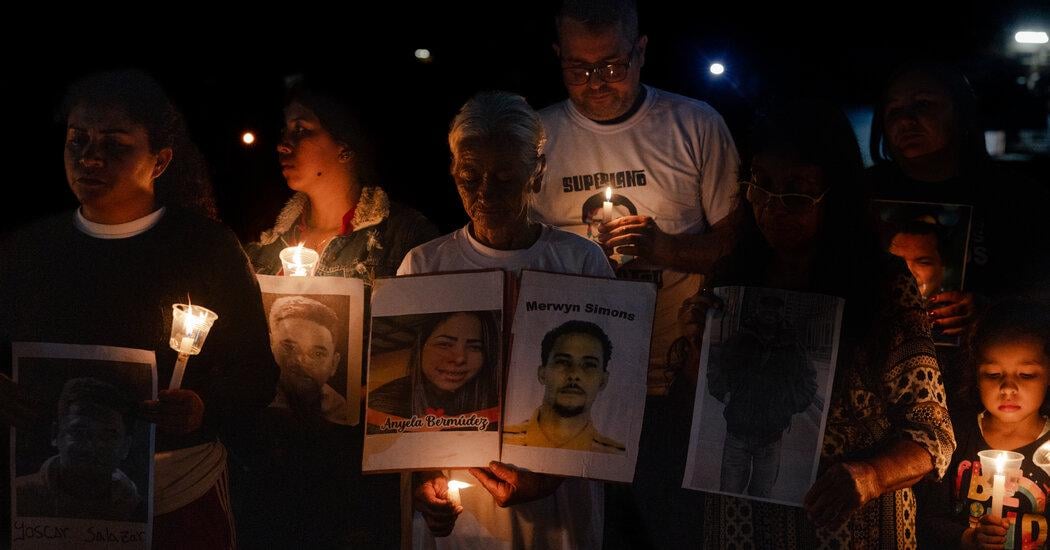
Venezuelan lawmakers passed a wide-ranging amnesty bill on Thursday that could free hundreds of political prisoners, in perhaps the strongest indication yet that the interim government, under pressure from the United States, is moving to ease some of the regime’s most repressive tactics. But some experts and activists for political prisoners say the amnesty measure, while long overdue, leaves out many people held by the state and relies on a compromised judiciary system to carry out the law. Even some of its supporters have called it imperfect.
The law applies to the years in power of the ruling government, starting in 1999, the first year in office of former President Hugo Chávez, a self-described socialist and charismatic strongman leader who put in place the current regime before his death in 2013.
The amnesty law, however, extends only to prisoners who were detained in a limited number of protests. Critics of the proposal also note that prisoners facing some of the most serious charges, such as those accused of violent, armed actions, will not be eligible. According to rights groups, these kind of allegations were often arbitrarily applied and often based on fabricated evidence.
“I say this as the acting president of the Chavista government,” Ms. Rodríguez said on Thursday at a ceremony at the presidential palace, where she signed the law after the national legislature approved it earlier that day. “We must know how to ask for forgiveness and how to receive forgiveness, and that is the process that this amnesty law sets in motion.”
She also publicly called on Interior Minister Diosdado Cabello to review cases excluded from the amnesty law, a noteworthy move amid tensions between her pragmatic wing of the ruling government and his hard-line faction.
In addition to concerns about exclusions baked into the amnesty legislation, there is also widespread fear that the government will not fully abide by the new law. The government remains largely unchanged after President Nicolás Maduro was captured by the United States on Jan. 3 and jailed in New York.
The new law will apply to many of the hundreds of people incarcerated for reasons linked to their opposition to the government, and will expunge their criminal records. But the amnesty is narrow in scope.
Only prisoners detained in connection with about a dozen specific “politically motivated violent events” will be eligible. These events were mostly large protests that in some cases spanned months and include a failed coup against Mr. Chávez in 2002.
These restrictions will most likely mean that not all political prisoners will be released, said Nicmer Evans, a political scientist and government critic recently held in El Helicoide.
Mr. Evans, who called the law “unjust,” said it could exclude those jailed for criticizing the government outside the periods specified in the law. “Practically all of us journalists who have been detained for our opinions outside of these established time frames are excluded,” he said.
Delsa Solórzano, a lawyer and former legislator who went into hiding after the country’s fraud-marred presidential election in 2024, said in an interview last week that the bill did not include the repeal of certain laws that have “served as real instruments of political persecution,” referencing, among others, an “anti-hate” measure, which has been used to silence critics.
The law allows those outside the country, many political exiles, to seek amnesty through their lawyers. But the law excludes anyone who has promoted armed action against Venezuela, like María Corina Machado, the exiled opposition leader who was awarded the Nobel Peace Prize and has backed U.S. military intervention.
Posted by John3262005
1 Comment
Because of this new amnesty bill describesd above, an AP article said that:
*At least 379 people held in Venezuela for political reasons are expected to be released from prison this weekend after submitting their applications under an amnesty bill that was signed into law this week, authorities said.*
*Thursday’s measure is expected to benefit opposition members, activists, human rights defenders, journalists and many others detained for months or even years.*
Some good news at least though I wonder if the released ones will be under house arrest or something similar restrictions