
Politics is a business of addition but this week New Democrat leadership candidates demonstrated they’re focused on subtraction.
Gone are the prospects of forming a government. Former leader Jack Layton’s 2011 orange wave, with 103 seats and a presence in every region of the country, may go down as the unfulfilled beachhead.
The biggest hurdle — obvious to anyone watching the NDP leadership debate Thursday or its more disastrous fall debate — is the painful to inadequate level of French the candidates demonstrated.
Not only do most leadership hopefuls not speak French, they do not view it as a requirement to lead a federal party in a country where 22 per cent of the population speaks the other official language.
“That is what translators are for,” farmer and leadership contender Tony McQuail said during the debate, after noting he’ll soon turn 74 and is unlikely to become fluent.
There go Quebec’s 78 seats in the 343-member House of Commons. No wonder Montreal MP Alexandre Boulerice, the lone-Quebec voice in the NDP caucus, is searching for the exit.
It’s more than odd that the party that fought for all Supreme Court of Canada justices to be bilingual did not think proficiency in both official languages was important enough to include as a requirement.
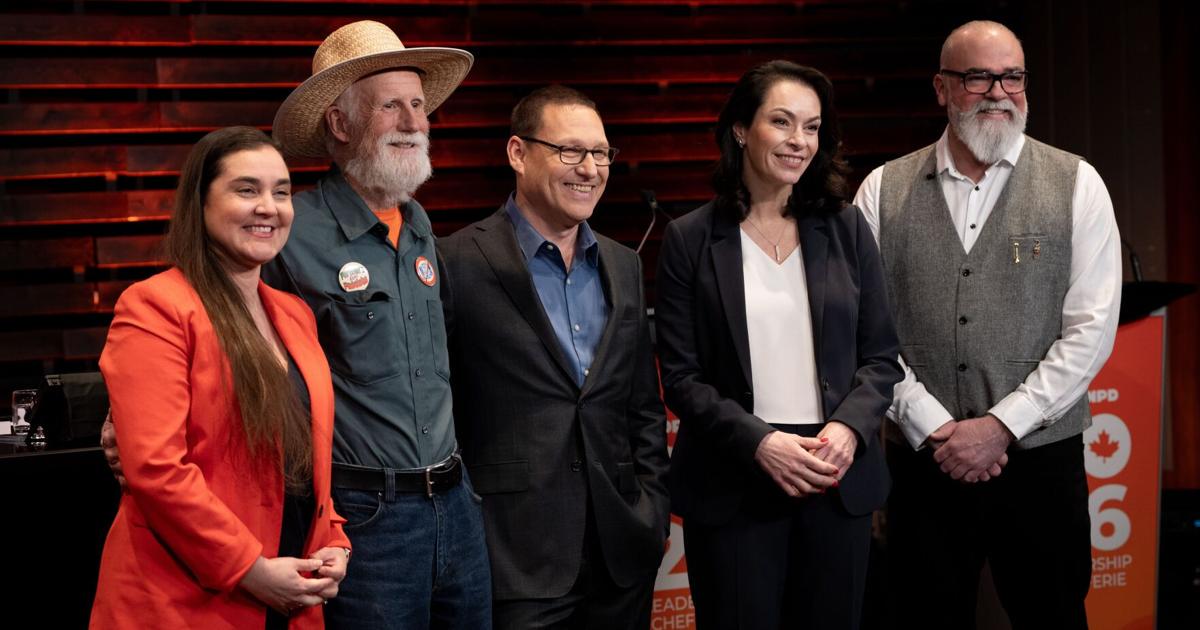
What’s perhaps more alarming for progressives across the country, however, is that the five leadership candidates vying to lead the NDP — McQuail, filmmaker Avi Lewis, Edmonton Strathcona MP Heather McPherson, union leader Rob Ashton, and social worker and city councillor Tanille Johnston — haven’t explained how they plan to win back past supporters, move past the challenges that have plagued the party (such as debates over gun control or oil and gas extraction), or substantively addressed new ones that the country currently faces.
Not one candidate spoke about Alberta or Quebec separation, how to they would respond to Donald Trump, the public’s shifting attitudes toward immigration, or how they would pay for expanded government programs if a wealth tax or increased corporate taxes just led capital to flee Canada’s borders.
At a time when Prime Minister Mark Carney is eschewing the green credentials many progressives thought he held — by musing about approving a pipeline to B.C.’s northwest coast and removing a long-standing oil tanker ban there, continuing fossil fuel subsidies and abandoning Canada’s Paris climate targets — while also slashing Indigenous services by $2 billion, offering billions more in corporate subsidies, attempting to build Canada into a defence supplier to countries with questionable human rights records, and standing by while a premier openly defies Canada’s health care law, there is a big void on the left. It is ready to be filled by a pragmatic, charismatic, fiscally responsible leader that can speak to centre-left voters, from suburban moms who care about their children’s futures to manufacturing workers concerned about their jobs and keeping the country together. Yet, none of the leadership candidates on stage Thursday stepped up to that task.
The candidates are focused inwards, on rebuilding the NDP after its devastating loss last spring. McPherson casts herself as the only candidate with a proven record of winning (Lewis twice lost his electoral bids) and someone who can stand in the House of Commons the day after the leadership race. Ashton has diagnosed that winning back blue-collar workers is key, but he hasn’t expanded his message much beyond that. Johnston, who is Indigenous, is a joyful surprise who speaks passionately about creating a guaranteed livable basic income, but she and McQuaid, who pitches co-operation with the Greens and the Bloc Québécois, won’t be elected in March.
Lewis, the fundraising front-runner, seems to be modelling his campaign on the successful New York City mayoral bid of Zohran Mamdani, with promises for government-run grocery stores, as well as a public option for cellphone and internet services. He told those watching Thursday that his goal is “party status and more.” But how will Lewis expand the tent when some of the party’s current caucus members seems unwilling to serve alongside him?
Thursday’s debate didn’t do much to address the tensions of the party’s past — between its coalition of rural Canadians, blue-collar workers and urban progressives, who have different and often competing priorities.
The fissures left groups of voters ripe for the picking, with Conservatives and Liberals each taking a slice of the NDP’s electorate.
Many New Democrats — like Ashton — blame Lewis for derailing NDP fortunes over the last decade, particularly in Alberta and Saskatchewan, after he spearheaded the “Leap Manifesto,” a document that called for no more oil and gas pipelines. Lewis dug in Thursday, saying “we have to get off fossil fuels as quickly as possible.” He plans to do it by funding the creation of a million new public climate-sector jobs.
That’s probably, the best piece of news Conservative Leader Pierre Poilievre heard all week.
Posted by IHateTrains123
4 Comments
https://preview.redd.it/5l188p8j2wkg1.jpeg?width=900&format=pjpg&auto=webp&s=ec517810c18af3a3b7db180d33492027f888dd42
Gonna need to update this graphic soon to reflect the new leader
SS: Althia Raj writes a scathing review of the NDP leadership debate on Thursday, essentially saying all of these candidates appear to be unserious and refuse to build a politically viable coalition or address any of the big questions currently grappling Canada. This is despite Mark Carney’s right-ward shift, which leaves an opening for the NDP, if it were serious, to exploit, but what this dismal performance suggests is that the NDP might run the risk of becoming a non-factor, which will further entrench the Liberals and Conservatives in a two party system.
Relevant excerpts below:
>The biggest hurdle — obvious to anyone watching the NDP leadership debate Thursday or its more disastrous fall debate — is the painful to inadequate level of French the candidates demonstrated.
>Not only do most leadership hopefuls not speak French, they do not view it as a requirement to lead a federal party in a country where 22 per cent of the population speaks the other official language.
>[…]
>What’s perhaps more alarming for progressives across the country, however, is that the five leadership candidates vying to lead the NDP — McQuail, filmmaker Avi Lewis, Edmonton Strathcona MP Heather McPherson, union leader Rob Ashton, and social worker and city councillor Tanille Johnston — haven’t explained how they plan to win back past supporters, move past the challenges that have plagued the party (such as debates over gun control or oil and gas extraction), or substantively addressed new ones that the country currently faces.
>Not one candidate spoke about Alberta or Quebec separation, how to they would respond to Donald Trump, the public’s shifting attitudes toward immigration, or how they would pay for expanded government programs if a wealth tax or increased corporate taxes just led capital to flee Canada’s borders.
>[Carney’s right-ward shift, leaves open a left-wing shaped hole in Canadian politics.] It is ready to be filled by a pragmatic, charismatic, fiscally responsible leader that can speak to centre-left voters, from suburban moms who care about their children’s futures to manufacturing workers concerned about their jobs and keeping the country together. Yet, none of the leadership candidates on stage Thursday stepped up to that task.
>The candidates are focused inwards, on rebuilding the NDP after its devastating loss last spring. McPherson casts herself as the only candidate with a proven record of winning (Lewis twice lost his electoral bids) and someone who can stand in the House of Commons the day after the leadership race. Ashton has diagnosed that winning back blue-collar workers is key, but he hasn’t expanded his message much beyond that. Johnston, who is Indigenous, is a joyful surprise who speaks passionately about creating a guaranteed livable basic income, but she and McQuaid, who pitches co-operation with the Greens and the Bloc Québécois, won’t be elected in March.
>Lewis, the fundraising front-runner, seems to be modelling his campaign on the successful New York City mayoral bid of Zohran Mamdani, with promises for government-run grocery stores, as well as a public option for cellphone and internet services. He told those watching Thursday that his goal is “party status and more.” But how will Lewis expand the tent when some of the party’s current caucus members seems unwilling to serve alongside him?
>Thursday’s debate didn’t do much to address the tensions of the party’s past — between its coalition of rural Canadians, blue-collar workers and urban progressives, who have different and often competing priorities.
>The fissures left groups of voters ripe for the picking, with Conservatives and Liberals each taking a slice of the NDP’s electorate.
>Many New Democrats — like Ashton — blame Lewis for derailing NDP fortunes over the last decade, particularly in Alberta and Saskatchewan, after he spearheaded the “Leap Manifesto,” a document that called for no more oil and gas pipelines. Lewis dug in Thursday, saying “we have to get off fossil fuels as quickly as possible.” He plans to do it by funding the creation of a million new public climate-sector jobs.
Other news:
[Senators gear up for fight over privacy changes in Bill C-4 – iPolitics](https://www.ipolitics.ca/2026/02/20/senators-gear-up-for-fight-over-privacy-changes-in-bill-c-4/)
[National Newswatch | Trump keeps carveout under CUSMA in new 10 per cent global tariff](https://nationalnewswatch.com/2026/02/20/trump-says-10-per-cent-global-tariff-coming-after-supreme-court-ruling)
[Warning shot: How Canada fits into Washington’s rebuke of the EU’s ‘buy European’ defence drive | CBC News](https://www.cbc.ca/news/politics/defence-industry-europe-trump-arms-warning-9.7100449)
[Ahead of budget bill vote, veterans plead with Ottawa to change course | CBC News](https://www.cbc.ca/news/politics/veterans-budget-bill-error-9.7099807)
!ping Can
For anyone unaware, the NDP leadership debate is the closest our nation’s political scene can get to the heady glories of the 2016 US Libertarian Party debate
I have a weird feeling about Ashton, he’s obviosuly the one with the right analysis (take back private union voters from the Cons) but he looks like what a middle-class journalist think a working class person organizer looks like. Kinda smarmy
Avi is just gonna compete with the Greens for the ultra-progressive votes, and if Mamdani fucks the bed he will always be compered to NYC.
McPherson is middle class pant suit smarmy too, she can probably attack Carney with a “reasonably progressive” pov.
Farmer guy also has a good idea to ally with the Greens but ecology politics hasn’t really been hype since inflation.
Johnston has a bit of the same as Avi, but she’s also indigenous, it’d be interesting to see if it would have an effect (although I’d say Kinew would be a better pick if you want that advantage),