Three buried details deserve sharp attention. First, from the BBC’s market report: Brent crude rose by more than 3% to above $115 a barrel and Brent is “on track for its biggest monthly gain on record” — a data point that puts the economic dimension of every military decision in stark relief, yet most coverage leads with troops and threats rather than the historic commodity shock unfolding in parallel. Second, the Guardian’s excerpt contains a quote from Republican Senator James Lankford that most headlines flattened into “lawmakers react.” His actual words were more conditional: “If this is special forces to be able to carry out a specific operation – get in, get out – that’s very different than longstanding occupation,” adding that “the worst thing that can happen is to be able to have this kind of conflict start and to not end it.” That is not congressional alarm — it is a Republican senator publicly defining the conditions under which he would *support* a ground operation, which is a materially different political signal than opposition. Third, from Time: the U.S. reportedly delivered a 15-point plan to end the war to Iran via Pakistan, calling for Tehran to dismantle its nuclear sites, halt uranium enrichment, suspend ballistic missile work, cease proxy support, and reopen Hormuz. That is a maximalist demand list — not a negotiating opening — and it contextualizes Iran’s characterization of the “peace talks” as a cover story as something less paranoid than it initially appears.
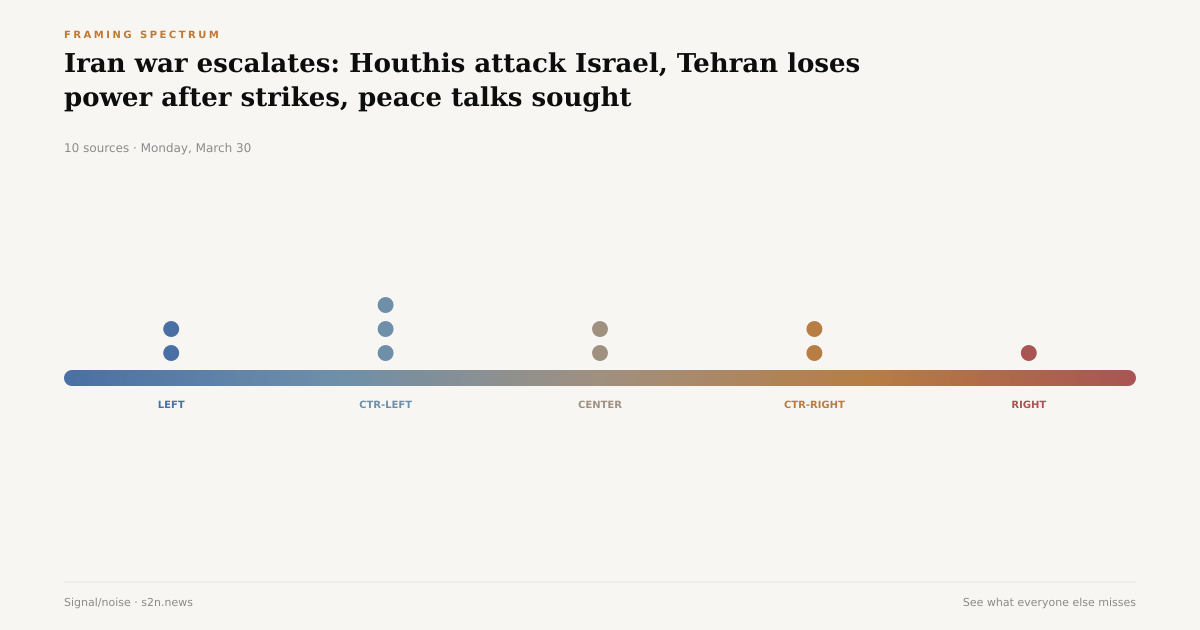
Fox Business’s decision to sidestep the “take the oil” statement entirely in favor of “Chinese vessels retreat at Strait of Hormuz” is not a neutral editorial call — it serves an audience that wants proof the administration’s pressure campaign is working, and a story about adversary retreat does that work more efficiently than a story about an American president contemplating an act that legal scholars would likely categorize as state seizure of sovereign economic infrastructure. The NYT’s “special operations forces have not been assigned specific roles” framing serves the opposite incentive: its readership is highly sensitive to the procedural guardrails around military escalation, and flagging the absence of defined mission parameters functions as a warning that the administration is moving forces before moving policy. Bloomberg’s strict attribution discipline — crediting the FT, specifying Kharg Island by name — reflects the liability calculus of a financial news organization whose readers are making real-time trading decisions and need sourcing they can act on.
The coverage almost entirely ignores the 15,000–20,000 civilian workers who live on Kharg Island itself. Around 15,000–20,000 people live on Kharg, most of them oil workers — any seizure operation would involve either displacing, detaining, or operating around this population, yet no outlet has asked the Pentagon, the White House, or human rights organizations what the legal framework or protection plan for these civilians would be. Relatedly, some 20,000 seafarers are stranded in the Persian Gulf due to the strait being closed and are “facing mental strain, fatigue and decreasing supplies” — a slow-motion humanitarian crisis that has received almost no sustained investigative attention relative to the military planning coverage. Some seafarers report being stuck in life-threatening conditions for as little as $16 a day.
A RUSI research fellow argues that seizing Kharg “would cut off Iran’s oil lifeline” and that “seizure would give the US leverage during negotiations, no matter which regime is in power after the military operation ends.” That framing — leverage for *post-regime* negotiations — suggests the administration may be treating seizure as a transitional control mechanism rather than a permanent occupation, which would be a significant strategic clarification if confirmed on record. Between March 1 and 25, there were 142 transits through the Strait of Hormuz; in the same period in 2025, there were 2,652 — if that number does not recover, economic pressure on Gulf states hosting U.S. forces will intensify and could fracture the coalition underpinning the campaign.

1 Comment
Three buried details deserve sharp attention. First, from the BBC’s market report: Brent crude rose by more than 3% to above $115 a barrel and Brent is “on track for its biggest monthly gain on record” — a data point that puts the economic dimension of every military decision in stark relief, yet most coverage leads with troops and threats rather than the historic commodity shock unfolding in parallel. Second, the Guardian’s excerpt contains a quote from Republican Senator James Lankford that most headlines flattened into “lawmakers react.” His actual words were more conditional: “If this is special forces to be able to carry out a specific operation – get in, get out – that’s very different than longstanding occupation,” adding that “the worst thing that can happen is to be able to have this kind of conflict start and to not end it.” That is not congressional alarm — it is a Republican senator publicly defining the conditions under which he would *support* a ground operation, which is a materially different political signal than opposition. Third, from Time: the U.S. reportedly delivered a 15-point plan to end the war to Iran via Pakistan, calling for Tehran to dismantle its nuclear sites, halt uranium enrichment, suspend ballistic missile work, cease proxy support, and reopen Hormuz. That is a maximalist demand list — not a negotiating opening — and it contextualizes Iran’s characterization of the “peace talks” as a cover story as something less paranoid than it initially appears.
Fox Business’s decision to sidestep the “take the oil” statement entirely in favor of “Chinese vessels retreat at Strait of Hormuz” is not a neutral editorial call — it serves an audience that wants proof the administration’s pressure campaign is working, and a story about adversary retreat does that work more efficiently than a story about an American president contemplating an act that legal scholars would likely categorize as state seizure of sovereign economic infrastructure. The NYT’s “special operations forces have not been assigned specific roles” framing serves the opposite incentive: its readership is highly sensitive to the procedural guardrails around military escalation, and flagging the absence of defined mission parameters functions as a warning that the administration is moving forces before moving policy. Bloomberg’s strict attribution discipline — crediting the FT, specifying Kharg Island by name — reflects the liability calculus of a financial news organization whose readers are making real-time trading decisions and need sourcing they can act on.
The coverage almost entirely ignores the 15,000–20,000 civilian workers who live on Kharg Island itself. Around 15,000–20,000 people live on Kharg, most of them oil workers — any seizure operation would involve either displacing, detaining, or operating around this population, yet no outlet has asked the Pentagon, the White House, or human rights organizations what the legal framework or protection plan for these civilians would be. Relatedly, some 20,000 seafarers are stranded in the Persian Gulf due to the strait being closed and are “facing mental strain, fatigue and decreasing supplies” — a slow-motion humanitarian crisis that has received almost no sustained investigative attention relative to the military planning coverage. Some seafarers report being stuck in life-threatening conditions for as little as $16 a day.
A RUSI research fellow argues that seizing Kharg “would cut off Iran’s oil lifeline” and that “seizure would give the US leverage during negotiations, no matter which regime is in power after the military operation ends.” That framing — leverage for *post-regime* negotiations — suggests the administration may be treating seizure as a transitional control mechanism rather than a permanent occupation, which would be a significant strategic clarification if confirmed on record. Between March 1 and 25, there were 142 transits through the Strait of Hormuz; in the same period in 2025, there were 2,652 — if that number does not recover, economic pressure on Gulf states hosting U.S. forces will intensify and could fracture the coalition underpinning the campaign.