
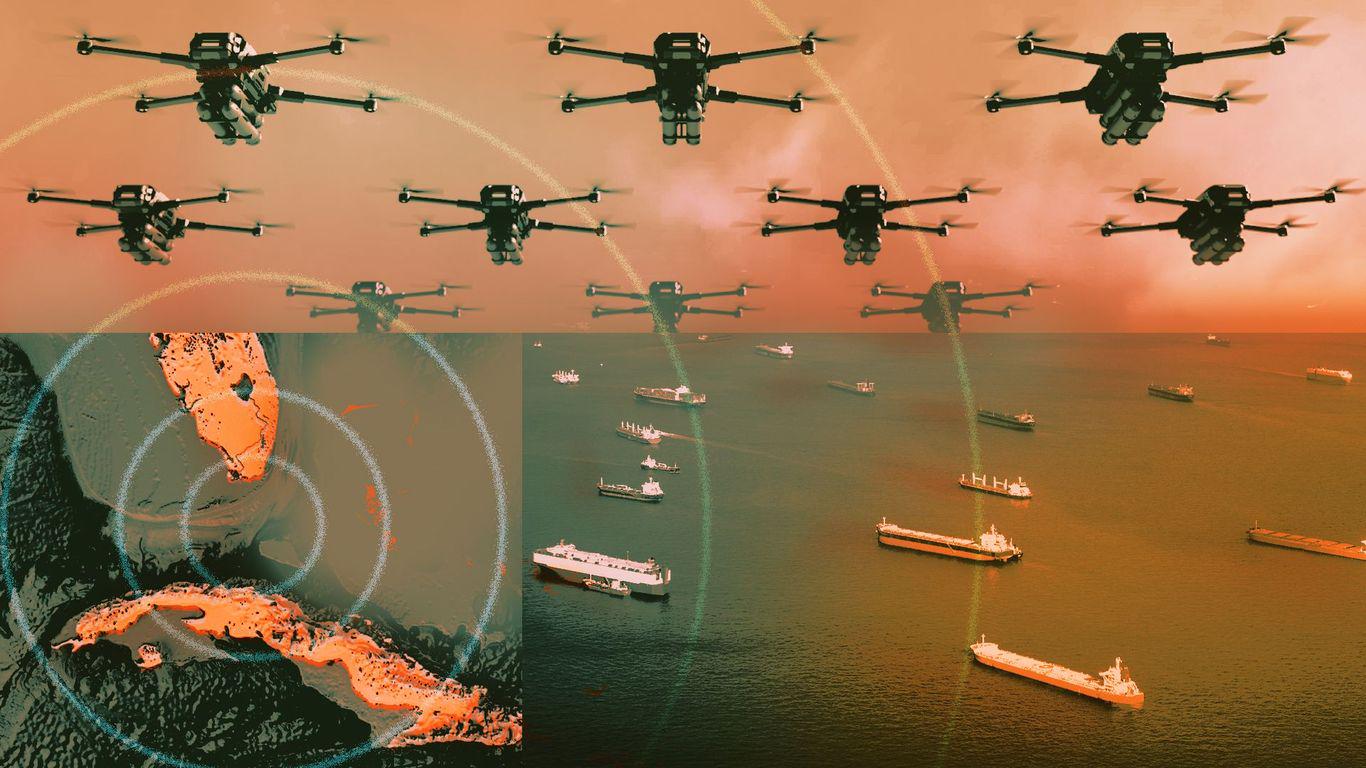
Cuba has acquired more than 300 military drones and recently began discussing plans to use them to attack the U.S. base at Guantanamo Bay, U.S. military vessels and possibly Key West, Fla., 90 miles north of Havana, according to classified intelligence shared with Axios.
The intelligence — which could become a pretext for U.S. military action — shows the degree to which the Trump administration sees Cuba as a threat because of developments in drone warfare and the presence of Iranian military advisers in Havana, a senior U.S. official said.
"When we think about those types of technologies being that close, and a range of bad actors from terror groups to drug cartels to Iranians to the Russians, it's concerning," the official said.
"It's a growing threat."
CIA Director John Ratcliffe traveled to Cuba on Thursday and bluntly warned officials there against engaging in hostilities. He also urged them to scrap their totalitarian government to end crippling U.S. sanctions, a CIA official told Axios.
"Director Ratcliffe made clear that Cuba can no longer serve as a platform for adversaries to advance hostile agendas in our hemisphere," that official said.
"The Western Hemisphere cannot be our adversaries' playground."
On Wednesday, the Department of Justice plans to unseal an indictment of Cuba's de facto leader, Raúl Castro, for allegedly ordering the 1996 downing of two planes flown by a Miami-based aid group called Brothers to the Rescue.
More sanctions against the island nation could be announced this week.
Cuba has been acquiring attack drones of "varying capabilities" from Russia and Iran since 2023, and has stashed them in strategic locations across the island, U.S. officials say.
Within the past month, Cuban officials have sought more drones and military equipment from Russia, the senior U.S. official said. The official cited intelligence intercepts that also indicated Cuban intelligence officials are "trying to learn about how Iran has resisted us."
Russia and China have high-tech espionage facilities for collecting "signals intelligence" (called SIGINT) in Cuba.
"We've long been concerned that a foreign adversary using that kind of location that close to our shores is highly problematic," Defense Secretary Pete Hegseth told Rep. Mario Diaz-Balart, a Miami Republican, during a congressional hearing Tuesday.
In response to Diaz-Balart, Hegseth also confirmed Castro's complicity in ordering the Brothers to the Rescue shootdown.
The concerns about drone attacks on U.S. forces have been heightened by Iran's use of the unmanned aircraft in its response to the U.S. attacks that began Feb. 28.
Iran's drones have damaged American bases in the Middle East, helped close the Strait of Hormuz and menaced neighboring Persian Gulf states, along with missile attacks.
U.S. officials estimate that as many as 5,000 Cuban soldiers have fought for Russia in its invasion of Ukraine, and that some informed the island's military leaders about the effectiveness of drone warfare. Russia has paid Cuba's government about $25,000 for each soldier deployed in Ukraine, U.S. officials estimate.
"They're part of the Putin meat grinder. They're learning about Iranian tactics. It's something we have to plan for," the senior official said.
The Castro regime is closer than ever to falling since it seized power in the 1959 revolution that brought it into conflict with the U.S., thanks largely to U.S. sanctions and the Marxist regime's financial mismanagement.
Cuba is classified as a state sponsor of terror by the U.S. and it's considered the "head of the snake," exporting revolutionary Marxism throughout Latin America.
One former Cuban ally, Venezuela's Nicolás Maduro, was removed from power in a Jan. 3 raid by the U.S.
Since Maduro's ouster, the U.S. has begun normalizing relations with Venezuela — and learned more about Cuba's drone program.
U.S. officials don't believe Cuba is an imminent threat, or actively planning to attack American interests. But U.S intelligence indicates the island's military officials have been discussing drone warfare plans in case hostilities erupt as relations with the U.S. continue to deteriorate.
Cuba doesn't have the ability to close the Straits of Florida in the same way Iran has brought shipping to a standstill in the Strait of Hormuz. U.S. officials also don't believe Cuba is as much of a military threat as it was during the 1962 Cuban Missile Crisis
"No one's worried about fighter jets from Cuba. It's not even clear they have one that can fly," the senior U.S. official said.
"But it's worth noting how close they are — 90 miles," the official added. "It's not a reality we are comfortable with."
Posted by John3262005