
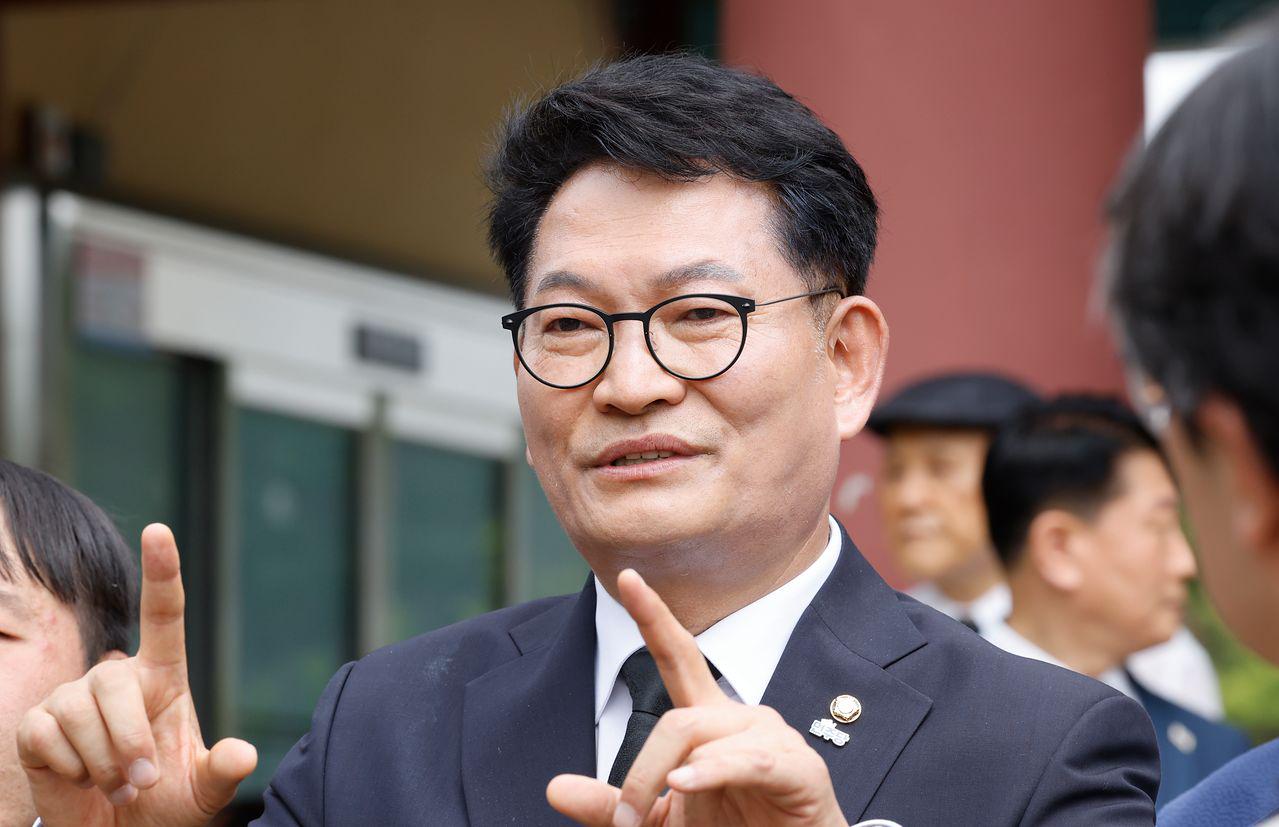
Rep. Song Young-gil, who has entered the Democratic Party of Korea’s leadership race scheduled for August, has been speaking out repeatedly on foreign affairs and national security issues. Since returning to the National Assembly through the June 3 by-election, he visited the United States almost immediately and has continued to issue related messages. Combined with speculation that he could be appointed foreign minister, his moves have prompted varied interpretations both inside political circles and among foreign-policy observers.
On Facebook on July 5, Song wrote, “I applaud Rep. Kim Hyun-jung of the Democratic Party for directly refuting the U.S. House ‘Coupang report,’” adding, “Together with Rep. Kim Hyun-jung, I will actively convey Korea’s position so that the Republic of Korea’s legitimate law enforcement and national interests are not distorted.” He was referring to a briefing document Kim had released earlier that day, arguing that Korea’s personal information protection and platform regulations operate not on the basis of nationality, but according to conduct, market dominance, consumer protection, and data protection principles.
Earlier, a report released on July 1 local time by the U.S. House Judiciary Committee, in connection with the Coupang data leak incident, characterized the Korean government’s actions as a “discriminatory attack against an American-owned company,” prompting the Korean government to express regret.
Including this issue, Song has posted about foreign affairs and security on Facebook ten times since winning the June 3 by-election. His comments have included: “Now is precisely the time for President Trump and Vice President JD Vance to listen to Andrew Kim’s extensive experience and realistic advice” on June 27; “I hope the Republic of Korea and Uzbekistan will expand cooperation not only in the economy, education, and culture, but also in exchanges among future generations” on July 2; and “Peace is security, and peace is the economy” on July 3. Taken together with his decision to travel to the United States immediately after his election, on June 23, the focus of his messaging appears to be shifting toward diplomacy and security.
There have also been moments in which Song seemed to emphasize his own potential role. While visiting the United States on June 25, he drew attention at an event hosted by the Korean American Public Action Committee in Washington, D.C., by reading President Lee’s congratulatory message on his behalf, despite attending not as a government official but as a ruling-party lawmaker. On a radio program on June 21, he said, “I very much want to go stand beside the president and help him.” He also said that during the Moon Jae-in administration he had expressed to then-presidential chief of staff Noh Young-min his desire to serve as foreign minister. He added that, before former Minister Choo Mi-ae, he had been offered the post of justice minister but had declined it. He also pointed to the Eastern Economic Forum in Vladivostok in September and suggested he intended to play a role in restoring South Korea-Russia relations.
These moves have helped keep speculation alive that Song could enter the Cabinet. At the same time, there is no shortage of caution within the ruling camp about replacing the foreign affairs and security team. Some argue that, at a moment when the government must proceed carefully on major issues such as opening up European defense markets and negotiating security matters with the United States, appointing a politician known for emphasizing relations with Russia as foreign minister could be politically burdensome. Talk that Foreign Minister Cho Hyun, a career diplomat, may remain in office is also connected to this atmosphere.
Amid this, some concerns have been raised that Song’s recent remarks could appear somewhat out of step with the government’s direction. At a press meeting with Korean correspondents in Washington, D.C., on June 25 local time, Song commented on the issue of Hanwha Ocean’s icebreaking LNG carriers bound for Russia. He said, “Six icebreaking LNG carriers ordered by Russia’s Novatek, worth a total of 2 trillion won, have been nearly completed, but they cannot be delivered because of economic sanctions against Russia.” He added that if the matter could not be resolved, “there will be no funds available to invest in the MASGA project, which would ultimately be a loss for the United States as well,” and said he was trying to persuade the U.S. side.
With the war in Ukraine dragging on, the remarks could be heard as a call by a prominent ruling-party politician for sanctions on Russia to be eased. In connection with this, some European diplomats in Korea reportedly sought to determine whether Song’s comments had been made after some kind of prior consultation and expressed displeasure. According to diplomatic circles, the reaction was along the lines of: “At a time when every message related to Russia is being reviewed carefully, why are remarks being made that could be interpreted as a demand to ease sanctions?”
Song’s remarks about the U.S. ambassador to Korea, posted on Facebook on June 27, are also potentially controversial. Referring to former U.S. Deputy Secretary of State Stephen Biegun, Song wrote, “I feel a great sense of regret that someone like him did not come as U.S. ambassador to Korea.” He continued, “Rather than repeatedly facing controversy after an appointment has been made, there is a need to exercise active diplomatic and political influence in advance by recommending figures both countries can trust and exchanging views.”
Some pointed out that this could sound like criticism of the selection of Michelle Steel as U.S. ambassador to Korea, even though the appointment process was already underway. The selection of ambassadors is a prerogative of the president.
One diplomatic source, speaking on condition of anonymity, said, “Ambassador Steel is of Korean descent and has a deep understanding of Korean politics and domestic circumstances.” The source added, “At a time when baseless suspicions are still being raised within U.S. conservative and MAGA circles about the Lee Jae-myung government’s stance toward the United States, messages that could create unnecessary misunderstandings are not helpful for South Korea-U.S. relations.”
Song’s past remarks from his time as chair of the National Assembly Foreign Affairs and Unification Committee are also being brought up again. In June 2020, immediately after North Korea blew up the inter-Korean liaison office, Song said, “At least they didn’t blow it up with artillery.” In January 2021, after Trump supporters stormed the U.S. Capitol, he took aim at Washington’s practice of pressuring other countries on human rights and democracy, saying, “Is the United States in any position to lecture Korea on democracy and human rights?” Both remarks stirred controversy at the time.
Posted by Freewhale98
1 Comment
1. Summary
Rep. Song Young-Gil, a candidate for Democratic Party of Korea Leadership, caused controversies with the remarks regarding to foreign affairs such as a statement that can interpret as call for easing sanction on Russia. His critical stance on America while deep friendship with Russia is raising concerns in Korean government.
2. How is this related to the sub
(1) Fracturing alliance: The US reckless behavior made it possible for American skeptics to come back to the surface and aim for the leadership of the ruling party.
3. My opinion
Song Young-Gil is considered a “Russia expert” in DPK and given awards by Putin. He is also has extensive American connection such as former DNI head Tulsi Gabbard. He was given a tour of US intelligence infrastructure when he visited the US as he translated many of Tulsi Gabbard’s books which introduced the Deep State concept and the corruption of US Democrats to Korean public. He explained the working class alienation and the treachery by Democratic Party which led to MAGA movement, a working class grassroots revolts against coastal elites.
Although, his deep knowledge on international affairs should be respected, his conclusion is weird. He claimed Korea’s democracy is superior to the US after Jan 6 riot and called for Russian pipeline to fuel Korean economy. I hope he doesn’t with the leadership race.