
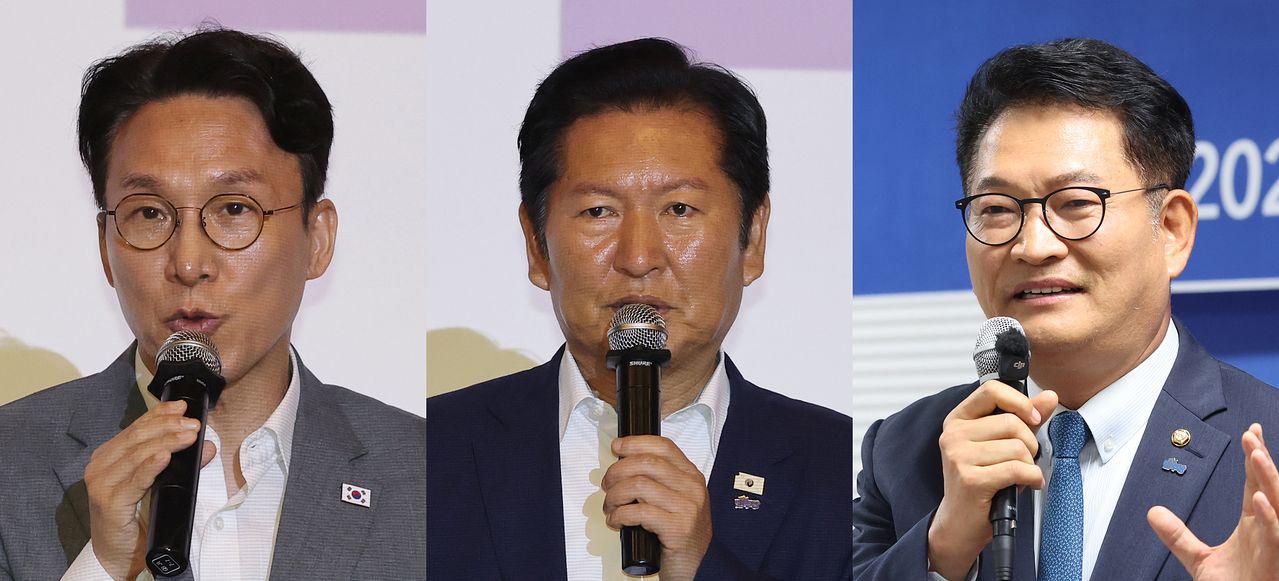
The Democratic Party of Korea is entering the final stretch of negotiations over the rules for its August 17 national convention. Although the dispute has not erupted into an open clash like the debate over introducing a preferential voting system, there has also been considerable disagreement over whether to create an elected youth supreme council member position.
The party held a Supreme Council meeting on July 12 to discuss whether one of the five elected Supreme Council seats should be reserved for a young member. The discussion followed a decision by the convention preparation committee on July 9 to revive the system for the first time in eight years. “The party must go beyond talking about politics for young people and become a party in which young people directly participate in politics,” Rep. Choi Ki-sang said.
Candidates running for the Supreme Council have been competing to announce youth-related pledges amid concerns over the party’s declining support among voters in their 20s and 30s. Rep. Park Sung-joon said at his campaign launch on July 12 that the party should “boldly open political space for young people.” He pledged to hold regular listening tours for people in their 20s and 30s and establish a new policy committee for that generation if elected.
Rep. Lee Keon-tae said on July 7 that he would address young people’s concerns over housing, assets and employment. Three-term lawmaker Kim Young-ho, who is also running for the Supreme Council, promised to create a task force within the party to restore support among young voters. Rep. Park Sun-won, who announced his candidacy last month, proposed the more unconventional idea of creating a ministry for youth and appointing someone in their mid-30s as minister.
The problem is that Supreme Council candidates in their 40s and 50s who have publicly emphasized youth issues now find it difficult to fully welcome the arrival of an elected youth member.
Until the convention preparation committee formally announced the youth Supreme Council proposal on July 7, the prevailing expectation within the party was that the position would be appointed rather than elected. However, the committee argued that the party should avoid producing “another Park Seong-min or Park Ji-hyun” and decided that one of the existing elected seats should instead be allocated to a youth candidate.
As a result, the number of elected Supreme Council seats available to non-youth candidates suddenly fell from five to four. The already crowded race, with more than 10 candidates, was immediately thrown into further uncertainty.
One candidate who had previously supported the youth seat said, “I assumed it would be an appointed youth Supreme Council member. I never imagined it would be an elected position. I tried to win over young voters, but now my own chances of being elected have fallen. I cannot withdraw what I said, so I am in an awkward position.”
Another candidate said, “The introduction of a youth Supreme Council member has made negotiations among the different factions even more complicated. The youth member has become a variable that cannot be ignored, not only in the convention but also in the operation of the next party leadership.”
The Democratic Party’s Supreme Council consists of five elected members and two appointed members. Reserving one of the elected seats for a youth candidate has therefore complicated the calculations of the party leadership contenders and their running mates.
A lawmaker from the Seoul metropolitan area said, “Both the pro-Kim Min-seok camp and the pro-Jung Chung-rae camp had been aiming to secure a stable three-to-two majority among the elected members of the next leadership. They will now have to revise their strategies.”
Some party members are already predicting that, excluding Rep. Park Sun-won, who is regarded as belonging to neither the pro-Kim nor pro-Jung camps, the two rival factions will effectively be fighting over the remaining three seats.
Supreme Council member Park Gyu-hwan, who is aligned with Jung Chung-rae, wrote on Facebook on July 12 that one of the appointed Supreme Council seats should be reserved for a young member. He proposed that the person be selected through an open recruitment and election process and then formally appointed by the party leader.
The proposal would preserve an electoral process while assigning the youth member to an appointed seat. A Supreme Council candidate aligned with Kim Min-seok, speaking on condition of anonymity, similarly said, “As with the ordinary party member Supreme Council position, the top vote-getter should be appointed to one of the appointed seats.”
Kim Hyung-nam, a former secretary-general of the Center for Military Human Rights Korea, and political influencer Jung Min-chul have declared their candidacies for the youth Supreme Council seat but have yet to display clear factional loyalties.
A party official said, “The party leadership contenders are contacting both of them, but there does not appear to be enough time to establish a formal running-mate arrangement.”
Meanwhile, the Democratic Party’s Supreme Council again discussed both the youth Supreme Council position and the introduction of a preferential voting system at an afternoon meeting but failed to reach a conclusion.
After the two-and-a-half-hour meeting, chief spokesperson Kang Joon-hyun said, “The closed-door Supreme Council meeting will not resume. We had sought to revise the party regulations in order to resolve controversy ahead of the national convention, but there were differences of opinion and further deliberation is needed.”
Members of the Supreme Council aligned with Jung Chung-rae reportedly strongly objected when an amendment to party regulations introducing preferential voting was placed on the agenda.
Supreme Council member Moon Jeong-bok told reporters, “It felt as though I had been driven into the corner of a boxing ring and was being repeatedly punched. It is difficult to understand how such an important matter could be pushed forward without any process for consulting party members.”
The pro-Jung camp argues that the party should gather the views of its members through measures such as an all-member vote, as it did when introducing the one-member, one-vote system.
Posted by Freewhale98
2 Comments
1. Summary
Democratic Party of Korea is in turmoil over the introducing a Supreme Council seat assigned which only Gen Z can be elected. This is an attempt to secure youth votes but became a center of factional fights within DPK as older members in their 40s and 50s are angry their slots are taken away and rival factions fight each other to attract new Gen Z politicians to their camp to secure that seat.
2. How is this related to the sub
(1) Youth politic: Democratic Party descended into infighting over attempt to open a new path for youth to participate in politics.
(2) DEI: Democratic Party introduced affirmative actions for a vulnerable minority group.
Dems (not USA) in disarray.