
Archived version: https://archive.fo/aWTwI
Why 1 per cent interest rates could shake everything up after a generation of deflation
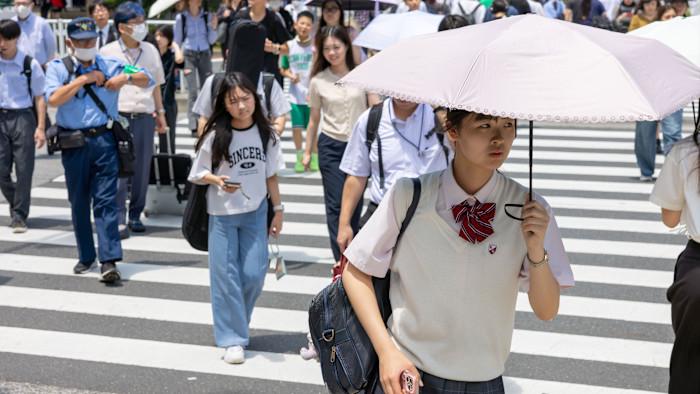
At the start of July, with cold beers, chilled zaru soba noodles and iced matcha lattes on the menu, the Japanese summer stretched ahead as a paradise-in-waiting for the nation’s bars, restaurants and cafés.
Japan is hot; foreign tourist arrivals continue to break records; at around ¥163 versus the dollar, the weak yen has convinced many locals to take their holidays at home; a record stock market rally and rising wages are creating a long-unfamiliar wealth effect.
More broadly, say economists, Japan is now behaving like a country that has emerged from a malaise once considered incurable. Deflation now seems consigned to the past. The output gap has closed. Pricing power has returned to parts of the economy that have not known it for decades.
At last Japan appears to have escaped the shadow of the 1980s asset-price bubble that led not only to bust but to over 30 years of economic stagnation.
The scale and significance of the alteration are remarkable. No country of Japan’s economic size has spent anything like as long in the grip of falling prices, and none has emerged with anything like its suite of unknowns as it returns to a still unspecified “normal”.
“This is a structural transformation of Japan,” says Keiichiro Kobayashi, an economist at Keio University in Tokyo, who has tracked the country’s three-decade-long struggle to emerge from deflation. “It is a shift from being a demand-shortage economy to a supply-shortage economy.”
The changes can be seen in the growth of confidence in the heart of government and the boardrooms of much of corporate Japan — but also in signs of strain in indebted households and companies.
This week the Japanese cabinet approved a grandiose spending plan, confident that it could depend on inflation to help boost its tax receipts, as its predecessors could not.
Branding itself as “a Copernican revolution in the very approach to economic and fiscal management”, the $2.3tn economic blueprint proclaimed that the country had now “transitioned to a non-deflationary state” after years in which stagnant prices had suppressed domestic investment and innovation.
But it added: “The full-scale transition to a new growth-oriented economy is still only halfway complete.”
Meanwhile, the Bank of Japan is “normalising” a monetary regime that became a global byword for abnormality.
For eight long years until 2024, its benchmark rate languished in negative territory, a symbol of Japan’s apparent inability to escape its “lost decades”. But in June the BoJ raised it to the landmark level of 1 per cent for the first time since 1995. Most economists expect the rate increases to continue this year, although the government may seek to lean on the bank to limit the rise.
Yields on the benchmark 10-year Japanese government bond, which move inversely to price and help set the cost of capital, have surged to a three-decade high of 2.91 per cent this year. Volatility is returning to a market once overwhelmingly controlled by the authorities and written off as moribund.
As for equities, the stock market has doubled in value since 2024, meaning that a new generation of Japanese people is discovering investment, as university economics professors report being asked for share-buying advice by students.
The general public, which grew used to holding a huge share of its wealth in bank deposits, is now facing the challenge of making its assets grow faster than prices.
A Japanese asset management sector that has never produced a truly global name may now be entrusted with tens of trillions of yen and a mandate to put them to work.
Entire swaths of industrial Japan, long coddled by cheap money and low inflation, are, according to bankers, talking seriously about the sort of mergers that many investors believed they should have attempted in the 1990s.
The new environment, say bankers, along with emboldened, pro-M&A guidance from both the government and the Tokyo Stock Exchange, has contributed what JPMorgan says was a record $385.9bn in Japan-related acquisitions in 2025.
While the consolidation is still relatively slow, a series of landmark deals in critical areas shows how profoundly the incentives have shifted.
In September, domestic competitors Mitsui Chemicals, Idemitsu Kosan and Sumitomo Chemical agreed to integrate their domestic production of polyolefin, a polymer used for making everyday plastics. This month, the CEO of Mitsubishi Electric revealed plans to combine power semiconductor operations with its once-bitter rivals Toshiba and Rohm.
A senior economy ministry official tells the FT that the department had been working for many years to persuade the chemicals and power semiconductor industries to consolidate — now, in an inflationary environment, they are finally doing so.
“By far the biggest change is the mindset of Japanese people and companies on the back of rates going up. It is changing behaviour,” says Alberto Tamura, the CEO of Morgan Stanley MUFG, the joint venture between the US bank and Mitsubishi UFJ Financial Group. “Companies are showing greater urgency around consolidation and domestic investment.”
But Japan at 1 per cent and out of deflation is also an unsettled place, populated with millions who were simply not alive the last time the country was in a similar position.
As Moody’s Analytics economist Stefan Angrick puts it: “Japan hasn’t quite internalised what it means to live in a world with inflation. It hasn’t wrapped its head around it.”
The country’s return to what is, in global and historical terms, modest headline inflation of 1.5 per cent feels, for many households, like a severe cost of living crisis, as real wage increases have failed, until recently, to match the costs of more expensive imports.
Japan’s Engel coefficient, a “pain index” that measures the proportion of household income spent on food, stood at a 25-year peak of 30.7 per cent in December — one of the highest in the developed world.
Angrick argues that younger families with mortgages have taken most of the pain because they are net debtors.
There are other, more eye-catching signals of unease. The sudden ¥115bn bankruptcy of Zentoshin, a hitherto obscure Osaka-based payment processing firm that serviced the nation’s bars, restaurants and cafés, has cast a shadow over the paradise summer, triggering panic among thousands of small businesses owed cash that may now never come.
The incident may be contained for now, say analysts, but it has reminded Japan how vulnerable large parts of its hinterland remain.
It has underscored how, in the space of two years, the realities that long defined the world’s fourth-biggest economy have been completely upended.
“For 25 years, managers and policymakers have only known deflation and zero rates,” says Kobayashi. “There is no experience for what is happening now.”
No longer in the ICU
Japan’s hiatus from normality was even longer than it looks: when rates were last at 1 per cent, in 1995, the central bank was still cutting borrowing costs.
“That was when Japan went into the intensive care unit,” says Nicholas Smith, Japan strategist at the Hong Kong-headquartered CLSA brokerage. “One per cent feels better this time.”
Smith’s engagement with clients these days centres around explaining how different Japan’s markets are with deflation in the rear-view mirror. He describes deflation as a “destroyer . . . It crushes profits, causes growth investment to plummet, kills consumption and puts a wrecking ball through the financial system. It’s hell.”
For decades prices were stubbornly immovable. But inflation spent most of the past four years above the central bank’s target rate of 2 per cent, as Japan shared in the consequences of the global price shock that followed the pandemic and the start of Russia’s full-scale invasion of Ukraine. The consequences were era-defining for the country: in the wake of higher food, energy and wage costs, companies became less afraid to pass costs on to corporate customers and, ultimately, end consumers.
Today, expectations are a world away from the deflation era. Surveys indicate that private groups, the government and a record 90 per cent of the general public expect the price rises to continue.
Japan’s naturally tightening labour markets will, in Smith’s view, drive up wages, demand big technology and productivity investments from companies currently sitting on cash, and ultimately rekindle consumption.
Foreign investors have piled into the country after the landslide election victory in February of Prime Minister Sanae Takaichi, on the hope of clear strategic direction. The “Abenomics” investment boom triggered by the late Shinzo Abe, one of her notable predecessors as prime minister, drew ¥25tn of foreign net stock buying over three years.
The “Takaichi trade” has drawn ¥10tn in just 19 weeks, although some economists argue that the prime minister’s spending plans would have been more suited to the deflationary zero-rate era.
There have been big symbolic moments. On July 13, Japan’s biggest bank, MUFG, overtook Toyota and SoftBank to become the country’s most valuable company by market capitalisation. It is the first time a lender has held that position in 40 years and represents a bet by the market that Japan’s financial industry now has a much bigger role to play in a positive interest rate regime.
But for many Japanese companies there will be ructions and the exposure of problems disguised for years by the availability of cheap money.
The first significant such predicament has now happened. On July 6 Zentoshin, whose 200,000 customers were mostly bars, restaurants and small retailers, collapsed under the burden of $711mn in liabilities. Troublingly for regulators charged with preventing precisely such a crisis, the company’s liabilities exceeded its assets by about $370mn.
As a signal of its fear of contagion, the government has set up 378 emergency consultation centres around the country to deal with anguished shareholders and called on the Japan Finance Corporation, a state-owned entity that lends to smaller businesses, to ease the requirements for safety-net loans.
Zentoshin, whose history spans that of the deflationary era that began in the 1990s, has always been a product of its time. Its collapse, say credit analysts, follows that pattern.
As Japan adopted credit cards, Zentoshin advanced its clients the sales they were due from customers’ credit card purchases that would not be paid until weeks later — a service that became ever more vital as the deflationary era thinned the operating margins of small businesses.
The pandemic forced many of Zentoshin’s customers out of business and the adoption of smartphone-based payment systems over recent years forced it to lower its fees.
The fact that over 60 regional Japanese banks and credit unions lent to Zentoshin and are financially exposed to the debacle, say analysts, provides a small taste of the risk that the sector may have taken.
“As rates continue to rise, an increasing number of companies are feeling significant negative impacts,” says Wataru Fujisaka, an analyst at the research group Teikoku Databank’s Osaka office. “Given that rates are expected to keep rising, this trend will become even more pronounced.”
In December, an extensive Databank survey of over 24,000 companies found that 44 per cent were concerned at the rising cost of borrowing as profits became squeezed.
Where there was optimism in December, it centred on the prospect that a hawkish BoJ would produce a stronger yen; in fact, it has sunk by more than 4 per cent against the dollar since then.
Fujisaka warns of “a risk that, as companies enter private restructuring due to their inability to repay loans, financial due diligence and other investigations will uncover past instances of financial fraud, such as window-dressing of financial statements”.
That is also the expectation of Masayuki Sannomiya, who runs a restaurant in Tokyo’s Shirokane district and has been a customer of Zentoshin for over 20 years. He has received no payments since mid-June and had banked on them to cover the cost of ingredients.
Restaurants like his cannot go fully cashless because they need hard currency to buy fish at Tokyo’s Toyosu market. That means they require a payment provider like Zentoshin to convert credit card payments into cash, even as rising interest rates make business tough for those services.
“I expect incidents [like the Zentoshin bankruptcy] to happen in the future,” says Sannomiya.
Living with 1 per cent
The signs of strain are multiplying elsewhere as well.
Japan at 1 per cent has failed to prevent the yen from sliding to multi-decade lows against the US dollar, defying interventions by the Japanese authorities. That weakness is starting to bite.
The BoJ’s latest quarterly survey of the general public’s view of the economy found that 62 per cent believed conditions had worsened from a year earlier, and almost 50 per cent said it would be worse a year from now. Over 95 per cent said prices had risen significantly or slightly — the same proportion who believe they will keep rising. Confidence in the BoJ stood at 14.1 per cent.
Last week, a report from the credit research group Tokyo Shoko Research reported surging bankruptcies among small and medium-sized housebuilders because of rising costs, increasing mortgage interest rates and labour shortages.
In the January to June period, there were 118 bankruptcies — an 87 per cent jump from the same period last year and the first time since the deflationary period that the number has exceeded 100 in the first half.
Among larger companies, the extent of the distortion caused by the deflation era continues to be squeezed into the open by the new environment. With that has come an unusually clear sense of urgency for remedial action now that inflation and interest rates are in place.
On Tuesday, the Ministry of Economy, Trade and Industry issued guidelines aimed at encouraging Japanese companies to overhaul years of conservative investment strategy and cash hoarding and start deploying capital for growth.
Among Japan’s 350 largest companies, the ministry found, 65 per cent of invested capital remains locked in value-destructive segments. Companies that should be investing for growth instead “continue to implement formulaic and uniform shareholder return policies”, said the new guidelines.
It may be premature to assume all that will change, despite the pressures. Citi Research economist Sosuke Nakamura says that there is yet to be clear evidence of Japanese companies changing their habits and spending their hoarded cash on growth, particularly at home.
But he does note a clear change in corporate pricing behaviour, with companies throughout supply chains all increasingly comfortable with raising prices.
Business leaders believe that 1 per cent interest rates and sustained inflation offer Japan a unique opportunity to finally expunge the memory of the 1980s bubble that pushed asset prices to sky-high limits and the unusually long shadow it cast.
But the road is an uncertain one.
A full generation of Japanese has grown to early adulthood and become householders without inflation; a generation of business leaders has been promoted with skills established in a period of nearly free money; bankers, savers and asset managers in their thirties and forties are having to learn a new financial vocabulary.
Many will find this daunting, but many, says H Edano, a 64-year-old Kanagawa-based executive of a local car-parking operator, will see it as a blank slate.
“I’m getting old, so I remember inflation, high interest rates in the 1980s and I don’t particularly look forward [to] or fear all of that coming back,” he says. “Sometimes I think I’ll explain these things to the younger people at the company, but really, I think they have to discover it all.”
Posted by IHateTrains123
4 Comments
>Many will find this daunting, but many, says H Edano, a 64-year-old Kanagawa-based executive of a local car-parking operator, will see it as a blank slate.
>“I’m getting old, so I remember inflation, high interest rates in the 1980s and I don’t particularly look forward [to] or fear all of that coming back,” he says. “Sometimes I think I’ll explain these things to the younger people at the company, but really, I think they have to discover it all.”
https://preview.redd.it/fp4zfkwyb0fh1.png?width=447&format=png&auto=webp&s=f67cff3884b81725b215f7220c16d8d9ae471830
Japan is finally woke.
倭?
In 2070 the saying will be that Japan has been living in 2050 since 2030.