
We must discuss the most difficult of policy questions. 🙁
The Anthropocene is the apocalypse.
—-
By
Seattle Times D.C. correspondent
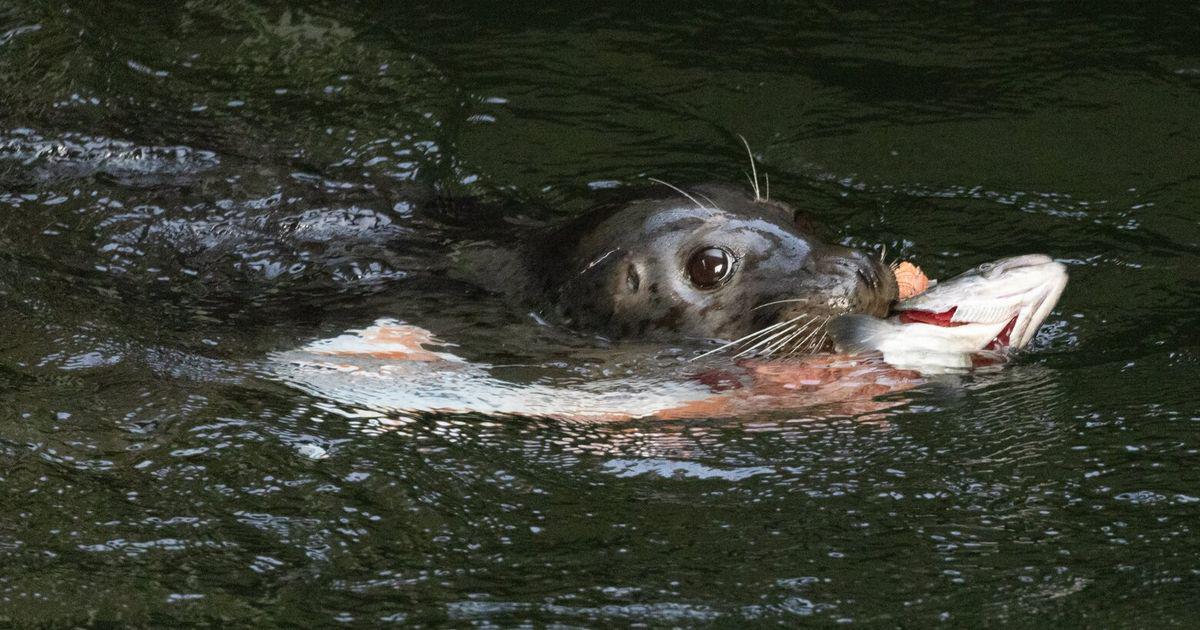
WASHINGTON, D.C. — Federal lawmakers are considering whether to expand the government’s authority to kill more sea lions and seals to bolster salmon recovery efforts in the Pacific Northwest.
The region’s critical salmon runs are on life support: Fourteen species and populations of salmon and steelhead trout in Washington are deemed at risk of extinction under the Endangered Species Act. The hurdles to their livelihood are numerous, spanning a worsening climate crisis, habitat loss, pollution and — as Congress members debated this week — proliferating predators.
The House Subcommittee on Water, Wildlife and Fisheries on Tuesday probed bipartisan legislation co-sponsored by Reps. Michael Baumgartner, R-Spokane, and Emily Randall, D-Bremerton, that would ease restrictions in the Marine Mammal Protection Act for killing sea lions and seals, renewing a decades-old conversation over whether humans should intervene to curb pinniped predation. It’s the second attempt this month by a Washington lawmaker to expand culling of the marine mammals.
The debate comes as marine wildlife officials investigate the shooting of a baby harbor seal found near Bellingham this month with a gunshot wound to its face. The pup, euthanized last week by medical professionals, is the third seal treated for a gunshot injury by SR3, a nonprofit sea life response, rehabilitation and research facility in Des Moines, in the past year, underscoring the tensions surrounding the animals even as Congress weighs broader lethal management.
Baumgartner in a statement before the hearing said his bill is a “common-sense” update that would allow Washington state and federally recognized tribes in Western Washington to explore new ways to responsibly manage booming pinniped populations. Randall told the committee that declining salmon runs also threaten tribal treaty-reserved fishing rights. “We have to find ecosystem balance,” she said. “Nonlethal methods of controlling the pinniped population haven’t worked for us.”
Both first-term members of Washington’s congressional delegation emphasized the bipartisan nature of the effort. Still, lawmakers representing the Pacific Northwest clashed on whether greater allowances to kill sea lions and seals is an effective — or prudent — solution.
“On the West Coast, we know salmon are the beating heart of the Columbia River,” said Rep. Maxine Dexter, D-Ore. “I’m concerned we’re getting ahead of ourselves with the changes in this legislation.” Predation is only one factor, she argued, and recovery will require tackling the many other pressures facing Columbia River fish.
Rep. Jared Huffman, the top Democrat on the House Committee on Natural Resources who represents one of California’s northernmost districts bordering Oregon, said the bill “goes too far” in greenlighting pinniped killings without adequate safeguards. Rep. Val Hoyle, D-Ore., criticized lawmakers for not consulting Oregon tribes while drafting the legislation. “Sea lions cross both sides of the river. They go from Washington to Oregon and back again. So we can’t have a one-state solution,” Hoyle said, adding that a fix remains urgent: “This issue is too critical to get wrong or sit on it.”
Salmon recovery is widely viewed as vital to Washington state and the broader Pacific Northwest because salmon are a cornerstone of the region’s ecosystems and economy. They provide food for numerous species, including endangered southern resident orca whales, and are essential to sustaining Northwest commercial and recreational fisheries, as well as tribal treaty-protected fishing traditions.
Baumgartner and Randall’s Northwest Endangered Salmon Predation Prevention Act of 2026 would broaden where, and how, Washington state and Western Washington tribes with protected fishing rights can manage the growing sea lion and seal populations. In 2018, Congress authorized Washington state to expand a program to capture and euthanize sea lions in the Columbia River Basin due to concerns for salmon survival.
Their bill goes further, expanding the law from “sea lions” to all pinnipeds, including harbor seals, California sea lions and Steller’s sea lions. It would remove geographical restrictions limiting killings to portions of the Columbia River and eliminates the requirement that chemical euthanasia be the only approved killing method. It would take the effort beyond the Columbia River, too, establishing permits for tribes and state officials to kill pinnipeds in “each river and stream in the State of Washington that flows into the marine waters of the State.” The bill would also direct the development of nonlethal methods that prevent pinnipeds from traveling upstream into salmon habitats.
The Northwest Indian Fisheries Commission, which represents 20 treaty tribes in Western Washington, threw its support behind the bill, and some researchers say the controversial tactic may save culturally, economically and ecologically critical fish.
“The Marine Mammal Protection Act already allows the targeted removal of predatory sea lions,” Tim Petty, assistant secretary for oceans and atmosphere with the U.S. Department of Commerce, told lawmakers during the hearing. “But that process hasn’t moved the needle in salmon recovery on the scale that we need to move.” The proposal, he said, gives Washington and eligible tribes broader authority to manage pinnipeds in state waters.
“We are so focused on trying to manage the salmon. We need to manage the pinniped the same way,” Petty said.
Richard Merrick, a marine scientist and retired chief science adviser with National Oceanic and Atmospheric Administration Fisheries, told lawmakers the legislation is well intentioned, but will do little to recover Pacific Northwest salmon. Healthy habitats for salmon remain limited, he said, and new sea lions will replace the culled mammals. Merrick suggested further studies to find comprehensive solutions.
Rep. Marie Gluesenkamp Perez, D-Washougal, pushed back. “This is a topic of conversation at dinner tables in my district for decades,” she said. “I fail to see what spending more time and money on biologists would provide here that we don’t already know. We know that sea lions are heavy predators on our salmon and steelhead.”
Gluesenkamp Perez — who has been vocal about sea lions overrunning stretches of the Columbia River in her district — introduced a separate billearlier this month with the same end goal: Kill pinnipeds to save salmon.
Her Protecting Columbia River Salmon Act of 2026 has a narrower scope, covering only California sea lions and Steller’s sea lions and focusing solely around the Columbia River. It would, however, allow a broader definition for tribes, allowing tribes with ancestral ties to the river to participate rather than limiting eligibility to tribes with treaty-reserved fishing rights.
“I have some concerns about this bill,” she said of Baumgartner and Randall’s legislation. “I am not hearing from my community that there are strong concerns about harbor seals.”
Her bill has not yet had a hearing.
Nate Pamplin, director of external affairs at the Washington Department of Fish and Wildlife, testified in support of Baumgartner and Randall’s measure at the hearing. For Pamplin, the effort represents significant progress.
“It’s pretty exciting that for this longstanding issue, there are two bills out there that are trying to address it,” Pamplin told The Seattle Times. “While we’re working across a variety of threats on salmon recovery, this is an area that we don’t have much authority to do anything about.”
Posted by hypsignathus
2 Comments
>Rep. Marie Gluesenkamp Perez, D-Washougal,
why am i not surprised lmao
Seals: cute
Sea Lions: cute
Salmon: not cute
I know where I stand on this.