
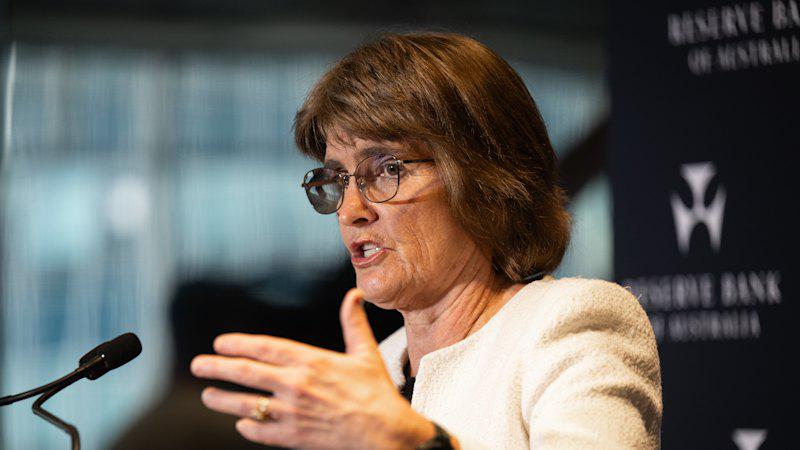
Reserve Bank governor Michele Bullock has put an interest rate hike on the agenda for the bank’s August meeting, but investors believe she and her board will blink as signs grow the slowing property market may take heat out of the economy faster than expected.
In just her second formal speech of the year, Bullock told a charity event in Sydney on Tuesday that while there were signs inflation had not risen as high as feared following the surge in oil prices, it remained too high.
The bank has lifted rates three times this year, taking the official cash rate to 4.35 per cent. Bullock said the full impact of those rate hikes had yet to work their way through the economy.
But she made clear ongoing underlying inflation pressures remained a key concern for the bank’s board, which next meets on August 10 and 11.
“Against a backdrop of ongoing capacity pressures, the board remains focused on preventing elevated cost pressures from entrenching inflation,” Bullock said.
“This does mean that some further easing in the growth of demand is likely to be required if we’re to bring inflation back down sustainably to target.
“The board is prepared to act as required to achieve its mandate, including by increasing the cash rate further if needed.”
While economists thought the governor had given a clear sign that a rate rise would be debated at the bank’s August meeting, investors believed key elements of her address confirmed their suspicions that inflation pressures were actually easing.
Ahead of the speech, markets had the chance of an August rate hike at one-in-three. They now put it at one-in-five.
The ASX200, which was trading in the red ahead of her speech, rallied through Tuesday afternoon to finish 0.6 per cent up to reach a 20-day-high.
Rates on Australian government debt dropped sharply as Bullock spoke, falling to their lowest level since early last week. The Australian dollar, which had been pushed almost above the US70¢ mark, eased to around US69.72¢ on expectations the Reserve would not lift rates at its next meeting.
The bank and markets could change their interest rate outlook depending on the June inflation report, which is due out on Wednesday.
Bullock said while she did not know what the board would decide next month, any sign of further inflation would require consideration of a further rate hike.
“What it is going to come down to is whether or not the board thinks that interest rates are at a level that they’re restrictive and they’re going to bring down inflation sustainably within a reasonable time-frame,” she said.
“If it looks like that inflation is not coming down, then I think the board has some difficult decisions to make in terms of raising interest rates.”
A key issue is the housing market. Sharply rising property prices are associated with the so-called “wealth effect”, as confident consumers increase spending and add to inflationary pressures.
Bullock noted the housing market had been weaker than anticipated, saying this reflected both the RBA’s three rate hikes earlier in the year and the federal government’s changes to property taxes.
Cotality’s daily measure of property values suggest even the Perth market, where values have soared by almost 23 per cent over the past year, has turned negative. Values in Sydney (down 1.2 per cent so far through June) and Melbourne (down 1 per cent) are continuing to slide.
Bullock used her speech to warn about the long-term impact of poor productivity growth across the economy.
Australian productivity has flatlined since 2021 – with falls in areas including housing construction and mining – while a greater share of government spending is flowing into so-called “non-market” areas such as disability support, aged care and health.
Bullock said setting monetary policy had become more difficult for the world’s central banks over the past few years by major economic shocks such as the COVID pandemic and the Russian war against Ukraine.
But the slowdown in productivity growth had also made it more difficult to set interest rates.
“One thing monetary policy can’t do, however, is address the economy’s slow productivity growth.
“While this persists, the ability of the economy to grow without generating inflation is constrained, and Australians will continue to experience limited growth in real wages.”
Bullock noted that petrol prices had not pushed up inflation as far as the bank had initially feared.
Prices are expected to climb from next week when the federal government ends its 16¢-a-litre cut in excise.
Foreign Minister Penny Wong on Tuesday suggested the government would not reverse the move.
“We said it would step down. What we are focused on is assuring continued fuel and fertiliser coming into Australia,” she said.
Posted by RTSBasebuilder
1 Comment
Submission: uncertainty strikes again + low productivity + fuel shocks.
!ping AUS