
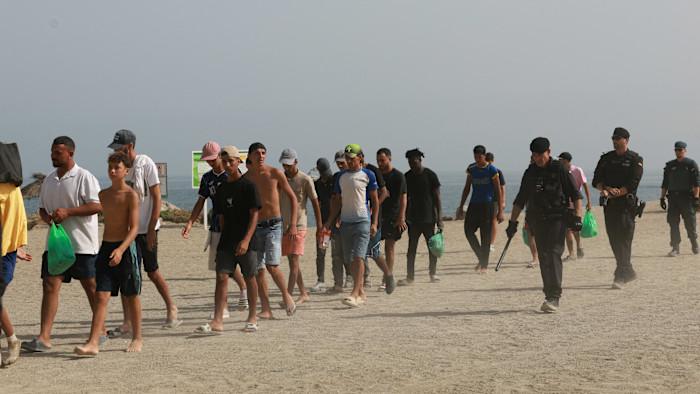
Soldiers round up Moroccans hoping to remain in the enclave in the face of local opposition
The last remaining migrants were clinging on in Ceuta on Saturday, but they knew they were not welcome.
Most of the 60,000 who streamed into the Spanish enclave in north Africa this week had returned to Morocco the previous day. Those who stayed on mingled warily with locals on morning dog walks, but their mumbled requests for help to charge long-dead smartphones were rebuffed.
A few food shops in the town had reopened — or at least opened cracks in their doors — but they turned away anyone who looked like they had swum from Morocco.
There was a bit of relief for the young men on the beach: they lined up to enjoy outdoor public showers, a small symbol of the rich-world comforts they had risked their lives to obtain.
Nourdine Boukherchoun was not yet ready to give up. Although the 26-year-old has a job stacking fruit in a Carrefour supermarket in Tangier, he said he wanted to escape because “life is bad” in his home country.
He had spent a second night sleeping on the street and was nursing a bandaged wound on his leg. “I’m gonna stay here in Spain, Ceuta, right till the end,” he said. “No more Morocco.”
Many of the thousands of migrants who streamed into the enclave on Thursday had dreams of a better life. Some were encouraged by a Spanish court ruling last month that made them think swimmers could not be sent home. Others, says the Spanish government, were manipulated by online campaigns with murky origins.
The migrants say they decided to make the crossing when word spread on social media that the border was open. At least 67 people drowned.
Some residents of Ceuta, whose Spanish sovereignty is disputed by Morocco, suspect Rabat orchestrated the influx to hurt its European neighbour. Migrants said that when they approached the Spanish frontier, Moroccan guards had ushered them on and in some cases had been overwhelmed by the crowds.
As Boukherchoun spoke on Saturday, two Spanish policemen yelled down the street to ask what was happening. Hearing that the Moroccan was being interviewed, one replied: “OK. When you finish, send him to the border.”
Overnight, two people sustained minor injuries in stabbings by migrants. The interior ministry assured Ceuta’s 83,000 residents that there had been “no deaths”.
Aside from having no food, some migrants said they had been chased by armed groups of Ceuta residents. It was a 45-minute walk back to the Tarajal breakwater they had swum around, a journey past beaches strewn with litter other migrants had left behind.
Spanish soldiers in body armour and helmets took the lead in directing hundreds of them home, some barking at them in fluent Arabic in a city where roughly 40 per cent of the population is of Arab origin. To help the migrants along, soldiers gave the occasional shove.
A young Spanish woman named Marina came running up to one soldier in panic. “There are more over there,” she said, pointing to three bedraggled young men trudging down the street.
The young woman’s mother, Gema, was watching on with friends. “They took the city. It was an invasion. There was no law and order,” she said, adding: “This doesn’t happen to Donald Trump.”
Her friend Isabel repeated a conspiracy theory that Trump could even be involved, given his enmity towards Spain’s leftwing prime minister Pedro Sánchez and closeness to Morocco’s King Mohammed VI.
Doubting that Morocco was caught unawares by the mass border crossing, she said: “Mohammed VI has the best intelligence service in the world. It’s like the Israeli one.”
Riccardo Fabiani, north Africa director of the International Crisis Group, said the evidence pointed to “some sort of Moroccan official role in this to send a message”. He said it was difficult to know what the motive was, but did not discount the idea it was an attempt to curry favour with the US.
American and Israeli rightwingers had in recent weeks called on Morocco to act on Ceuta to punish Sánchez for his opposition to the war in Iran, Fabiani noted. US and Israeli politicians quickly seized on the crisis to attack Sánchez’s pro-immigration policies.
Spain has lambasted people-trafficking mafias but gone out of its way to avoid criticising the Moroccan authorities about the Ceuta influx. Fernando Grande-Marlaska, Spain’s interior minister, said that he felt “very satisfied” about Madrid’s co-operation with Rabat in recent years.
Asked by the FT if Morocco was a danger to Ceuta’s security, he said: “Morocco is not a threat to either Ceuta or the rest of Spain. It’s an absolutely reliable partner.”
The people of Ceuta, however, were in shock, not least because the influx was so much bigger than a similar incident in 2021 when at least 8,000 migrants crossed.
“They’re in shock because they can’t understand how something that’s already happened could happen all over again,” said Arantxa Campos, president of the Ceuta Employers’ Confederation. “The moment someone crosses over, there should be a system that’s organised, structured and well thought-out.”
There were signs, she added, that some migrants were trying to hide from the authorities in order to stay in Ceuta.
On the road back to the border, a group of four men slipped away from a Spanish soldier. They headed down some steps to a beach, where they lay in the shade of a straw parasol and ignored his yells of “Yalla!” or “Move!”
Others complied reluctantly, including four teenage girls in long party dresses who were being escorted by a female good Samaritan. A man shouted “Viva España” ironically, then lifted his T-shirt to reveal a red welt across his back from a baton strike.
In Fnideq, the Moroccan beach town on the other side of the border, the streets were lined with disappointed and rattled boys and men who had streamed out of Ceuta on Saturday.
Moroccan police had set up checkpoints and some migrants were loaded into buses out of the city. Anxious women sat waiting on a wall, holding pictures of missing sons and brothers.
Ahmed, who had just returned from Ceuta, said that like many others he had not even told his parents where he was going.
Wearing black jeans he’d put into a plastic bag during his swim, the 28-year-old said he had wanted to emigrate to Europe to pursue a football career for the past five years and had tried to cross three times before. But his experience in Ceuta “changed my mind completely”.
He said that he and the other migrants had become pawns in power games between Morocco and Spain.
“They have political problems, they’re not getting along, so they opened up the border to allow us to cross. We were exploited.”
Posted by IHateTrains123