
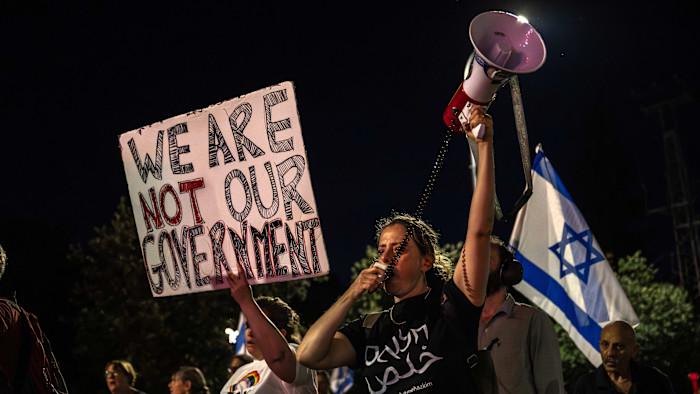
As Prime Minister Benjamin Netanyahu trails in the polls, many fear what measures his government may take to keep power
In a technology park just north of Tel Aviv, Israeli activists are preparing for the worst.
Dozens of computer monitors and flatscreen televisions sit dormant, awaiting what one of the group’s leaders has called “D-Day” and “our World Cup final”: the October election.
As long-serving Prime Minister Benjamin Netanyahu trails in the polls, the opposition, civil society and much of the public are fretting over the lengths to which his far-right government would go to avoid losing power.
Many activists are putting their hopes in this “Election War Room”, which is mobilising teams across the country to monitor polls and react to alleged irregularities.
“Our goal is to create an election day that is within the democratic rules,” said Michal Beinisch, one of the project’s leaders. “We want a free and fair vote, and the results will be what they’ll be.”
Opposition leaders say warning signs have been blaring for months.
Netanyahu’s Likud party has taken aim at the apolitical elections commission, calling its judgment into question. The government has eliminated polling stations at old-age homes and could scuttle overseas Israelis returning to vote, believing they skew leftwing. And after years attacking the Supreme Court — which could ultimately rule on any legal challenge to the vote — it rejected for the first time one of its rulings last month.
“There will be an attempt to undermine the election campaign” and an event akin to the US January 6 insurrection “is definitely possible”, opposition politician and ex-finance minister Avigdor Lieberman said in a recent television interview.
“Netanyahu also understands he’s going to lose and he’s already building explanations as to why they lost,” said Lieberman, suggesting the prime minister would claim votes were faked or that people committed treason.
Likud denied all allegations, calling them “slogans, fear-mongering and lies”.
But many voters appear to share Lieberman’s concerns.
A poll in May showed 56 per cent of respondents feared the election would be compromised, while 35 per cent did not. And a survey in July found 48 per cent of those questioned were worried Netanyahu would create a security crisis to undermine the vote, versus 45 per cent who did not.
Israel’s President Isaac Herzog, whose role is largely ceremonial, went so far as to give a primetime address in July in which he called on the public to “exercise caution” and warned that “various threats . . . both internal and external” could jeopardise the vote’s integrity.
He voiced support — for decades so self-evident it did not warrant mentioning — for the Central Elections Committee (CEC) and law enforcement.
Netanyahu, often referred to as a political “magician” for his three decades of electoral successes, is expected to face his most difficult test yet.
Voter support for the 76-year-old has been eroded by his coalition allies’ extreme positions; the security failures leading up to Hamas’s October 7 2023 attack; and his continuing corruption trial, which brings genuine personal jeopardy to the election.
Until now, Israel’s electoral system had in truth run “correctly and cleanly”, said Guy Lurie of the non-partisan Israel Democracy Institute. Yet Likud’s attacks on the CEC may be preparation for fraud allegations that could “call into question the entire election process”.
The CEC’s long-serving director-general resigned under pressure earlier this year, and Netanyahu’s allies have taken aim at her successor. At a Knesset hearing last week, one senior Likud lawmaker complained of “puzzling” CEC appointments that “required explanations” and warned of the “erosion of public trust” in the body.
Many activists and analysts say Israeli institutions have been under siege since Netanyahu’s coalition took power in late 2022, fanning division and upheaval, trying to undermine the judiciary and attacking legal officials and the media.
The opposition and civil society are preparing for “many challenges . . . and 1,000 possible scenarios”, said Karine Elharrar, a lawmaker from the centrist Together party. “There has never been anything like this because there has never been a government like this.”
For its part, a Likud spokesman slammed “the Left” for “warning about what it itself was planning”, and alleged that dozens of civil society groups were illegally working with the political opposition to skew the election and “topple a rightwing government”.
Beinisch, a tech entrepreneur, and her Election War Room co-leader Eyal Naveh gained prominence in 2023 during the nationwide protests against the government’s bid to overhaul the judiciary. They stress that the war room is apolitical and does not work with any specific parties, though their concerns centre on the government.
Those fears are many: that AI-powered disinformation campaigns will be used to sow discord and manipulate voters. That Netanyahu could manufacture crises to distort the vote. That the ruling coalition may simply refuse to recognise the results, potentially pitting the government against the CEC and the courts.
The project has been co-ordinating dozens of non-profits for more than a year, building a nationwide infrastructure to monitor the campaign, with a legal, media and operations strategy meant to quickly halt any irregularities at polling stations. They aim to recruit 100,000 election-day observers and have set up an “army” of people to patrol the digital space.
Naveh, a former elite commando, said the group expected online misinformation to be the “main area of contestation”. “We’ve created a massive dashboard and react quickly to everything,” he said. “Online is no longer only Netanyahu’s.”
One scenario raised repeatedly by opposition officials and activists was of election day “crises” breaking out to suppress the vote in liberal bastions such as north Tel Aviv.
In this telling, rightwing provocateurs would be sent to create disturbances, engender fear and deter voters from heading to the polls. Other more radical scenarios involve violence by Jewish extremists in Arab-Israeli towns or elsewhere.
Both the war room and the Together party have recruited retired senior police officials, in the hope they will be best placed to work with a force now controlled by far-right national security minister Itamar Ben-Gvir.
They also fear the powerful Shin Bet internal security agency — whose statutory duty is to protect Israeli democracy — could be deployed against Netanyahu’s enemies and “unfriendly” media.
The organisation’s new director, former military general David Zini — handpicked by Netanyahu — has pledged to support the CEC. But many critics have questioned his qualifications for the job, as well as his background in ultranationalist circles and personal loyalty to the premier.
“I hope he does his job,” Elharrar said of Zini. “We need to keep our eyes on the ball.”
Elharrar is not overly concerned about the most extreme scenario posited by some in the opposition: that Netanyahu, fearing defeat, cancels the election because of a security crisis, either real or fabricated.
“He can’t just cancel an election, even because of a security situation,” she said, noting that he lacked the two-thirds majority in the Knesset needed to do so.
But there is genuine fear that Netanyahu may spark a constitutional crisis by refusing to recognise the result or rulings by the Supreme Court around the vote’s legitimacy.
The opposition believes the government began paving the way for such a move last month with the unprecedented step of rejecting a Supreme Court ruling over a relatively minor issue of television regulation.
“This is a calculated plan aimed at stealing the elections,” opposition leader Yair Lapid said at the time. “The government wants to reach the elections without a court.”
Opposition politicians and activists are also gaming out scenarios where outgoing parliamentarians or the Knesset Speaker — a senior Likud official — refuse to vacate their posts. They are even preparing for a January 6 2021 scenario where Netanyahu supporters storm the Knesset.
Naveh said he hoped in that case the police and Shin Bet would “stay loyal” to the country. If not, he said, the public would mobilise. “They won’t be allowed to ignore 1mn people on the streets,” he said.
His colleague Beinisch summed up the anxieties about the government: “The more they feel like they have less to lose, the more dangerous it’ll become.”
Posted by IHateTrains123
1 Comment
Archived version: [https://archive.fo/sbAAy](https://archive.fo/sbAAy).
The long and short of it is that there is a sizeable amount of fear among opposition groups, civil society and much of the Israeli public that Prime Minister Benjamin Netanyahu, who is trailing in the polls, will tamper with the electoral process to avoid losing power. In the lead up to the coming October elections Netanyahu’s Likud party has increasingly attacked the apolitical elections commission and has sought ways to suppress the vote by eliminating polling stations at old-age homes and planning on preventing overseas Israelis from voting. To combat this activists are placing their hopes in “Election War Room,” which aim to mobilise teams across the country to monitor polls and react to alleged irregularities.
!ping Israel&Democracy