
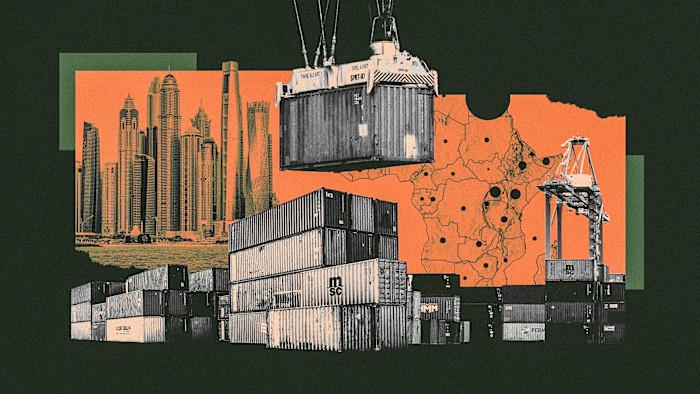
The Gulf state is investing heavily in land, ports and influence across the continent. But its entangled goals come at a price
It was one of the largest gold heists in world history, executed in the opening salvos of Sudan’s civil war in April 2023.
As paramilitary forces battled their former allies from the Sudan military, they seized the state-owned gold refinery in Khartoum and broke into the central bank. At least 1.5 tonnes of bullion worth $100mn at that time was stolen, together with jewellery raided from safe-deposit boxes at commercial banks.
A witness, whose version of events was corroborated by three other people familiar with the operation, says the paramilitary Rapid Support Forces transported the gold across borders, including to neighbouring Chad and South Sudan. The RSF denies involvement and the details of the theft are contested.
But where much of the gold went next is no mystery: from the international airport in South Sudan’s capital, it was loaded on to planes destined for the UAE.
“The Emiratis sent cargo planes, sometimes civilian, sometimes military, to come and ship the gold,” the insider says.
The UAE’s part in this episode underscores the central role the Gulf state is playing as Africa’s offshore capital, and as the most consequential foreign power to stamp its mark on the continent in the past decade.
Under the leadership of its autocratic ruler Sheikh Mohamed bin Zayed al-Nahyan, known as MBZ, the small desert state has spread investment, influence and military hardware across Africa with dizzying speed in a bid to harness trade and resources for its post-oil future.
The UAE’s projection of power spans the continent, ranging from ports to green energy projects to industrial-scale farms. It has leased millions of hectares of agricultural land to bolster food security. It has acquired mining rights from DR Congo to Guinea to secure critical minerals for the energy transition and for its burgeoning defence sector.
The pace and imperial ambition of the UAE under MBZ has caught African policymakers on the back foot, arguably marking the most significant geopolitical shift since China began courting the continent with a mix of loans, infrastructure and mining deals at the turn of the millennium.
That engagement also comes at a price. The UAE is creating a complex system of commercial, industrial and military entanglements that sometimes reinforce but also undermine the sovereignty of fragile states — most notably in war-torn Sudan.
Emirati officials are fiercely defensive of the role they are playing in building trade relations and fostering investment in Africa.
The UAE’s expanding footprint in Africa reflects its view that the continent is “extremely important” to its post-oil agenda, says Nadim Koteich, a Lebanese-Emirati media executive and policy adviser.
“Africa is one of the emerging lungs of the global economy. It sits at the intersection of the US-China cold war, it has an Arab-Islamic dimension, and the UAE needs a stake not just in Africa’s future but in defining its stability and prosperity,” Koteich says. “What Abu Dhabi is building is not a portfolio, it’s a system.”
But many African politicians who have crossed Abu Dhabi in the past are wary. “The problem with the UAE here in Africa is the inexplicable ambition to control the whole region,” says Yemane Gebremeskel, Eritrea’s information minister and right-hand man to its autocratic president Isaias Afwerki, who is no friend to Abu Dhabi.
“It started with dominating a constellation of satellite ports throughout eastern Africa but seems to have morphed into much larger power projection and resource exploitation,” Gebremeskel adds.
The UAE’s push into Africa began with the ports.
DP World, which grew out of Dubai’s drive to establish itself as a trade and logistics hub, won its first container terminal concessions in Africa in Djibouti, Maputo and Dakar in the 2000s. The logistics giant has aggressively expanded since, harnessing trade between Africa, Asia and the Middle East to its Dubai hub at Jebel Ali, the largest man-made harbour in the world.
Together with the smaller logistics company Abu Dhabi Ports, which was launched in 2006, DP World now operates or is developing ports, inland terminals and free zones in 13 African countries.
More recently the company has begun acquiring long-established distribution networks including Imperial Logistics in South Africa and FMCG in Nigeria, giving it a hand in the flow of goods in more than 25 African states.
DP World’s logistics network flows through its hub in Dubai, driving trade: Non-oil trade between Africa and the Gulf countries now exceeds $100bn, according to the IMF, the vast share of it from the UAE and Saudi Arabia.
Eleonora Ardemagni, an Italian academic and expert on the Gulf who has tracked the UAE’s multipronged approach to the continent, describes the ports as “vectors of influence at the core of the UAE’s Africa policy”.
But Abu Dhabi’s increasing sway is also driven by cash — or at least the promise of it. By some estimates, the UAE has become the largest source of capital to Africa over the past decade.
Since 2017, it has announced investments worth upwards of $168bn — sometimes more a statement of intent than a realistic outcome — according to data from fDi Markets, an online database from the Financial Times that tracks cross-border foreign direct investment projects.
The vehicle for many of these investments is the $240bn International Holding Company (IHC), chaired by Sheikh Tahnoon bin Zayed al-Nahyan, the UAE’s national security adviser and MBZ’s brother.
The country’s projects are varied and spread across the continent, often announced with enormous valuations: a $10bn wind farm in Egypt, a $4bn oil refinery in Uganda and a $1.2bn port in Senegal.
Not every announcement is completed: in at least one, a $34bn green hydrogen joint venture in Mauritania, the German partner told the FT the development was delayed due to “challenging” demand and that the UAE-backed investor withdrew from the deal.
Emirati officials say these investments reflect a willingness to back African countries where others are more risk averse. Many African governments, which each year face a collective infrastructure investment shortfall estimated at $130bn-$170bn by the African Development Bank, welcome the inflows.
“Our engagement is not transactional; it is guided by shared values and a vision for sustainable development and inclusive growth,” a UAE official said in response to questions from the FT. The official described the relationship with Africa as one of “mutual trust, respect and a shared vision for a more prosperous future for our peoples”.
On the continent, however, there is disquiet in some quarters about the UAE’s motives and the leverage it is winning via trade, investment, debt and opaque security co-operation with governments of varying autocratic pedigree.
“There is a need to appreciate the limits of Africa’s agency,” says Mehari Taddele Maru, an Ethiopian academic and veteran expert on regional peace and security. “The resources [the UAE is] deploying are huge.”
Moreover, he says, Emirati largesse extends beyond formal relations with governments in ways that are destabilising. In the Horn and east of Africa in particular, the UAE has partnered with non-state armed groups in the supply of weapons and trafficking of illicit gold. According to estimates from Swissaid, nearly $30bn of artisanal gold is exported undeclared from Africa to Dubai each year.
While gold has flown in one direction, weapons have flowed in the other.
Over the past two years UN experts, western intelligence agencies, flight-tracking specialists and human rights groups have gathered extensive evidence of the supply lines fuelling the civil war in Sudan.
These include airstrips, military and naval bases on the Red Sea coast and in other allied African states that Abu Dhabi uses for covert arms trafficking operations.
Using this network, the UAE has helped turn the once lightly armed Rapid Support Forces in Sudan — accused by the UN, US and human rights groups of carrying out crimes of ethnic cleansing and genocide against non-Arab groups — into a well-equipped militia with sophisticated drones, air defences and fleets of armoured personnel carriers.
Abu Dhabi makes no secret of its fears about the rise of Islamist forces in the Horn of Africa and has security agreements with a range of governments in the region. Yet a spokesperson says that “the UAE has not provided and is not providing military or financial support to any warring party in Sudan”.
Many on the continent see links between its growing economic interests in the region and its military interventionism.
“Unlike China, the UAE — especially Abu Dhabi — has inserted itself in a negative way into African politics,” says a senior Muslim leader in west Africa, who, like many public figures on the continent, was reluctant to speak openly for fear of repercussions.
One of the clearest cases of the nexus of commercial ambition and power projection is the port of Berbera in Somaliland.
Tussled over by empires since the time of the ancient Greeks, it has long been prized for its position on one of the world’s busiest maritime corridors at the Gulf of Aden. Crumbling Ottoman villas, British cannons on the waterfront and a 4.2km airstrip built by the Soviets attest to the interests of past imperial powers.
Towering above is a more recent addition: a giant rank of ship-to-shore gantries that DP World, the multinational logistics company owned by the Dubai government, has erected on the quaysides.
These form part of a $450mn investment that has followed a “Field of Dreams” approach — named after the Hollywood movie — of building first in the hope that demand will follow. In addition to the cranes, the UAE has upgraded storage infrastructure and built a 250km highway connecting Berbera to Somaliland’s fast-growing neighbour Ethiopia.
DP World’s 30-year deal to lease the deepwater port was negotiated in parallel with an opaque agreement that gave the UAE control of a nearby naval and military base and access to the Soviet-era airstrip. Recent satellite images show the construction of additional bunkers and military facilities near the runway.
This arrangement exemplifies the Emirati approach. Dubai, the junior partner in the UAE federation, won a hand as trading middleman. Abu Dhabi, where power and petrodollars reside, handles security, surveilling shipping routes and countering regional threats from Somali pirates, Yemeni Houthis and other militant Islamist groups.
In the process, a declining asset has been revitalised for the 21st century. The port is primed to be a gateway to landlocked Ethiopia’s market of 120mn people. In 2023, the World Bank and S&P Global ranked the port as the most efficient in sub-Saharan Africa.
DP World has committed to doubling the port’s capacity — should Somaliland overcome geopolitical constraints that have prevented Ethiopia from diverting trade from neighbouring Djibouti. Regional tensions over Somaliland’s contentious bid for international recognition as a sovereign state, which the UAE sympathises with and Israel supports, stand in the way.
“There are things that need to fall in place, but it’s a matter of time,” says Joseph Oguta, a Kenyan national who runs the nearby free zone for DP World. He laughs off suggestions that the company was the bridgehead for some imperial Emirati design.
“We are not playing Vasco da Gama here,” he says, referring to the 16th-century Portuguese mariner who sailed the sea lanes that opened Africa and Asia to colonial exploitation.
Koteich, the policy adviser, concedes that for the UAE “the security dimension in certain places overlaps with the economic one, but that’s a bug in the strategy, not a feature,” he says. “The driving force is economic development and supply chain integration.”
Echoes of the past are nevertheless a cause of concern across Africa as the UAE’s commercial expansion proliferates across supply chains, often in extractive industries, and its role as the continent’s offshore capital grows.
Sudan, like Ethiopia, has long been central to Abu Dhabi’s bid to gain a strategic foothold over the Horn of Africa and Red Sea trade. Before its civil war erupted, Emirati groups were planning a new port on the coast together with the logistics to connect it to a vast hinterland of Nile Valley agricultural land.
Among the UAE’s early forays was a huge farm on the banks of the Nile in Abu Hamad, in the north, in 2020. For $225mn, IHC’s Food Holding division launched a joint venture with DAL Group, a Sudanese conglomerate, to grow crops on 170,000 acres of land. In 2022, the Abu Dhabi Ports group announced a $6bn investment in Abu Amama, a Red Sea port on Sudan’s coast that would be connected to Abu Hamad’s farmland by a 450km road.
The civil war upended these plans: the port deal was killed along with a string of other agreements with the UAE by Sudan’s de facto military government in 2024, in retaliation for the UAE’s alleged support for its rival, the RSF.
An IHC spokesperson said it was no longer involved in the Abu Hamad farm, or any of its other projects in Sudan. Satellite imagery indicates that their partners have continued growing crops on its large circular fields nearly 1km across — although the expansion of new plots has stopped short of the 750 planned.
Satellite images show thousands of hectares of farmland at other sites once controlled by Emirati firms in Sudan’s nutrient-rich Nile Valley. But FT analysis shows that the growth of these farms has slowed since the onset of the civil war.
At the same time, tens of thousands of hectares of similarly large industrial farms have been developed just across the northern border in Egypt’s Toshka New Valley — many owned by Al Dahra, a company founded and chaired by Sheikh Hamdan bin Zayed, a younger brother of MBZ. These farms in the desert mainly grow alfalfa, wheat and other feed crops — most of them destined for the UAE.
Emirati companies have also secured land in Angola, Mauritania, South Sudan, Kenya and Tanzania, diversifying agricultural holdings across the continent.
In the past five years, IHC has also emerged as a leading investor in African mines. It has committed billions of dollars to ventures in copper in Zambia, gold in DR Congo, Ethiopia and Mali, and iron ore in Mauritania. Since last year, IHC has controlled 7 per cent of global tin supply through its holdings in the eastern DR Congo.
In parallel, Dubai’s pre-eminence as the global market for African gold has continued to grow.
Before the RSF seized the refinery in Khartoum, the Central Bank of Sudan had also been building up its gold reserves. According to former Khartoum officials, these had reached 7.2 tonnes in October 2021 when the paramilitary RSF joined forces with the Sudanese Armed Forces to overthrow the transitional government.
Accounts as to what happened to these reserves have diverged in the fog of war, as the two factions became locked in conflict. The RSF’s civilian administration denies the group played a role in the looting that took place. A spokesman categorically rejected the allegation that bullion was exported at the time to the UAE through South Sudan.
A UAE official did not address the FT’s questions about the heist, but said the country has “developed a robust regulatory framework to maximise the security, integrity, and transparency of every gold transaction” with “full enforcement at all points of entries”.
The official also noted that, in 2025, the value of Sudanese gold passing through the UAE was just over $1bn, a small share of the UAE’s $300bn market.
Gold exported to the UAE from Sudan is nevertheless helping to finance the civil war, according to multiple research organisations including Chatham House, which published a detailed study on the issue last year. Much of the country’s artisanal production — estimated by Swissaid at more than 40 tonnes a year — is trafficked to Dubai without being taxed formally by the state.
This includes gold from mines controlled by Al Junaid, a holding company belonging to the family of RSF leader Mohamed Hamdan Dagalo, known as Hemeti, that has been sanctioned by both the US Treasury and the UK.
Responding to allegations about gold smuggling, a UAE official said the country was working according to “international best practice” in its efforts to combat money laundering and strengthen responsible gold sourcing. As a global hub for commerce, it recognised that “prosperity must be underpinned by transparency and accountability”.
As the UAE has spread itself across Africa, the continent’s elites have also made a second home in Dubai — a city which encapsulates the contradictions in evolving relations between the tiny desert state and the vast continent it is seeking to exploit.
Dubai is at once a well-positioned entrepôt and financial centre from which formal trade and investment with Africa is being driven. In 2025 there were 30,409 active African companies registered with the Dubai Chamber of Commerce.
The city is also a siphon for African wealth drawn to its low taxation, loose regulatory environment and secrecy, says Ricardo Soares de Oliveira, a professor of politics at Sciences Po in Paris and author of a recent study of the role Dubai plays as an offshore centre for African capital.
“Africa is one part of the story for Dubai, but Dubai is a huge part of the story for Africa,” he says, alleging that it has become the go-to city for the laundering of ill-gotten gains as scrutiny of OECD financial centres including London and Geneva has intensified.
The UAE is “fully aware, and committed to, its responsibilities to protect the integrity of the global financial system”, a government spokesperson says.
Africans invested $30.6bn cumulatively in real estate in Dubai between 2019 and 2025, according to the confidential estimate of one African development institution. A third of this came from Nigeria.
“They have captured large inflows from Africans who, not being able to put money in the old colonial centres, are now investing in real estate and other things in Dubai where they can escape controls,” says one of Africa’s top financial executives, who asked not to be named.
Much of that business is conducted by the same bankers who previously operated in western financial centres but who have also been drawn to Dubai’s more permissive culture, according to Soares de Oliveira.
“They are just being clever,” the senior African banker says of Dubai. “If they didn’t do it, someone else had been doing it and someone else was thinking of doing it. So why shouldn’t they?”
The retreat of western donors in Africa has left a vacuum for middle powers to fill. The UAE is by no means alone: Turkey, Saudi Arabia, Qatar and others have entered the mix and competition is intensifying.
But of these middle powers the Gulf state has been the most active. “The UAE has entrenched significant alliances in many African countries both at government level but also with other actors,” says Ardemagni, the Italian researcher: “They have proved very adaptable in coping with changing dynamics,” she said.
Its latest challenge is Iran’s closure of the Strait of Hormuz, isolating DP World’s key port of Jebel Ali — the cornerstone of the UAE’s global logistics network. But analysts assess that the UAE’s ambitions on the African continent will persist even with a war on their doorstep.
Moreover, argues Mehari Taddele Maru, the Ethiopian academic, the UAE’s influence over western powers, accumulated through a shared alliance with Israel and antipathy to Islamist groups, together with petrodollar investments and aggressive lobbying, has allowed it “to act as it wishes in Africa”.
Mehari Taddele Maru, among many other academics, activists and researchers, hopes the militarised corporatism that has characterised the opening chapter of the UAE’s foray into Africa will be tempered in the future.
“The UAE is a middle power which doesn’t follow norms of engagement,” he says, posing a conundrum for African leaders: “It’s about taming their behaviour . . . while getting their investment.”
“They are our neighbours. They will be involved,” he notes. “But how do you maximise the benefits to countries and not to the individuals or racketeers?”
Posted by IHateTrains123