>Expensive energy subsidies are holding down Japan’s inflation figures, there is talk of an imminent huge fiscal expansion, the yen keeps weakening, Japanese government borrowing costs are rising rapidly and talk of threats to the Bank of Japan’s independence fills the country’s air. On a fact-finding visit to Tokyo last week, I could not ignore the similarities with Liz Truss’s short and disastrous spell as UK prime minister in 2022.
>Japan, of course, has sufficient self-respect not to look to Britain as a point of reference. Japanese media enjoy adding the suffix “-shokku” to words to signify danger, much as Anglophones add “-gate” for scandals. Now, the annual summer government economic policy statement is called the “Honebuto” and the [published drafts](https://www5.cao.go.jp/keizai-shimon/kaigi/minutes/2026/0630_shiryo01.pdf) have already sent borrowing costs up and the yen down. Therefore, this question is on everyone’s lips: will Japan suffer an imminent “Honebuto-shokku”?
>The starting point for answering that question should be the most recent economic indicators, including [regional anecdotal reports](https://www.boj.or.jp/en/research/brp/rer/data/rer260709.pdf) on business conditions. These are healthy. Despite Japan’s huge reliance on imported oil for energy and industrial feedstock, resilience in the global economy has boosted Japanese economic activity more than the energy shock from the US war against Iran has held it back.
>The AI boom has directly benefited the two companies with the largest weights in the Nikkei 225, Tokyo Electron and Advantest, which both produce semiconductor equipment. Reports suggest the AI data-centre boom is spreading its riches far and wide within the country: from small fibre-optic connector companies and heavy machinery manufacturers for use in copper mining to the tourism sector in Okinawa, which is hosting a surge in visitors from South Korea and Taiwan.
>There is now little doubt that the country has cast deflation and stagnant nominal wages and prices into the past, firmly entrenching a virtuous cycle between income, spending and prices. Breaking persistent deflationary forces has been a 30-year battle for the [BoJ](https://www.ft.com/stream/05714202-ec5b-48df-a43a-20549355c070) that it appears to have won. For the past five years, wages and prices have been rising steadily.
>Of course, rising nominal wages and prices are normal for advanced economies. That this phenomenon now occurs in Japan has enabled the BoJ to make progress on bringing its interest rates into line with peers. It [raised its policy rate to 1 per cent](https://www.boj.or.jp/en/mopo/mpmdeci/mpr_2026/k260616a.pdf) a month ago, the highest level since the mid-1990s.
>There are clearly downside risks from escalation of the war in the Gulf, which could generate a more serious stagflationary shock later this year. But the mood was one of economic resilience, even if households do not believe it. The [BoJ’s household survey](https://www.boj.or.jp/en/research/o_survey/data/ishiki2607.pdf) shows a large majority of consumers think economic conditions have worsened and will continue to do so.
>One thing is clear, however. The normalisation of the Japanese economy comes with the big problem of higher borrowing costs for government. Yields on 10-year Japanese government bonds have been rising ever closer to 3 per cent, levels not seen in 30 years, while gross Japanese government debt exceeds 200 per cent of national income.
>It is important not simply to look at rising yields alongside higher debt-servicing costs and think this is a problem. The BoJ only formally ended its yield curve control policy as recently as March 2024, which artificially held down yields. Break-even benchmark inflation expectations are now hovering around 2 per cent, so an upward-sloping yield curve with on-target market inflation expectations is arguably the perfect sweet spot for Japanese monetary policy.
>In this more normal economy, it would be naive to think that everything is fine in Japan, despite Tokyo’s dynamism and “cool biz” summer vibe.
>The government has repeatedly intervened to stop a relentless yen decline and yet it falls further. Finance minister Satsuki Katayama seemed to attempt a stealthy intervention earlier this month by [calling on Japanese pension funds](https://www.ft.com/content/f06e2bec-bab6-4633-a88f-376729fdc914?syn-25a6b1a6=1) to invest more at home. There is no sign yet of it working. The yen is falling and Tokyo can be cheap. I enjoyed a standard conveyor sushi bar that was selling two pieces of nigiri for less than $1.
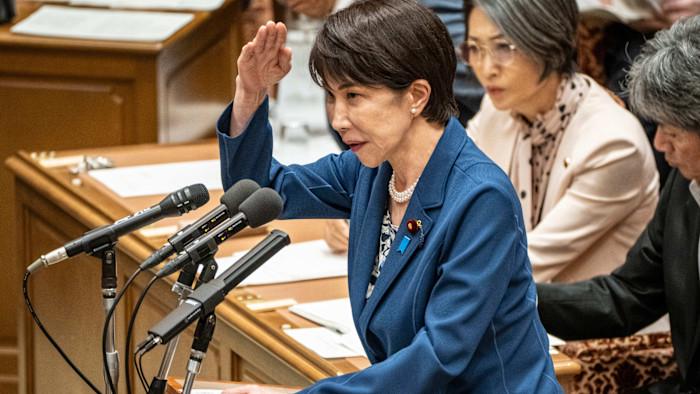
>This brings us to the big question. Is Prime Minister Sanae Takaichi’s government about to deliver a “Honubuto-shokku” that will undermine monetary and fiscal credibility and spook markets?
>As the FT’s Tokyo bureau chief [beautifully explained](https://www.ft.com/content/15f15092-3b14-4ba7-be3a-d3cdf70ed670?syn-25a6b1a6=1) recently, it is wrong to think of the new government led by Takaichi as a revival of the late former prime minister Shinzo Abe’s “Abenomics”, with its three arrows of loose fiscal policy, accommodative monetary policy and structural reforms that emphasised improved corporate governance.
>Takaichi’s government appears to prefer loose monetary and fiscal policy, but puts much less emphasis on structural reforms. It also enjoys dabbling in big-number politics. One headline figure in the draft Honebuto was a desire to [unlock ¥370tn in investment](https://www.ft.com/content/2acfbdf5-d86b-46be-89d4-6d0cc5756ed3?syn-25a6b1a6=1) by 2040, suggesting a boost of public and private investment of about 4.6 per cent of GDP. This comes alongside [the energy subsidies already in place](https://www.ft.com/content/9746292e-7f7c-42af-8d09-64c8bd3fd939) of about 0.5 per cent of GDP, a planned cut in consumption tax on food from 8 to 1 per cent (0.8 per cent of GDP) and an ambition to raise defence spending from about 1 to 3.5 per cent of GDP.
>If these were enacted at a time when Japan no longer obviously needed economic stimulus, it would transform the country’s primary deficit from something that looks relatively healthy among G7 peers to something that would make financial markets wince.
>But the smart people I met suggested taking account of the difference between announcements designed to make a political impact and policies that will actually happen. With inflation helping to raise nominal GDP, tax revenues are buoyant and disbursements of public money often lag far behind announcements, they added.
>So what does the BoJ do in these circumstances? It is likely to take a typical “keep calm and carry on” stance, slowly normalising monetary policy until it thinks short-term rates are no longer accommodative. It can do this even with tacit disapproval from the Takaichi government, because more than 80 per cent of those who offered an opinion in a June [BoJ survey of attitudes](https://www.boj.or.jp/en/research/o_survey/data/ishiki2607.pdf) have confidence in the central bank.
>As long as the Takaichi government talks about opening the fiscal spigot while making relatively minor changes, the Japanese economy appears likely to avoid the UK’s dreadful 2022 experience and remain reasonably healthy — as healthy as a rapidly ageing advanced economy can be.

5 Comments
>Expensive energy subsidies are holding down Japan’s inflation figures, there is talk of an imminent huge fiscal expansion, the yen keeps weakening, Japanese government borrowing costs are rising rapidly and talk of threats to the Bank of Japan’s independence fills the country’s air. On a fact-finding visit to Tokyo last week, I could not ignore the similarities with Liz Truss’s short and disastrous spell as UK prime minister in 2022.
>Japan, of course, has sufficient self-respect not to look to Britain as a point of reference. Japanese media enjoy adding the suffix “-shokku” to words to signify danger, much as Anglophones add “-gate” for scandals. Now, the annual summer government economic policy statement is called the “Honebuto” and the [published drafts](https://www5.cao.go.jp/keizai-shimon/kaigi/minutes/2026/0630_shiryo01.pdf) have already sent borrowing costs up and the yen down. Therefore, this question is on everyone’s lips: will Japan suffer an imminent “Honebuto-shokku”?
>The starting point for answering that question should be the most recent economic indicators, including [regional anecdotal reports](https://www.boj.or.jp/en/research/brp/rer/data/rer260709.pdf) on business conditions. These are healthy. Despite Japan’s huge reliance on imported oil for energy and industrial feedstock, resilience in the global economy has boosted Japanese economic activity more than the energy shock from the US war against Iran has held it back.
>The AI boom has directly benefited the two companies with the largest weights in the Nikkei 225, Tokyo Electron and Advantest, which both produce semiconductor equipment. Reports suggest the AI data-centre boom is spreading its riches far and wide within the country: from small fibre-optic connector companies and heavy machinery manufacturers for use in copper mining to the tourism sector in Okinawa, which is hosting a surge in visitors from South Korea and Taiwan.
>There is now little doubt that the country has cast deflation and stagnant nominal wages and prices into the past, firmly entrenching a virtuous cycle between income, spending and prices. Breaking persistent deflationary forces has been a 30-year battle for the [BoJ](https://www.ft.com/stream/05714202-ec5b-48df-a43a-20549355c070) that it appears to have won. For the past five years, wages and prices have been rising steadily.
>Of course, rising nominal wages and prices are normal for advanced economies. That this phenomenon now occurs in Japan has enabled the BoJ to make progress on bringing its interest rates into line with peers. It [raised its policy rate to 1 per cent](https://www.boj.or.jp/en/mopo/mpmdeci/mpr_2026/k260616a.pdf) a month ago, the highest level since the mid-1990s.
>There are clearly downside risks from escalation of the war in the Gulf, which could generate a more serious stagflationary shock later this year. But the mood was one of economic resilience, even if households do not believe it. The [BoJ’s household survey](https://www.boj.or.jp/en/research/o_survey/data/ishiki2607.pdf) shows a large majority of consumers think economic conditions have worsened and will continue to do so.
>One thing is clear, however. The normalisation of the Japanese economy comes with the big problem of higher borrowing costs for government. Yields on 10-year Japanese government bonds have been rising ever closer to 3 per cent, levels not seen in 30 years, while gross Japanese government debt exceeds 200 per cent of national income.
>It is important not simply to look at rising yields alongside higher debt-servicing costs and think this is a problem. The BoJ only formally ended its yield curve control policy as recently as March 2024, which artificially held down yields. Break-even benchmark inflation expectations are now hovering around 2 per cent, so an upward-sloping yield curve with on-target market inflation expectations is arguably the perfect sweet spot for Japanese monetary policy.
>In this more normal economy, it would be naive to think that everything is fine in Japan, despite Tokyo’s dynamism and “cool biz” summer vibe.
>The government has repeatedly intervened to stop a relentless yen decline and yet it falls further. Finance minister Satsuki Katayama seemed to attempt a stealthy intervention earlier this month by [calling on Japanese pension funds](https://www.ft.com/content/f06e2bec-bab6-4633-a88f-376729fdc914?syn-25a6b1a6=1) to invest more at home. There is no sign yet of it working. The yen is falling and Tokyo can be cheap. I enjoyed a standard conveyor sushi bar that was selling two pieces of nigiri for less than $1.
>This brings us to the big question. Is Prime Minister Sanae Takaichi’s government about to deliver a “Honubuto-shokku” that will undermine monetary and fiscal credibility and spook markets?
>As the FT’s Tokyo bureau chief [beautifully explained](https://www.ft.com/content/15f15092-3b14-4ba7-be3a-d3cdf70ed670?syn-25a6b1a6=1) recently, it is wrong to think of the new government led by Takaichi as a revival of the late former prime minister Shinzo Abe’s “Abenomics”, with its three arrows of loose fiscal policy, accommodative monetary policy and structural reforms that emphasised improved corporate governance.
>Takaichi’s government appears to prefer loose monetary and fiscal policy, but puts much less emphasis on structural reforms. It also enjoys dabbling in big-number politics. One headline figure in the draft Honebuto was a desire to [unlock ¥370tn in investment](https://www.ft.com/content/2acfbdf5-d86b-46be-89d4-6d0cc5756ed3?syn-25a6b1a6=1) by 2040, suggesting a boost of public and private investment of about 4.6 per cent of GDP. This comes alongside [the energy subsidies already in place](https://www.ft.com/content/9746292e-7f7c-42af-8d09-64c8bd3fd939) of about 0.5 per cent of GDP, a planned cut in consumption tax on food from 8 to 1 per cent (0.8 per cent of GDP) and an ambition to raise defence spending from about 1 to 3.5 per cent of GDP.
>If these were enacted at a time when Japan no longer obviously needed economic stimulus, it would transform the country’s primary deficit from something that looks relatively healthy among G7 peers to something that would make financial markets wince.
>But the smart people I met suggested taking account of the difference between announcements designed to make a political impact and policies that will actually happen. With inflation helping to raise nominal GDP, tax revenues are buoyant and disbursements of public money often lag far behind announcements, they added.
>Reuters [reported](https://www.reuters.com/world/asia-pacific/japan-considering-tweaking-blueprint-language-boj-nikkei-reports-2026-07-08/) that the administration will tone down the language on the BoJ in the Honebuto, removing a reference to the importance of guiding monetary policy to achieve a stronger economy and replacing it with a bland statement that says monetary policy needs to be appropriate to achieve stable inflation.
>So what does the BoJ do in these circumstances? It is likely to take a typical “keep calm and carry on” stance, slowly normalising monetary policy until it thinks short-term rates are no longer accommodative. It can do this even with tacit disapproval from the Takaichi government, because more than 80 per cent of those who offered an opinion in a June [BoJ survey of attitudes](https://www.boj.or.jp/en/research/o_survey/data/ishiki2607.pdf) have confidence in the central bank.
>As long as the Takaichi government talks about opening the fiscal spigot while making relatively minor changes, the Japanese economy appears likely to avoid the UK’s dreadful 2022 experience and remain reasonably healthy — as healthy as a rapidly ageing advanced economy can be.
https://preview.redd.it/46uclprrwqhh1.png?width=932&format=png&auto=webp&s=b8ccd1343e0c050ffaacce6a8576b12131652cfa
https://preview.redd.it/pfeg9z0twqhh1.png?width=942&format=png&auto=webp&s=9c7f873631dd27dc0dd35a4f25363eb935e8dece
https://preview.redd.it/7gtq2okuwqhh1.png?width=938&format=png&auto=webp&s=5f333e46fb0890564f0772a24c39e7f0acf67c56
https://preview.redd.it/rak5t5hwwqhh1.png?width=905&format=png&auto=webp&s=296a2c12f383bd693e9b5db1a0eabdcefc015dfe