
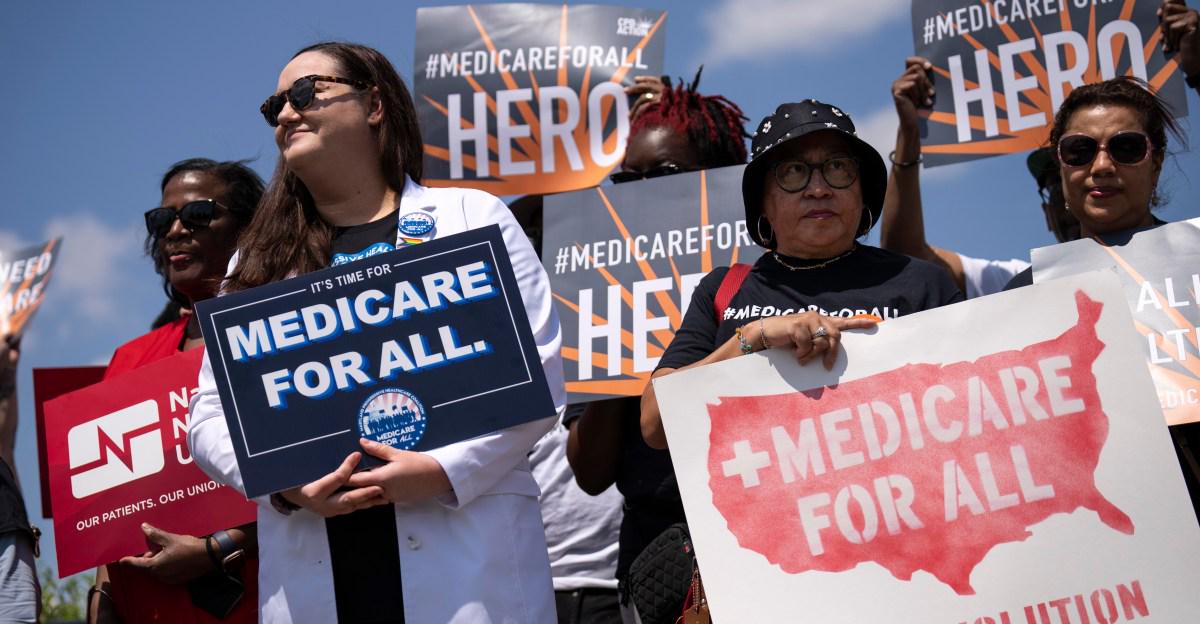
The premise here is that the healthcare debate in 2028 may be different and less volatile vs 2020 because democrats may converge on a compromise by expanding public insurance, mainly Medicare, without ending or eliminating private insurance.
She cites that Michigan Senate candidate Abdul El-Sayed “is campaigning for US Senate on a version that would let people keep their private health insurance, a potentially major shift”, but that’s not quite what he nor his website has stated.
Per his campaign website: I will fight to expand Medicare to cover all necessary healthcare, including vision, dental, and hearing, and extend it to every single American from cradle to grave without premiums, copays, or deductibles. Medicare should be automatic, for everyone, and accepted everywhere. Medicare for All does not have to ban additional private insurance through unions or employers, although Medicare for All should make those choices redundant and unnecessary.
He says M4A doesn’t have to ban “additional” private insurance but that it should be made redundant and unnecessary. Is this really interpreted to mean that private plans with duplicate coverage would be allowed or is does he mean supplemental coverage? Supplemental coverage vs keeping duplicate coverage are two different things.
We’ve also acknowledged that people don’t quite understand that Medicare for all or single payer means losing your private coverage rather than having the option to keep it. Additionally when people learn that a single-payer system means losing private coverage, support drops as 70 percent of people indicate they’d rather keep their private coverage.
I don’t think Medicare for All proponents have acknowledged several issues.
-
67 percent of American workers are on self-funded insurance plans that can be highly customized and transparent for the plan sponsor and depending on the employer, very generous compared to the ACA.
-
Unions are divided and not sold on Medicare for All. They view their healthcare as a hard won, earned benefit and M4A could threaten a strong negotiating power for them.
-
Passing M4A means needing 60 votes to invoke cloture or ending the filibuster which has its own risks. A lot of ACA improvements can instead pass via budget reconciliation needing only 51 votes.
There are already “single-payer” proposals that exist which put large employers in play or pay positions by letting them keep offering insurance or pay a payroll tax to the government if they stop so it can fund the public system. The point is, if you truly want single payer to take over, or at least have public insurance cover the majority of Americans, you shouldn’t eliminate employer sponsored insurance immediately.
Posted by ChillnShill
3 Comments
Submission statement: this article is relevant to the sub as we have debated the efficacy of Medicare for all vs iterations on the ACA. The upcoming midterms and eventual democratic primary will be a large testing ground for the direction we ultimately go on healthcare reform.
just throw more money at scare healthcare resources. that will definitely fix the problem.
not enough money, just print more!
Medicare also pays way less to a hospital, a doctor, etc…
It’s not some magical button for cheaper care. They do it by cutting costs to the providers
Also you have to pay a premium every month for Medicare just like every other insurance so that part of his promise is inaccurate already
Finally, we have a special Medicare tax on every paycheck. Is that going to rise when you put new people on it and by how much.
Edit: also why are people so obsessed with Medicare. It’s been a total shit show throughout development. It had zero drug coverage until GWB passed legislation after which it was still horrible (donut hole) and wasn’t fixed until Obama fixed it in ACA