
Paywall free version: https://archive.fo/Oytc5
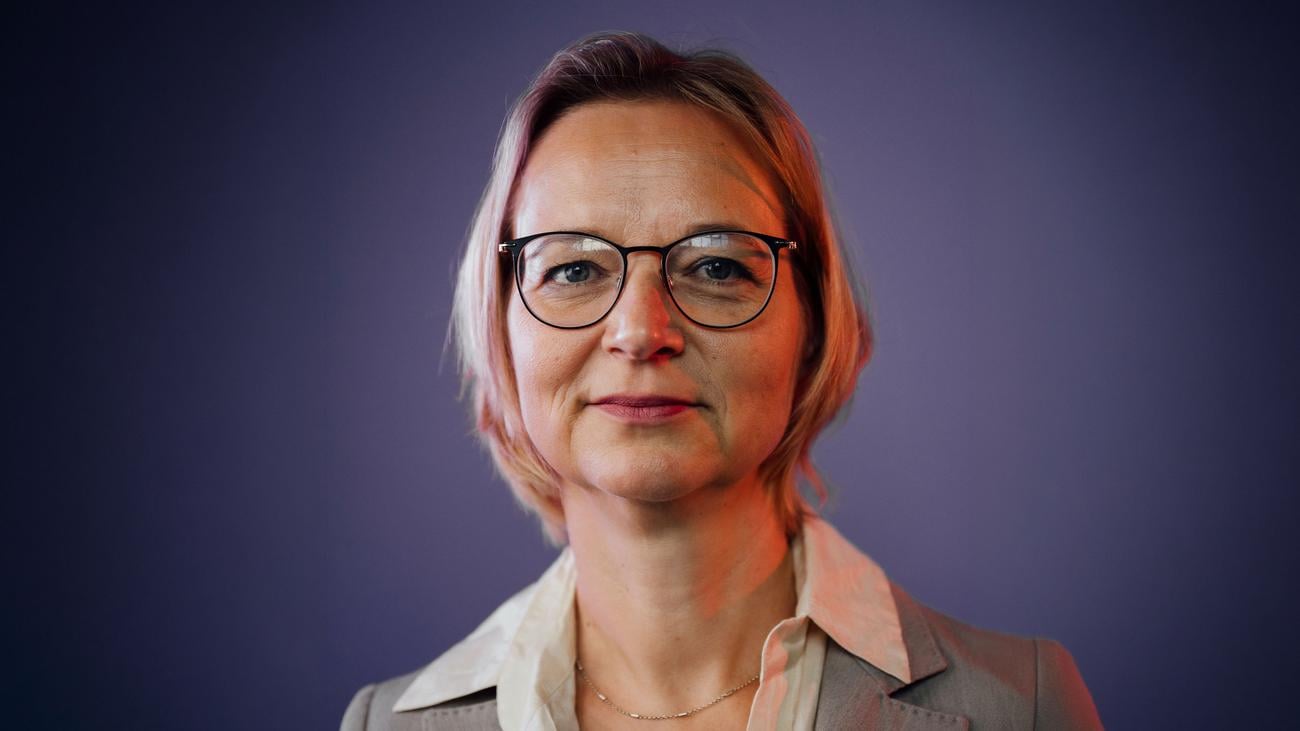
Katja Wolf, the Thuringia leader of the BSW, says the party's founder is courting the AfD only out of desperation. However, she adds that helping the far right gain power is wrong.
One might expect Katja Wolf to appear nervous. For days, the Deputy Minister-President and state chair of the BSW has been facing fierce criticism from her party’s national leadership. They are not only preparing for a policy shift that would bring the party closer to the AfD but are also demanding that Wolf end her cooperation with the "blackberry coalition" currently governing Thuringia. Yet, far from it. Before the interview begins at the Erfurt Ministry of Finance, Wolf mentions a song she has been listening to a lot lately: "Der Kampf geht weiter" (The Struggle Goes On) by Ton Steine Scherben. And she adds that she is in quite a good mood.
DIE ZEIT: Ms. Wolf, do you sometimes miss the cozy days when you were still the mayor of Eisenach?
Katja Wolf: It wasn’t cozy. I would warn against underestimating local politics. Back then, I bore responsibility for an entire city. That task is no less significant than leading the Thuringian Ministry of Finance here in Erfurt.
ZEIT: But surely you weren’t subjected to such harsh attacks in Eisenach as you are now from your fellow party member Sahra Wagenknecht?
Wolf: They were different back then, but no less harsh. I once had to survive a recall procedure in the city council initiated by the NPD. The vote was held by secret ballot; I won in the end, but I received more votes against me than the NPD had seats. That was no walk in the park, either. That was when I learned that in conflicts like that, you need people to support you. You can’t win on your own.
ZEIT: The dispute between you and Ms. Wagenknecht regarding the direction of the BSW has actually been simmering for two years now.
Wolf: Well, in reality, it began even before the state election in September 2024. That was when I first sensed that the party leadership in Berlin had a strong interest in pulling the strings here in Thuringia.
ZEIT: Just a few months earlier, at the start of 2024, you had decided to switch from the Left Party to the newly founded BSW. What exactly was the agreement between you and Wagenknecht at the time?
Wolf: Our understanding was clear: My priority was to be able to assume responsibility within a stable state government and to prevent Björn Höcke of the AfD from becoming Minister-President of Thuringia. And we succeeded in that. During the election campaign, Ms. Wagenknecht even spoke of me as a candidate for Minister-President. Our willingness to take on responsibility was therefore evident. The goal was not to go into opposition.
ZEIT: After the election, Wagenknecht changed her mind; she became critical of participating in government coalitions in Saxony, Thuringia, and Brandenburg.
Wolf: I could understand that to some extent. But unfortunately, it very quickly ceased to be about what was best for those three federal states—and became solely about the future of her life’s project. After all, the BSW bore—and still bears—her name.
ZEIT: Today, the BSW is fighting against irrelevance. Nationally, the party is polling at around three percent, and its chances of entering the state parliaments of Saxony-Anhalt and Mecklenburg-Western Pomerania are considered uncertain. Now, Wagenknecht has announced that she would not prevent the AfD’s lead candidate, Ulrich Siegmund, from becoming Minister-President of Saxony-Anhalt in a potential third round of voting—by choosing to abstain.
Wolf: Of course, it is right to set one’s own agenda and fight for visibility during an election campaign. But by moving closer to the AfD, Sahra Wagenknecht has crossed a line. She isn’t just aligning herself with the far right on policy issues; she is positioning herself as a potential partner for them in power. Yet the AfD is not merely a party that happens to harbor a few individual extremists. It is not the "lesser evil"—even when compared to a CDU state premier—but rather highly dangerous in many respects. The AfD does not pursue policies for ordinary people; instead, it acts in a racist and misogynistic manner. For the BSW, there can be no fraternizing with the AfD.
ZEIT: Wagenknecht, on the other hand, has repeatedly stated recently that the "firewall" policy has failed. How do you explain this stance? And didn't you know—or at least suspect—this when you joined the BSW?
Wolf: No. And I am not going to speculate about Sahra Wagenknecht’s state of mind. But she was, of course, deeply disappointed that the party so narrowly missed entering the Bundestag. Now, she is fighting desperately for visibility.
"Revoking the doctoral title is a diversionary tactic."
ZEIT: The BSW federal leadership is calling on your Thuringia state branch to withdraw its confidence in the incumbent Minister-President, Mario Voigt (CDU). Why have you decided against doing so?
Wolf: Wagenknecht is using Thuringia’s political fate to score campaign points for Saxony-Anhalt and Mecklenburg-Western Pomerania. The federal executive board’s resolution—which came about largely at her initiative—clearly demands that we oust Mario Voigt from office. The plan is then to dissolve our state government in its current form and elect a government of experts that would operate with shifting majorities. That includes the AfD and would mean that the stability established here by the "blackberry coalition" would be a thing of the past.
ZEIT: Chemnitz University of Technology revoked Voigt’s doctoral degree due to academic misconduct. There was a time when people resigned over such matters. Why do you stand by him?
Wolf: The bitter reality is that the move to strip him of his doctorate is a diversionary tactic. The real aim is to destroy the state government. The expert report accusing Voigt of plagiarism in his dissertation was paid for by the AfD parliamentary group in the Thuringian state parliament and is part of a campaign. I can understand why Mr. Voigt is taking legal action against this. It is his right to do so, and as long as the process is ongoing, the outcome remains open.
ZEIT: However, the BSW is now set to hold a special party conference to discuss once again whether your party will actually remain part of the state government.
Wolf: I also believe it is important for us to discuss this question. And I am convinced that if I explain to our members at the special conference what withdrawing from the government and ushering in an expert government would entail, they will act in the best interests of the state. That cannot be the right path for Thuringia; an expert government would no longer be a conventional minority government, but rather a dangerous technocratic administration. Elected representatives would be absolved of their responsibilities, while a minister-president whom the people did not elect could appoint the ministers instead. That is what our state constitution stipulates. I would consider such a decoupling undemocratic. Moreover, this model would essentially shift things in the direction of the AfD. We must not allow a scenario involving this mix of technocracy, predictable cuts to social services, and a lurch to the right.
ZEIT: Proponents of the proposal argue that this model could demystify the AfD.
Wolf: That is far too cavalier an attitude. I do not want the AfD in power. Their state election manifesto in Saxony-Anhalt—like the one in Thuringia—is unequivocal: it calls for the destruction of public broadcasting and seeks to exert ideological influence over academia, culture, and civil society. Regarding migration, it would lead to a fracturing of society. This policy is in no way fair to people with low and middle incomes; all calculations show this.
ZEIT: Yet the AfD has steadily grown despite the "firewall." Today, it stands at around 40 percent in all the East German federal states. From your perspective, what still speaks in favor of a firewall?
Wolf: I also consider the term "firewall" to be wrong and inwardly reject it, because it has become an ideological buzzword used in political combat. It implies that the democratic rules of the game should be altered so that the AfD can be kept out without political debate. However, a truly resilient democracy ought to be structured in such a way that we engage with the substance of the AfD’s positions, rather than ideologically dictating to people what is right and wrong.
ZEIT: Do you have an example of that?
Wolf: For me, it wouldn’t be a problem to elect an AfD member as a vice-president of the Thuringian state parliament, provided the AfD nominated someone suitable for the role. The recent candidates either had criminal records or held clearly right-wing extremist views. It is also conceivable for AfD members to chair committees. A resilient democracy must be able to tolerate AfD motions being referred to committees and, where appropriate, even securing a majority.
ZEIT: That is your standard answer to this question. Where do you see any genuinely sound ideas coming from the AfD?
Wolf: In reality, the AfD does everything it can to perpetuate its narrative of victimhood. They nominate candidates who are effectively unelectable, or they try to force our hand by simply copying proposals from our own election manifesto. I find that too cheap a tactic. In practice, we are still waiting for a motion that we can actually get behind.
ZEIT: But how do you explain the AfD’s growth, including here in Thuringia?
Wolf: A great deal of trust in politics has been lost in the East over the decades. That process began shortly after reunification. At the time, a feeling emerged that people were being left to cope with their problems alone. Then came Hartz IV and the refugee crisis; later, Russia’s war of aggression against Ukraine drove up inflation and energy prices. Regaining that trust is incredibly difficult and takes time, because political processes move slowly. The initiatives we launch today won’t be felt for a few years yet.
ZEIT: So you’re saying you understand why people vote for the AfD?
Wolf: Let’s just say I can understand why people are disillusioned with politics. Democratic parties often lack an understanding of the East. You can see that in the federal government’s current pension reform, for instance. It is right for the minister-presidents of the eastern states to take a clear stand together on this issue and point out that the so-called "retirement at 63" is important for the East and that 45 years of work are sufficient. The East needs to show such self-confidence regarding these matters.
ZEIT: We’ve looked at the polls in Thuringia. Since the "Blackberry coalition" took office, none of the parties have lost much support—except for the BSW. It has seen its election result more than cut in half, dropping from just under 16 percent to seven percent today. Could it be that you’ve lost many supporters to the AfD? Is Wagenknecht right about that?
Wolf: I want the BSW to be the alternative to the "Alternative." I want to offer a political option to people who no longer believe that politicians care about their problems. We know from post-election surveys that our supporters previously tended to lean toward The Left party. We’ve lost some of them—including to the AfD. But that’s because parties plagued by infighting quickly lose trust. We had momentum in 2024, but we didn’t capitalize on it sufficiently at the federal level to clearly articulate what we actually stand for.
ZEIT: Sahra Wagenknecht, on the other hand, accuses you of damaging the BSW’s core identity with your pragmatic political approach.
Wolf: I remain convinced by the BSW’s founding consensus. It was based on four clear pillars: peace, social justice, economic common sense, and a diversity of opinion. We are the party of the ordinary working person—the "little guy," as I like to say. We focus on solving problems for these people that they cannot solve themselves—ensuring that kindergartens function, buses run reliably, and children receive the education they deserve in school.
ZEIT: What would you actually do if the BSW were to enable Ulrich Siegmund to become Minister-President of Saxony-Anhalt by abstaining in the third round of voting?
Wolf: I consider that inconceivable. It would be a total breach of taboo. In any case, I would raise my voice from Thuringia and fight to ensure that doesn’t happen.
ZEIT: Do you want to warn the people of Saxony-Anhalt about your own party? Wolf: I warn against my party recklessly helping the AfD come to power. That would be the opposite of the socially just policies I stand for.
ZEIT: Would you leave the BSW if it actually came to that?
Wolf: I am not asking myself that question, because I assume it won't come to that.
ZEIT: So you are banking on your own party’s failure.
Wolf: No, I am banking on its good sense. And I am hoping for an uprising of decent people.
Translated by Google Translate, mistakes are my own.
Posted by IHateTrains123
2 Comments
!ping Germany
„The Death of Stalin“ ahh infighting, classic.
Real shame we have no Jason Isaacs level actor