
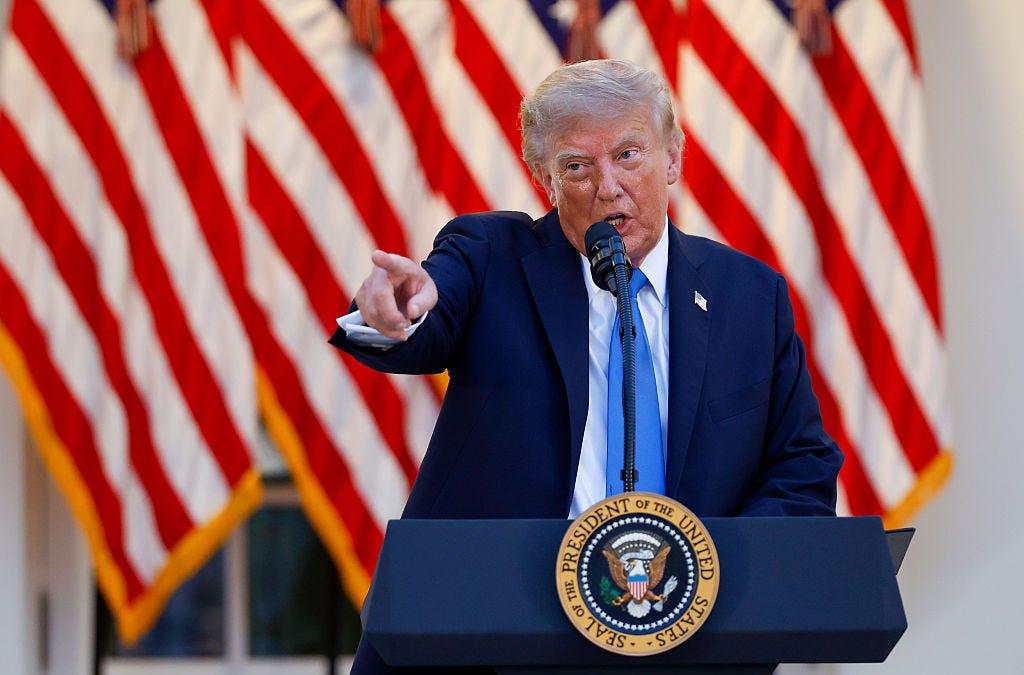
Donald Trump’s misjudgment of Iran has specific causes, including the wanton destruction of the normal policy process under his administration. U.S. history, however, is replete with examples of serious misjudgments of our adversaries. Sometimes, they appeared to us to be ten feet tall, while at other times we were oblivious to their real strengths.
Assessing relative strength is difficult because what matters often goes beyond official statistics and objectively measurable indicators. For example, over several decades during the Cold War, successive editions of Paul Samuelson’s famous Economics textbook included the same chart showing Soviet output growing at roughly twice the American rate, albeit from a lower base. This overtaking, which Samuelson confidently expected some time between 1984 and 1997, never quite materialized. Yet, the graph kept being reprinted anyway. Even the intelligence community took the USSR’s output statistics at face value—this at a time when the Soviet Union was embroiled in a deep economic stagnation, retrospectively recognized as the worst growth record in the world.
Ahead of Russia’s full-scale invasion of Ukraine, meanwhile, the polite Western consensus held that Kyiv stood no chance in a confrontation with a much larger enemy—an analysis that ignored the magnitude of Russian waste, corruption, and theft. In national income statistics, a dollar is a dollar. But while Russian GDP doubled between 2000 and 2023, from $780 billion to $1.5 trillion in 2015 dollars, this growth reflected commodity windfalls siphoned into corrupt schemes rather than sustained productivity gains, and eventually gave way to chronic stagnation, starting around 2012.
Meanwhile, few would dispute that China’s economic takeoff was real and enormous, from roughly $1 trillion of real GDP in 1990 to $16 trillion in 2022, though a lot of uncertainty remains about the reliability of Chinese income figures. One perceptive study, for example, uses satellite data on nighttime light growth, which is tightly related to economic growth, and finds that China (and India) likely grew more slowly between 1993 and 2013 than official statistics suggest.
What matters more than raw output is much harder to measure: institutional quality and resilience. Both at home and in “net assessments” of our adversaries, we should try to understand how well our societies and theirs are governed, and what incentives key actors in our political and economic life face, as these tend to determine the long-term success and failure of geopolitical contests.
In my new book, Unshackled, I discuss at length the work of Stefan Possony, a largely forgotten Cold War thinker who initially made his mark in the 1930s, debunking the ideas of Nazi theorists preparing for the next war. A command-and-control, autarkic economy stands no chance of fighting a modern, economically and industrially intensive war, Possony argued. Only a country with a sufficiently large stock of productive capital, embedded in an international division of labor, will have the strategic depth needed to sustain a large-scale conflict.
Capital is a stockpile of labor, which will be in short supply during a major war. Anything that detracts from accumulating productive capital, including tariffs and other economic distortions, thus puts the economy on a weaker footing ahead of the conflict. What is more, Possony argued, wars are inherently unpredictable—meaning that flexible market economies that can adapt quickly to realities on the ground enjoy a natural advantage over top-down industrial systems.
The danger of underestimating your opponent is obvious. The practical risk of exaggerating an adversary, for instance by accepting their headline economic figures instead of evaluating the intrinsic strength of their institutions, is no less real, and it boils down to imitation. Convince yourself that Beijing’s model is winning and you will start copying it. From heavy-handed industrial policy in pursuit of an illusion of self-sufficiency, through barriers to trade and investment, to an immigration policy that treats foreign talent with suspicion, the effort to defeat the autocrats at their own game will not succeed. Rather, it will undo the foundations of what makes America—and the collective West—strong.
That reflex has a mirror image at home. If headline output could hide Soviet rot for decades, it can hide American rot too, and it does. The United States has not run out of money, engineers, or ambition; by the top-line numbers it remains the envy of the developed world. But it is safe to say that something has gone awfully wrong with our politics, political culture, and the policymaking process—and that that decline will have downstream effects on other areas of life.
Unshackled points at the American paralysis, from our expensive and slow-moving defense-industrial base to our chronic NIMBYism and vetocracy, which paralyze infrastructure, energy, and housing projects. In the 1930s, the Golden Gate Bridge was completed in under four and a half years, ahead of schedule and under budget; California’s high-speed rail, in development for 30 years, has yet to carry a passenger.
Then there is the inward turn taken by the United States—most visibly in its trade relations, where U.S. allies are being treated worse than our adversaries. Yet, the parochialism goes beyond just trade in goods, undermining America’s key geopolitical strength as the go-to place for international talent.
The National Science Foundation saw its fellowship cohort halved in 2025. Over a few weeks in April 2025, roughly 1,500 foreign students had their visas revoked, typically for opaque reasons, in a country that in a typical year earns more from education services sold abroad than from natural gas and oil.
The fact that the West’s share of the global economy is down relative to the Cold War era does not doom us to failure. It does, however, reduce the room for error and drive home the imperative of economic growth. Our institutional capacity to keep making the economic pie bigger, through domestic economic dynamism, openness to immigration, and by being able to lead coalitions of likeminded nations, is our most important strategic asset—and it is one that is currently being destroyed for no good reason.
“Unless our intrinsic strength improves, defection will inevitably thin the ranks of our allies. Our own strength is the most convincing pledge of loyalty to friends and allies,” Possony and his co-authors wrote in 1961. Their warning rings even truer 65 years later, as the United States is doing its utmost both to undercut the sources of its intrinsic strength and to chase away partners most eager to work with it.
Until that basic fact changes, we are on track to lose the new Cold War with China—and, as Iran’s example shows, many smaller fights with much less capable adversaries. If that happens, it will not be because our enemies are suddenly ten feet tall. It will be because we are unable, or unwilling, to stand up straight.
Posted by AmericanPurposeMag
5 Comments
Trump. The reason is trump.
You could probably just delete the entire text except for the first two words and still have a correct answer to the question posed
TLDR
NIMBYism
Weakening scientific and pool of talent
Alienating allies
Because he’s a fucking Russian asset, that’s why.
Is it cuz we have evil morons in charge? Cuz that’s probably part of it