
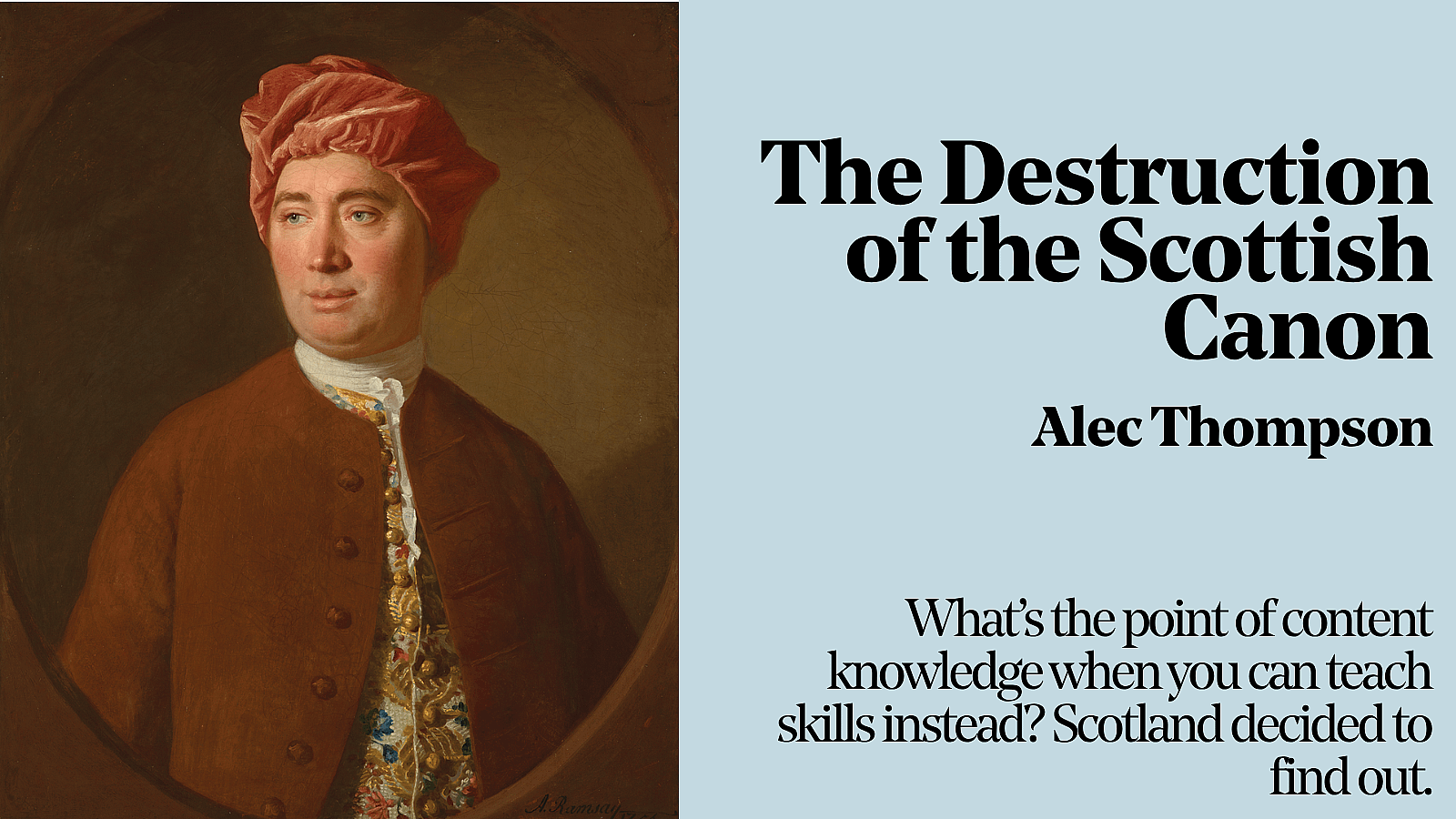
In the 60s, Scotland had a highly sophisticated literary school system, lovingly called The Great Tradition. For years, Scottish students scored in the top of international tests. A 1905 report noted:
In… seven months, [a] 13-year-old working class girl, and the teacher, revised with the whole class The Merchant of Venice, A Christmas Carol, The Talisman, The Abbott, Enoch Arden, Evangeline.
Examinations may include prompts such as:
Without war, the world would deteriorate into materialism. Somehow or other, courage of the ancient, heroic, physical kind has been preserved in the modern character. Is war the only condition that calls it forth? (SLC 1912)
But reforms in 1990s and 2010s eliminated this remarkable rigor. Such "knowledge-based" curriculums were considered elitist, increasing inequality. So began a switch to a modularized skills-based curriculum that lacked nearly the same depth of the old system. Scores tumbled.
All this and more is covered by the article. Curious what r/neoliberal thinks about this.
Posted by DudleyFluffles
3 Comments
I found the global trend the author describes interesting to hear about, but I wish he’d discussed potential reasons why the change in curriculums might have led to decreasing test scores
England currently has some of the best PISA scores in the world, one of the only main Tory successes since 2010 has been Michael Gove’s reforms. I think we just have to conceed that the tried and true methods just work.
I think it’s interesting to note that, somewhat counter-intuitively, the most *g*-loaded cognitive domain is vocabulary. One might expect that just knowing the meanings of words, as opposed to say, solving matrix induction problems, would be associated with crystalized knowledge and not fluid intelligence, but it’s not. It’s not clear what way the causation actually lies here, but its entirely possible that the kind of verbal-heavy rich content that had been studied previously is actually especially stimulating for the mind, or something.