
High-level talks in Beijing between the European Union and China ended on Friday with an unexpected agreement that could pull the two sides back from an imminent trade war.
The most notable feature of the agreement involved what both sides described as an understanding on China’s exports of hybrid electric-gasoline cars, which have been among the most contentious points of tension between the two sides.
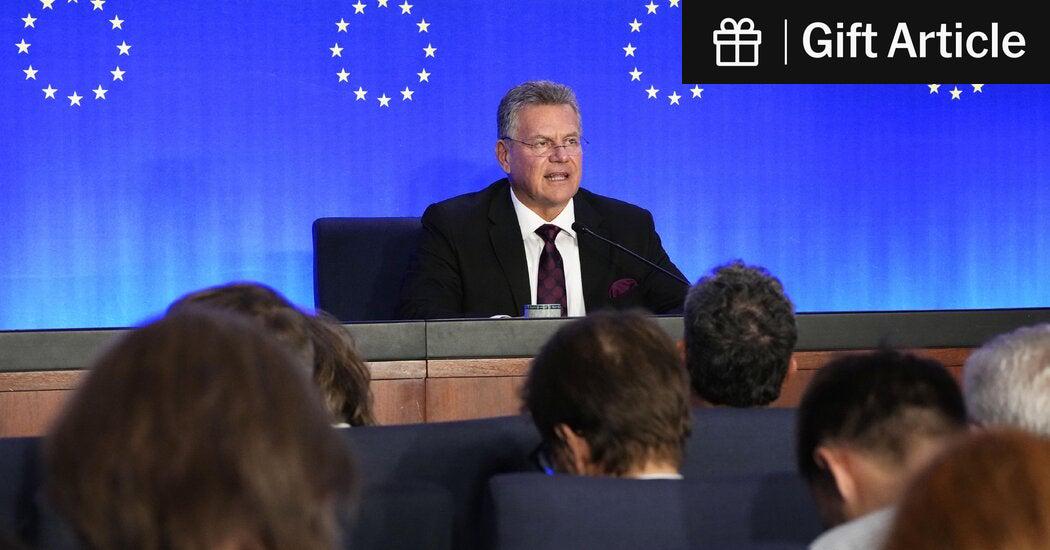
Maros Sefcovic, the trade commissioner of the 27-nation bloc, said that the understanding could lead to China’s halving the number of hybrid gasoline-electric cars that it sends to the European Union in the next four years. Neither side made any mention of any tariffs on those cars, which China has resolutely opposed.
China’s Ministry of Commerce said in a separate statement that the two sides had “reached an understanding on trade in hybrid vehicles in a manner consistent with World Trade Organization rules.” Complying with those rules makes it difficult for Europe to impose tariffs quickly. Tariffs also make it hard to know how many cars will continue to arrive from China, but Mr. Sefcovic said that the understanding would achieve specific reductions in imported cars.
The compromise described by Mr. Sefcovic appeared to address the European Union’s need for immediate caps on the number of cars imported from China. It also addressed China’s need for an arrangement that would limit the often fierce competition among Chinese automakers in the European market, which has contributed to the Chinese automakers’ heavy losses.
The agreement on hybrid cars appeared to have a strong resemblance to the two sides’ deal in 2013 for China to reduce the number of solar panels that it shipped each year to Europe, while Europe agreed to forgo its previous plans for tariffs on those shipments. This allowed Chinese solar panel makers to raise prices sharply in Europe for their limited supply of solar panels, producing large profits for Chinese solar panel manufacturers that previously were losing money.
The Chinese manufacturers invested those profits in more research and new factories, and now produce almost all of the world’s solar panels.
China’s exports of plug-in hybrids to Europe have rapidly gained market share there and have contributed to Volkswagen’s recent plans to cut another 50,000 workers by the end of the decade, bringing its total reduction in work force to 100,000.
The European Union imposed tariffs of 7.8 to 35.3 percent on Chinese electric cars two years ago, on top of the region’s usual 10 percent tariff on imported cars. But the E.U. did not impose extra tariffs then on plug-in hybrids.
China’s exports of plug-in hybrids have soared to almost 200,000 a month, from fewer than 10,000 a month, in just three years. Many are going to Europe.
China has strenuously opposed the extra tariffs on its electric cars that the European Union imposed to limit the number of these cars that are imported from China. Beijing has called for the tariffs on electric cars to be replaced instead with limits on the number of cars shipped.
This would allow Chinese electric car manufacturers to raise prices and improve profitability — the arrangement for hybrid gasoline-electric cars that is now emerging.
Asked on Friday whether the understanding on hybrid cars resembled the solar panel deal, Mr. Sefcovic said that current circumstances were different and that Europe needed immediate action on hybrid cars. “The public opinion and the leaders really expect very fast action from our side,” he said.
China has contended that unilateral tariffs are a violation of W.T.O. trade rules, which Beijing and the European Union are both still committed to uphold. By contrast, the Trump administration has repeatedly taken unilateral actions in defiance of W.T.O. norms. President Trump’s trade advisers have contended that China has a government-guided economy that does not follow the free market principles on which the W.T.O. was founded.
China’s Commerce Ministry dangled several carrots for the European Union to reach a compromise with Beijing. Mr. Sefcovic said that China had agreed to reduce tariffs on imports of European goods in categories like auto parts, olive oil and footwear with an annual value of almost 4 billion euros.
This will save European exporters about 125 million euros a year in duties on their shipments to China, he said.
A joint statement issued by China and the European Union was less specific, saying that “both sides will continue, within the framework of W.T.O. rules, to explore the possibility of tariff reductions or elimination for certain goods.”
Some issues were left unresolved, notably whether the European Union will also forgo plans to require that key components of technologies like electric cars and wind turbines be made in Europe. Also unresolved is whether the European Union will proceed with anti-subsidy tariffs on wind turbines. Mr. Sefcovic said that more talks were planned early next year.
Mr. Sefcovic was scheduled to return to Brussels on Saturday and brief officials ahead of a meeting of European presidents and prime ministers next week.
The first item on the agenda for the meeting of Europe’s leaders is how to handle the region’s weakening economic competitiveness — and trade with China is a central issue. European leaders have been warning of a hollowing out of Europe’s industrial base because of surging imports of manufactured goods from China.
Time is on China’s side, with each passing month producing more than $30 billion in trade surplus for China and further weakening European competitors of Chinese manufacturers.
China’s Commerce Ministry said in its statement that China would continue approving exports of rare earths and rare earth magnets to Europe. China has restricted exports of rare earths and rare earth magnets since April 2025 and has threatened further restrictions if Europe takes action against China’s exports.
The ministry also said that Europe had agreed to help resolve disputes over its export controls.
Under pressure from President Joseph R. Biden Jr. and now President Trump, European companies have avoided selling to China the latest equipment used to make semiconductors with potential military applications. Beijing officials have contended that one of the fastest ways for Europe to narrow somewhat its trade deficit with China would be to sell the most advanced equipment regardless of American objections.
Europe has also been preparing legislation to impose a made-in-Europe requirement for important components of products like electric cars or wind turbines. China used to have similar requirements for cars and wind turbines, but repealed them after years of complaints from Europe and other trading partners. Beijing now contends that Europe should not adopt such rules, which would force Chinese companies to invest in factories in Europe instead of exporting from factories at home, where their costs are often lower.
The Chinese statement said that China and the European Union had “agreed to explore investment cooperation to foster mutual economic development and to discuss future-oriented cooperation.”
Posted by John3262005
1 Comment
Looks like an agreement was made that addressed immediate issues like the EU’s need for caps on number of cars imported from China and China’s need for an agreement that would limit the competition between Chinese car makers
However, it still leaves behind issues like key components and anti subsidy tariffs for another day
Still, at least another trade war didn’t happen