
Shekhar gupta with his own take at the problems facing modi these past couple of months and how modi is shaping up
Posted by ewatta200
Shekhar gupta with his own take at the problems facing modi these past couple of months and how modi is shaping up
Posted by ewatta200
3 Comments
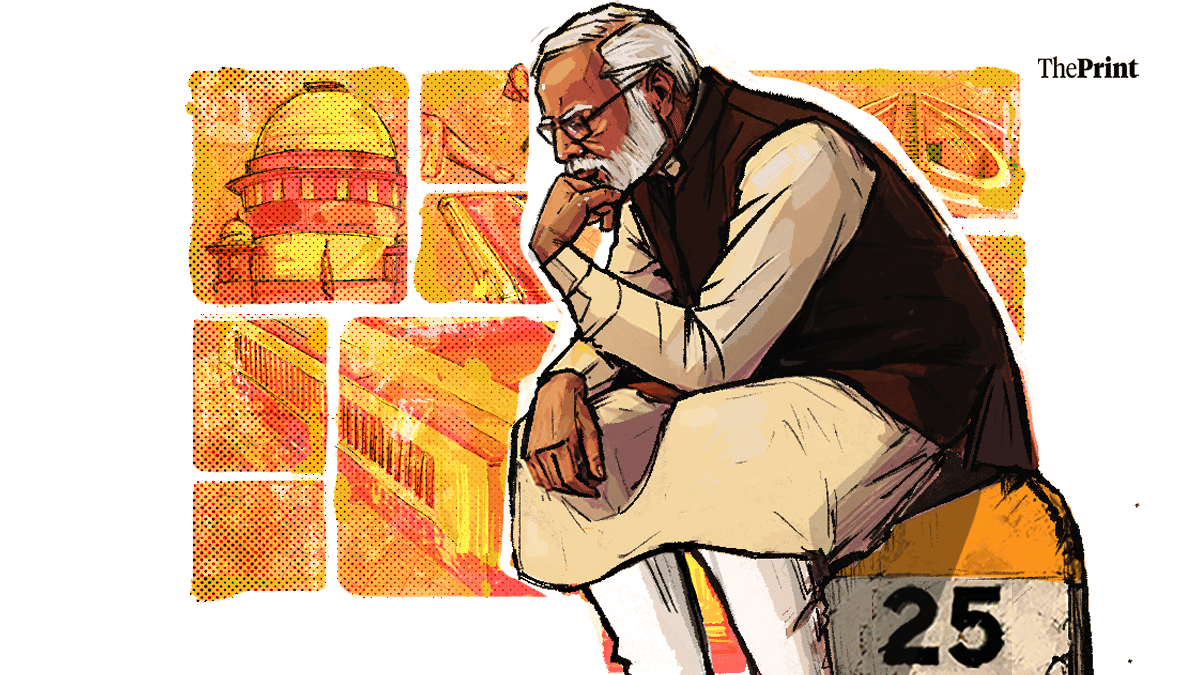
his is the season for looking at Narendra Modi’s 25 years in power, and beyond. His followers are celebrating. His Cabinet has passed a resolution praising him. Critics, of course, are dissecting his quarter century in public life, not with a scalpel but with a scythe.
[](https://vdo.ai/contact?utm_medium=video&utm_term=theprint.in&utm_source=vdoai_logo)
[](https://theprint.in/india/second-fishing-boat-worker-dies-after-suspected-gas-inhalation-in-keralam/3068229/?utm_campaign=theprint&utm_medium=ticker&utm_source=vdoai_ticker)
It’s also the season for people, especially journalists, telling their ‘when I first met Modi’ stories. I’ll hold on to mine for another day. Let’s not risk diluting today’s serious argument.
Two weeks ago, we noted[ in a National Interest column](https://theprint.in/national-interest/since-indira-govts-drift-in-the-3rd-year-modi-must-restore-ec-image-to-get-out-of-it/3053831/) that, for any incumbent in India, the third year of a term is the toughest. This is when challenges build up, fatigue sets in, aspiring successors sharpen the knives. We also said that the last of these doesn’t apply to Modi. Nobody in his party would even dare to whisper the ‘S’ word.
The third year of Modi’s third term, however, is beset with all of the other challenges. His tired and incomplete Cabinet is struggling. His chief ministers—barring Yogi Adityanath, Devendra Fadnavis and Himanta Biswa Sarma—aren’t up to the multiple challenges.
Having used the ancient editorial privilege of ‘tabooing’ a word, and listing the cliched “narrative” under it, I then can’t use it. The fact is, this market of popular opinion is rife with competing, contradictory notions. The Modi-BJP story is still the most significant. It just isn’t as dominant as before. Multiple headwinds make the turbulence Modi is battling as he steps into his 26th year in public office.
This has brought the classical, and so far all-conquering, three-point Modi proposition under the greatest pressure since 2014. The three points are: hard, Hinduised nationalism; ever-expanding welfare, distributed efficiently, with minimal friction or leakage; and visible construction of physical infrastructure. All of this without significant overhang of corruption.
The Modi proposition survives. It’s just that several other factors have now emerged. And we aren’t just talking about the rebellion of an irreverential, ageist, educated and mostly not-impoverished Gen-Z. What makes this period of crisis unprecedented in Modi’s prime ministership is the convergence of these factors. Like the Shakespearean “when sorrows come, they come not single spies, but in battalions”.
In isolation, each of these factors may look small. But they become formidable when the big picture comes together. As the great management guru late C.K. Prahalad used to say, ‘weak signals add up to a big change’. He elaborated this in his oft-quoted 1995 paper “Weak Signals Versus Strong Paradigms” (*Sage Journals*). Prahalad himself summarised it thus: “Taken one at a time, these signals don’t add up to much. But taken together, they present a picture of a country (or industry) in dramatic transformation.”
Is this what Modi is confronted with now? Let’s check out some facts.
Oh lord this thread is gonna get heated isn’t it
ECI really a took a huge credibility hit. It’s a very bad sign for democracy