
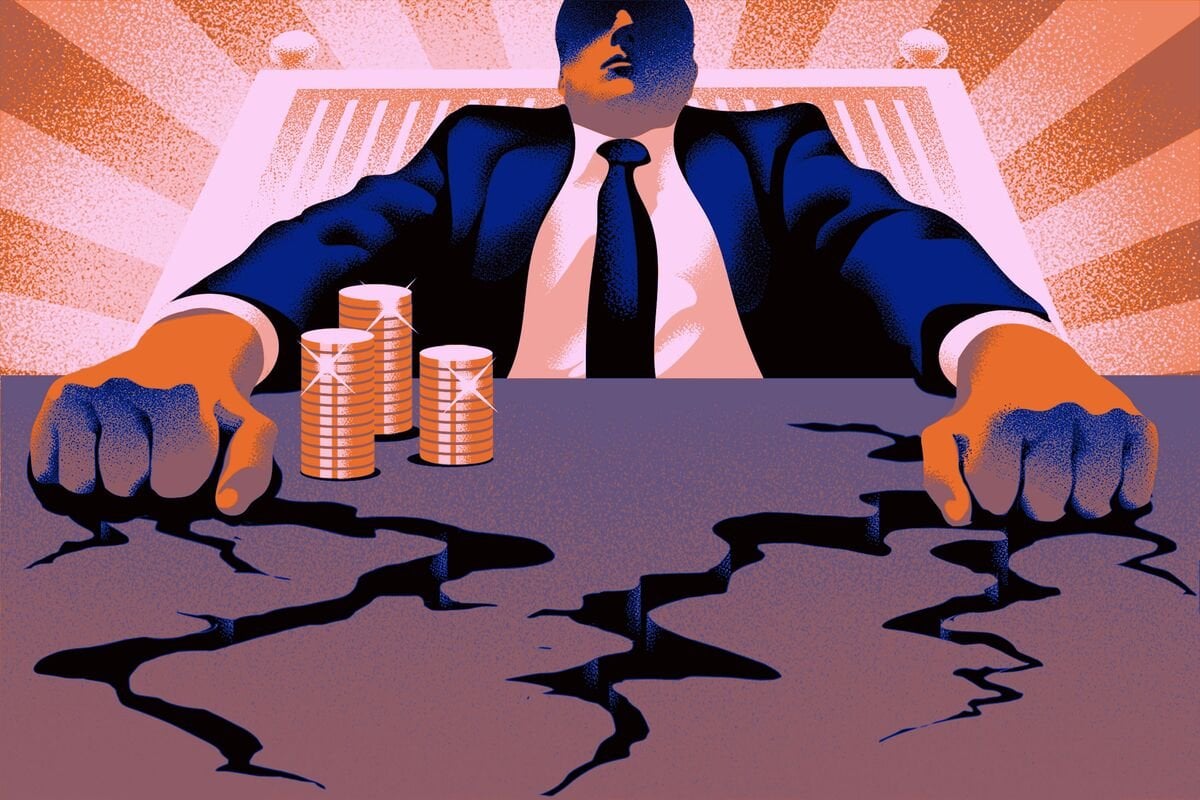
Once an economy switches from rules to deals, it’s hard to go back | “Governance by deal-making creates the sort of uncertainty and restricted economic opportunities that are harmful to investment and growth; only the well-connected need apply”
Posted by ONETRILLIONAMERICANS
2 Comments
While technically true, I have no doubt the capital class can easily do a chuck schumer and pretend everything is the same, and thus we won’t see the effects until a few decades later
I really enjoyed this article about how economies in countries with personalist rule are more likely to be corrupt and why:
# Personalist rule means rolling the dice
> Citizens of democracies like to point out that personalistic political systems, like the one Mao built and handed to Deng, don’t deliver for their citizens as well as democracies do. In the long run, on average, there’s a good chance that’s true. But the full story is more subtle. History is filled with examples where personalistic systems seemed to work for a time. China under Deng, Singapore under Lee Kuan Yew, South Korea under Park Chung-hee, Indonesia under Suharto: There are numerous instances of rapid economic growth under autocratic and personalistic leadership.
> What the evidence does suggest is that personalistic political systems lead to greater variance in economic performance. In other words, the range of possible outcomes is much wider.
> In a 2005 study, economists Benjamin Jones and Benjamin Olken analyzed the impact of political leaders on economic performance by examining what happened in the wake of leaders’ unexpected deaths. There were no systematic post-death economic shifts following the demise of democratically elected leaders — like, say, when Lyndon B. Johnson took over for John F. Kennedy. But the death of autocrats led to marked shifts in economic outcomes: sometimes for the better, and sometimes for the worse.
> When leaders operate without constraints, you have to rely on luck: Maybe you will get a “good” leader who manages things well. But maybe you will get a bad one. Without constraints, the range of possibilities widens and the risk of disaster increases. History suggests that good luck in leaders seldom lasts.
# The Unconstrained Presidency
> While many US presidents have attempted to claim new powers for the executive branch, the Trump administration is unique in the extent to which they are pursuing maximalist claims of executive authority, as well as in their willingness to challenge the courts.
> It’s also notable how little pushback Trump has received from the legislative branch. A Republican-controlled Congress has largely abdicated from any sort of institutional dissent with respect to the president’s initiatives. (The judicial branch has been active, in comparison, but with limited enforcement ability.)
> The Trump administration’s agenda, paired with the lack of pushback, amounts to a bid to concentrate enormous power in the hands of the president and his hand-picked agents (like Musk). If successful, this would replace a system of rules-based policymaking across branches with decision-making by a few individuals.
# From Rules to Deals
> The US government is now veering toward the kind of governing-by-deal-making that Trump, who fancies himself as a master of the “Art of the Deal,” no doubt favors. This contrasts with the rule of law, whereby legislation is passed and regulations are put in place through a well-ordered policymaking process.
> The first risk of a personalistic system, as we’ve described, is that too much hinges on who’s in charge. The second is that no single leader, no matter how smart, can make every decision. When rule of law is replaced by the whims of the executive, that process filters down into everyday decision-making.
> This was documented by researchers Mary Hallward-Driemeier and Lant Pritchett in a study titled, “How Business is Done in the Developing World: Deals versus Rules.” While there’s politicking and uncertainty in every government, they describe why low-income countries are more likely to be dominated by deals.
> Take a business trying to get a construction permit, one example from their paper. A rules-based approach would specify what’s required upfront. The process might be quick or slow, but it would be predictable. There is no negotiation and therefore less room for outright corruption.
> But in many low-income countries, the authors observe, the rules are merely the starting point for a negotiation — deal-making, if you will — between business and government. Governance by deal-making creates the sort of uncertainty and restricted economic opportunities that are harmful to investment and growth; only the well-connected need apply.
> This is an inevitable consequence of an unconstrained leader at the top. The lack of clear rules filters down, empowering thousands of dictatorial bureaucrats along the way. Where the rule of law languishes, corruption flourishes.
# The Cost of the Deal
> In an unpredictable, deal-making world, the way to succeed is to curry favor with whomever is in power. That may not sound so bad if deal-making replaces, say, stifling taxation — it could even be the grease that makes the wheel of business spin faster. But the evidence suggests this is not the case: A 2000 study by economist Shang-Jin Wei argued that corruption discourages investment far more than taxes, precisely because it is fickle and uncertain.
> The political implications are even more concerning than the economics. By placing extraordinary powers in just a few individuals at the top of the deal-making hierarchy, they can become very difficult to dislodge. When success in business requires being in the good graces of those in power, leaders can wield that authority to build their own political resources — from campaign money to favorable media coverage.
> Furthermore, unchecked authority raises the stakes of holding on to power. If whoever gets to be in charge can push whatever policies they like, and if it is hard to remove them once they get there, each side of the political aisle will see electoral losses as existential challenges. This, in turn, can add yet more political instability. And as the late, great economist Alberto Alesina documented with colleagues in the mid-1990s, political instability is associated with lower economic growth.