
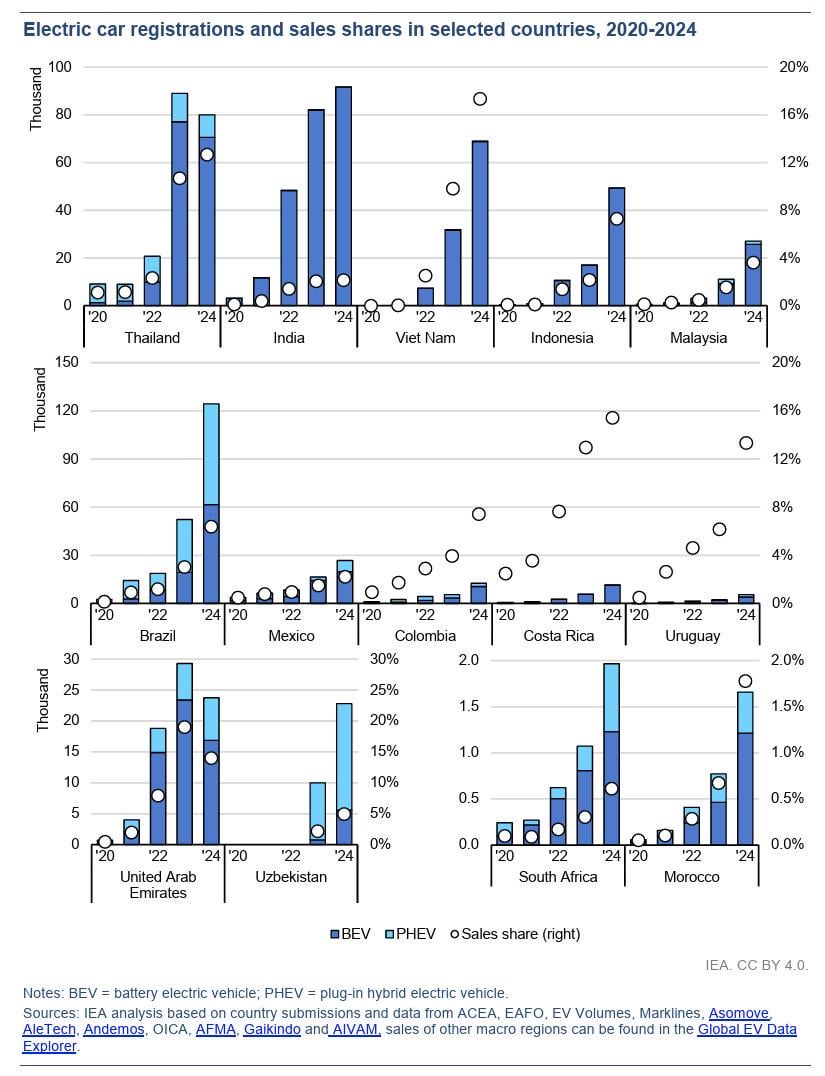
EV sales are booming in developing countries, with some already overtaking the US in EV market share for new cars (10% in 2024)
Posted by Straight_Ad2258
EV sales are booming in developing countries, with some already overtaking the US in EV market share for new cars (10% in 2024)
Posted by Straight_Ad2258
4 Comments
source: [https://rmi.org/record-global-ev-growth-five-takeaways-from-recent-electric-vehicle-outlooks/](https://rmi.org/record-global-ev-growth-five-takeaways-from-recent-electric-vehicle-outlooks/)
What I find really interesting is countries like Morocco and South Africa. These aren’t oil rich countries, and in fact many countries in Africa have to provide subsidies for petrol/diesel so people can afford it, which ruins budgets. You’d think they’d be jumping for joy to get off that
I mean South Africa has a literal mafia inside their power grid selling off parts, but Morocco? Exactly the type of country you’d exist to jump on that
Also Uzbekistan is funny; literally just BYD opening a factory in country kicked the whole thing into gear. Post Soviet car companies are TRASH
developing countries overtaking US and even EU in EV market share got to be one of the most stunning developments in history of technology
it was always assumed that EVs will first take over developed countries car markets, and then trickle down to middle income and low income countries over decades
instead, it seems to be that countries at all income levels are joining the EV race, catching up and even overtaking developed countries
i think there are couple factors that drive it
* oil imports cost the same for most countries, thus developing countries without domestic oil production have a huge interest to promote electrification to cut the oil import bill
* electricity is far cheaper in developing countries, due to lower infrastructure and network costs( in turn ,due to lower labor costs), use of coal and cheap solar( those countries are usually sunnier, and thus they get more solar output per each GW off generation
* many developing countries put huge import tarrifs on cars to stimulate domestic production. this makes it so that an EV maker like Togg in Turkey or Vinfast in Vietnam can sell cars at competitive prices even without subsidies. Since EVs are very easy to make, companies can set up production rather quickly
I think it would be interesting to add car ownership. Vietnam for example has very low car ownership.