> Beijing officials call China’s current deflationary malaise “involution” — a destructive cycle of intense, self-destroying business competition sparked by excess capacity. Yang Zhifeng calls it something else: “twisted.” The 24-year-old, who has drifted from one low-paid job to another since graduating college two years ago, is living in the reality of a deflationary spiral that Bloomberg News analysis found looks even deeper than what the official numbers show. Using data on almost 70 everyday products and services from multiple sources, our analysis showed prices dropped more sharply than the headline Consumer Price Index indicates, especially for goods that ordinary consumers buy. Yang is both a victim and perpetrator of this vicious cycle. With job prospects looking slim, she opened a cocktail stall earlier this year but had to close it just three months later. Discounts from food delivery platforms — drinks for a few cents — wiped her out. She considered going back to a factory job she had five years ago that used to pay about $980 a month, only to find it now pays just $630. With money tight, she spends $1.40 or less on meals, bought from the same delivery platforms that forced her out of competition. “I’ve become the kind of consumer who destroys businesses like mine,” she said.
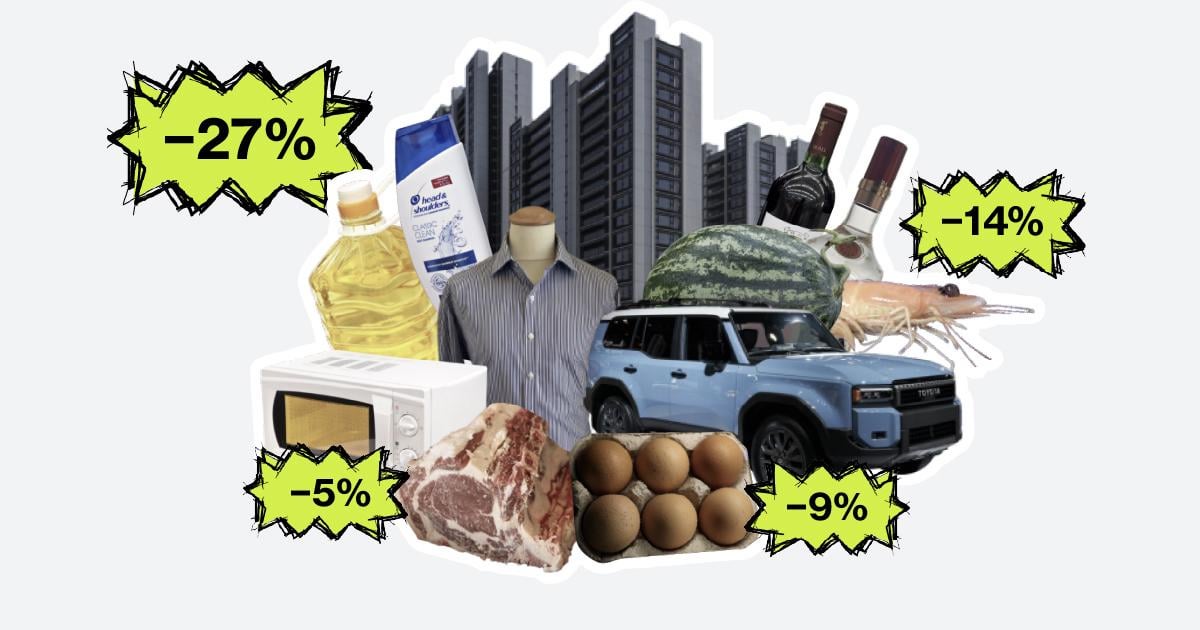
> She’s just one example out of many where falling prices are hurting the bottom line. Deflation signals a lopsided economy where supply dwarfs demand. That hurts companies, which in turn hurts workers. As consumption weakens, businesses spend less, economic activity slows, debt burdens rise, which then causes more deflation. The downward loop, known in economics as a deflationary spiral, feeds on itself once entrenched. The trend also carries global implications: cheap Chinese exports can depress prices abroad, strain relations with trading partners, and create knock-on effects for multinational companies. Global institutions are sounding the alarm, with the International Monetary Fund projecting that consumer inflation in China will average zero this year — the second-lowest of nearly 200 economies it tracks. The Bank of Korea warned in July that China could export deflation to its trading partners. And the problem could be even worse than they realize. China’s official CPI figure — which offers limited item-level detail and is shaped by a complex methodology that isn’t transparent — has hovered around zero since early 2023, occasionally posting modest gains. Bloomberg News analyzed prices for dozens of products in 36 major cities as well as both official and private data across China to get a sense of how much cheaper things have become on the ground. We looked at items in categories like food, groceries, consumer goods and services, as well as housing costs and price changes for specific car brands.
> The analysis showed that prices are unmistakably dropping. Among 67 items tracked by Bloomberg News, prices on 51 dropped over the last two years. Economists say that official inflation measures may only partially capture the reality. Many key data series have quietly disappeared in recent years, and the National Bureau of Statistics has never offered the sort of granularity more common in the US, where inflation trackers go so far as to publish the cost of indoor plants and pet food. An outdated methodology for calculating rent changes in the CPI likely led to its overestimation in the past few years. The NBS didn’t reply to a faxed request for comment. Meanwhile, a broader gauge that includes upstream sectors, known as the GDP deflator, has been steadily declining for 10 quarters, indicating that deflation is much more entrenched in the industrial sector. Polysilicon, the raw material for solar panels, saw prices drop to less than a fifth of its peak in 2022. Prices for steel rebar, widely used in construction, fell to an eight-year low in May.
> The drop in prices is already weighing on company results. Recent filings show losses widening and margins thinning, with many firms citing weak demand and price wars. A Bloomberg News analysis of around 6,000 publicly traded Chinese companies points to a broad-based strain. Beijing is showing signs of understanding the danger. In July, officials led by President Xi Jinping cracked down on excessive competition and price wars. That move briefly stirred optimism over a return of inflation among financial market traders, lifting raw material prices. But with consumers depressed and the property market still mired in a slump, economists doubt the government’s measures will move the needle. “The deflationary problem is systemic,” said Logan Wright, a partner and director of China markets research at Rhodium Group, a research firm that has done alternative estimates of China’s GDP growth. “We wouldn’t expect that this is a short term data anomaly or anything that can be easily cyclically resolved or just fixed with a certain policy stimulus.” There’s also a clear political calculation shaping Beijing’s response. China’s government has been historically wary of sparking inflation or simply handing cash to households like some other countries. At the same time, the party is eager to maintain momentum in tech breakthroughs and other “strategic industries.” The result: measured interventions instead of bold reflation, with authorities reluctant to take the foot off the accelerator in sectors like AI, semiconductors and green energy.
Choice_Ad2121 on
Schumpeter would have loved China. Creative destruction taken to imaginary proportions with the price aspect added to it. And it is indeed destroying capitalism.
WAGRAMWAGRAM on
>With job prospects looking slim, she opened a cocktail stall earlier this year but had to close it just three months later
Oh no, will the state think of the poor inefficient entrepreneur?
>The Bank of Korea warned in July that China could export deflation to its trading partners. And the problem could be even worse than they realize. China’s official CPI figure — which offers limited item-level detail and is shaped by a complex methodology that isn’t transparent — has hovered around zero since early 2023, occasionally posting modest gains.
Maybe the CCP has realized they were subsidizing Western consumption and decided they were against it
>The squeeze doesn’t stop at the balance sheet. It reaches paychecks — and loops back into demand. Erica Chen is a prime example. The 40-year old used to earn more than about $333,000 a year after taxes at a major internet firm in Beijing while her husband drew a comfortable salary from an international tech company. A second home brought in rental income while their 7-year-old son attended international school. Their three nannies kept the household humming — one to cook, one to clean, one to watch the child — a domestic payroll exceeding $49,000 a year.

3 Comments
> Beijing officials call China’s current deflationary malaise “involution” — a destructive cycle of intense, self-destroying business competition sparked by excess capacity. Yang Zhifeng calls it something else: “twisted.” The 24-year-old, who has drifted from one low-paid job to another since graduating college two years ago, is living in the reality of a deflationary spiral that Bloomberg News analysis found looks even deeper than what the official numbers show. Using data on almost 70 everyday products and services from multiple sources, our analysis showed prices dropped more sharply than the headline Consumer Price Index indicates, especially for goods that ordinary consumers buy. Yang is both a victim and perpetrator of this vicious cycle. With job prospects looking slim, she opened a cocktail stall earlier this year but had to close it just three months later. Discounts from food delivery platforms — drinks for a few cents — wiped her out. She considered going back to a factory job she had five years ago that used to pay about $980 a month, only to find it now pays just $630. With money tight, she spends $1.40 or less on meals, bought from the same delivery platforms that forced her out of competition. “I’ve become the kind of consumer who destroys businesses like mine,” she said.
> She’s just one example out of many where falling prices are hurting the bottom line. Deflation signals a lopsided economy where supply dwarfs demand. That hurts companies, which in turn hurts workers. As consumption weakens, businesses spend less, economic activity slows, debt burdens rise, which then causes more deflation. The downward loop, known in economics as a deflationary spiral, feeds on itself once entrenched. The trend also carries global implications: cheap Chinese exports can depress prices abroad, strain relations with trading partners, and create knock-on effects for multinational companies. Global institutions are sounding the alarm, with the International Monetary Fund projecting that consumer inflation in China will average zero this year — the second-lowest of nearly 200 economies it tracks. The Bank of Korea warned in July that China could export deflation to its trading partners. And the problem could be even worse than they realize. China’s official CPI figure — which offers limited item-level detail and is shaped by a complex methodology that isn’t transparent — has hovered around zero since early 2023, occasionally posting modest gains. Bloomberg News analyzed prices for dozens of products in 36 major cities as well as both official and private data across China to get a sense of how much cheaper things have become on the ground. We looked at items in categories like food, groceries, consumer goods and services, as well as housing costs and price changes for specific car brands.
> The analysis showed that prices are unmistakably dropping. Among 67 items tracked by Bloomberg News, prices on 51 dropped over the last two years. Economists say that official inflation measures may only partially capture the reality. Many key data series have quietly disappeared in recent years, and the National Bureau of Statistics has never offered the sort of granularity more common in the US, where inflation trackers go so far as to publish the cost of indoor plants and pet food. An outdated methodology for calculating rent changes in the CPI likely led to its overestimation in the past few years. The NBS didn’t reply to a faxed request for comment. Meanwhile, a broader gauge that includes upstream sectors, known as the GDP deflator, has been steadily declining for 10 quarters, indicating that deflation is much more entrenched in the industrial sector. Polysilicon, the raw material for solar panels, saw prices drop to less than a fifth of its peak in 2022. Prices for steel rebar, widely used in construction, fell to an eight-year low in May.
> The drop in prices is already weighing on company results. Recent filings show losses widening and margins thinning, with many firms citing weak demand and price wars. A Bloomberg News analysis of around 6,000 publicly traded Chinese companies points to a broad-based strain. Beijing is showing signs of understanding the danger. In July, officials led by President Xi Jinping cracked down on excessive competition and price wars. That move briefly stirred optimism over a return of inflation among financial market traders, lifting raw material prices. But with consumers depressed and the property market still mired in a slump, economists doubt the government’s measures will move the needle. “The deflationary problem is systemic,” said Logan Wright, a partner and director of China markets research at Rhodium Group, a research firm that has done alternative estimates of China’s GDP growth. “We wouldn’t expect that this is a short term data anomaly or anything that can be easily cyclically resolved or just fixed with a certain policy stimulus.” There’s also a clear political calculation shaping Beijing’s response. China’s government has been historically wary of sparking inflation or simply handing cash to households like some other countries. At the same time, the party is eager to maintain momentum in tech breakthroughs and other “strategic industries.” The result: measured interventions instead of bold reflation, with authorities reluctant to take the foot off the accelerator in sectors like AI, semiconductors and green energy.
Schumpeter would have loved China. Creative destruction taken to imaginary proportions with the price aspect added to it. And it is indeed destroying capitalism.
>With job prospects looking slim, she opened a cocktail stall earlier this year but had to close it just three months later
Oh no, will the state think of the poor inefficient entrepreneur?
>The Bank of Korea warned in July that China could export deflation to its trading partners. And the problem could be even worse than they realize. China’s official CPI figure — which offers limited item-level detail and is shaped by a complex methodology that isn’t transparent — has hovered around zero since early 2023, occasionally posting modest gains.
Maybe the CCP has realized they were subsidizing Western consumption and decided they were against it
>The squeeze doesn’t stop at the balance sheet. It reaches paychecks — and loops back into demand. Erica Chen is a prime example. The 40-year old used to earn more than about $333,000 a year after taxes at a major internet firm in Beijing while her husband drew a comfortable salary from an international tech company. A second home brought in rental income while their 7-year-old son attended international school. Their three nannies kept the household humming — one to cook, one to clean, one to watch the child — a domestic payroll exceeding $49,000 a year.
poor 1%ers