
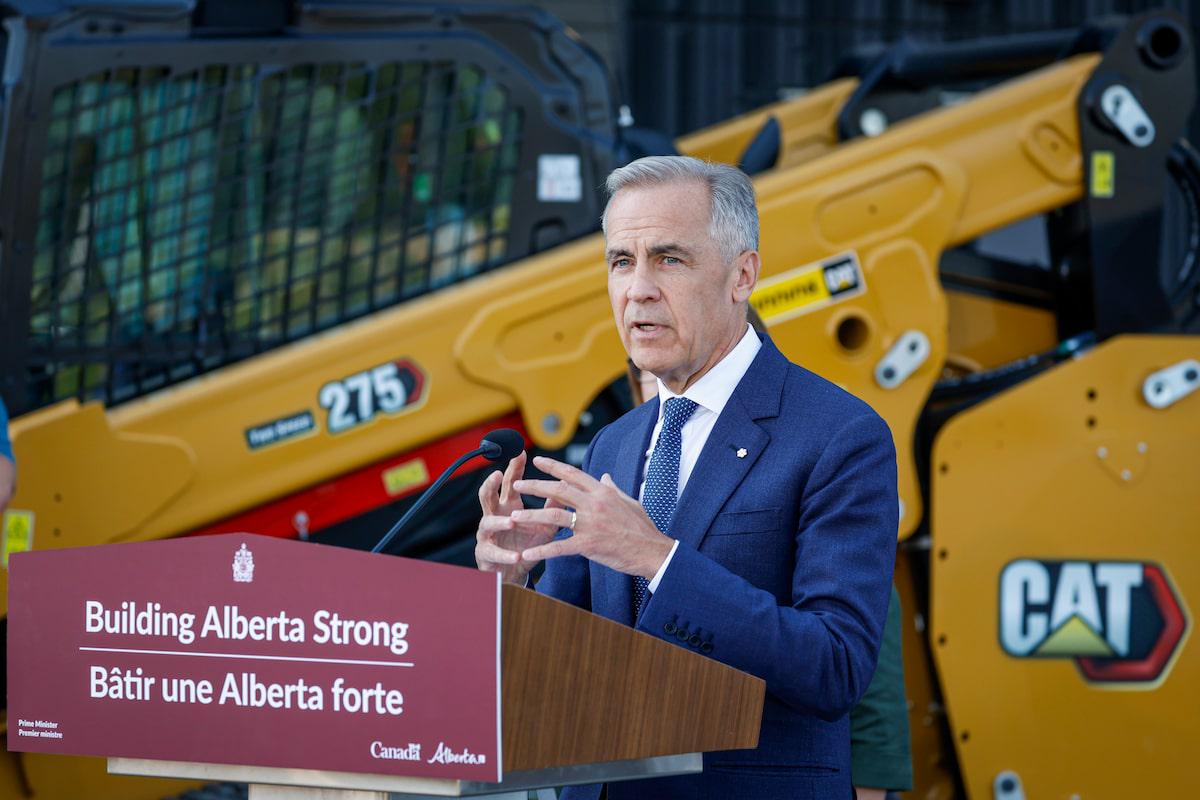
Prime Minister Mark Carney ruled out restricting Canada’s energy supply to the U.S. as a bargaining chip in trade talks aimed at getting President Donald Trump to end his trade war on the country.
Speaking to reporters in Red Deer, Alta., on Wednesday, Mr. Carney said “I don’t see the value” in putting energy, including Alberta’s oil, on the table in the negotiations.
“Being a reliable supplier is important. Canadians are reliable. Canadians can be trusted,” he said. “One of the biggest commodities, arguably the best, is trust. People trust us, and so, when you’re a supplier of a key commodity, key service, you’ve got to think really hard about not supplying.”
The move marks a divergence from the Prime Minister’s insistence last week that “everything is on the table” as Ottawa decides how to respond to the latest round of Mr. Trump’s tariffs, which are set to take effect on Aug. 19.
It also comes as Intergovernmental Affairs Minister Dominic LeBlanc and Janice Charette, Canada’s chief trade negotiator, are in Washington seeking to make progress on a deal that could forestall the tariffs.
The new round of levies would impose 50-per-cent duties on roughly US$20-billion of Canadian goods, from alcohol to electronics equipment. They would be in addition to tariffs Canada has faced since last year on steel, autos and aluminum, and a separate general duty on anything not traded under the United States-Mexico-Canada Agreement.
Mr. Carney also on Wednesday defended making concessions to the U.S. on the Gordie Howe International Bridge and Canadian content requirements for streamers.
He defended the decision to split toll revenues from the new bridge with the U.S., even though Canada paid the full cost of the span, as necessary to make sure it opened. “That’s being pragmatic and moving forward and we got a bridge that’s open,” he said.
The Prime Minister insisted that his government ordering the federal broadcast regulator to review a decision to impose a 15-per-cent charge on Netflix, Amazon Prime and other streamers – with the money going to support the creation of Canadian content – was about reducing household costs.
“Most Canadians have one or two or more of these streamers and its real money. This stuff adds up,” he said.
The Canadian content charge has been repeatedly cited by U.S. officials as a major irritant in trade talks.
The idea of curbing Canadian energy exports to gain leverage at the bargaining table has come up since Mr. Trump returned to office last year. In March, 2025, Ontario Premier Doug Ford announced a 25-per-cent surcharge on electricity exports to the U.S. but almost immediately backed down in the face of threats of tariffs on Canadian steel and aluminum. Mr. Trump ultimately imposed those metals tariffs months later anyway.
Oil and gas are a particularly vulnerable spot for the U.S. economy. Mr. Trump has so far exempted them from tariffs because the U.S. depends so heavily on Canadian imports.
The Prime Minister insisted that he would only sign a trade deal with the U.S. if he can get a good one and held open the possibility that there would be no agreement.
“We’re only going to accept a solution that works for Canadians,” he said. “We’re going to focus now on building towards an agreement, if an agreement is possible.”
Otherwise, he said, Canada has “lots of options” but he declined to get into details.
He did say, however, that part of the equation would be continuing to find other markets for Canadian goods.
“Everybody wants to do more with Canada, except the United States. Everyone wants to do more with Canada,” he said.
Posted by IHateTrains123
1 Comment
Furiously exhaling through my nose right now.