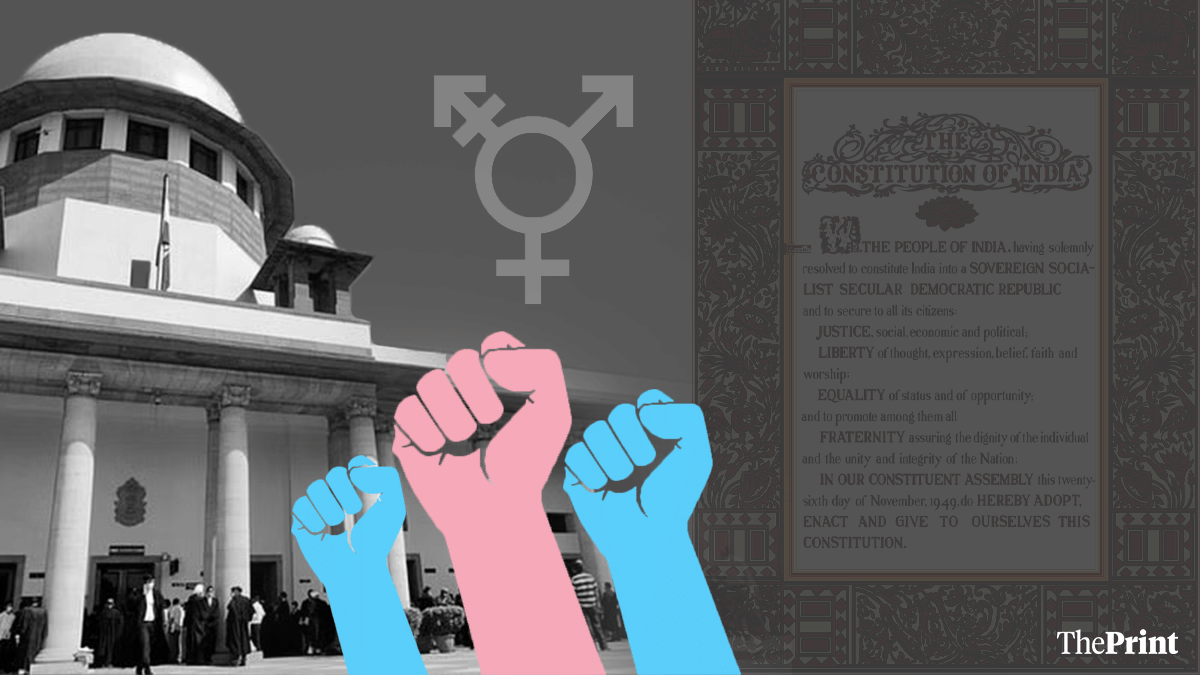
**New Delhi:** Nearly a decade after the Supreme Court’s landmark NALSA judgment and five years after Parliament enacted the Transgender Persons (Protection of Rights) Act, 2019, transgenders in India are still forced to knock on court doors for rights as basic as identification documents, access to welfare schemes, and protection from police abuse.
The National Legal Services Authority (NALSA) judgment affirmed the right of transgender persons to self-identify as male, female or third gender in 2014. Parliament enacted the Transgender Persons (Protection of Rights) Act, 2019 to operationalise this recognition through welfare measures, reservations, protection against discrimination and simplified identity documentation processes.
From Andhra Pradesh to Tamil Nadu, Kerala to Uttar Pradesh, the judiciary has repeatedly stepped in—often in individual petitions—to compel state authorities to carry out their fundamental duties, which are already mandated by the existing law.
These interventions, spread across high courts and the Supreme Court in recent months, underscore a widening gap: While courts are frequently accused of encroaching into legislative or executive domains, the reality reveals the opposite.
An eye on the recent trends show that courts are filling administrative vacuums because governments have failed to implement their own policies on transgender rights.
Implementation at the grassroots remains the State’s constitutional obligation, and courts are stepping in only when this obligation is ignored.
In view of the situation, the Supreme Court, in its Jane Kaushik verdict in October, constituted an expert committee under former Justice Asha Menon to draft a model Equal Opportunity Policy, identify gaps in the Act and propose measures for inclusive healthcare, protection and access to rights. Under Article 142, the court directed every state and UT to establish Transgender Welfare Boards and Protection Cells within three months.
Noting failures across states to even appoint nodal officers for issuing transgender identity cards, the court held that transgender persons were being “forced to litigate for basic entitlements” because governments had “repeatedly failed to operationalise statutory rights.”

1 Comment
**New Delhi:** Nearly a decade after the Supreme Court’s landmark NALSA judgment and five years after Parliament enacted the Transgender Persons (Protection of Rights) Act, 2019, transgenders in India are still forced to knock on court doors for rights as basic as identification documents, access to welfare schemes, and protection from police abuse.
The National Legal Services Authority (NALSA) judgment affirmed the right of transgender persons to self-identify as male, female or third gender in 2014. Parliament enacted the Transgender Persons (Protection of Rights) Act, 2019 to operationalise this recognition through welfare measures, reservations, protection against discrimination and simplified identity documentation processes.
[](https://vdo.ai/contact?utm_medium=video&utm_term=theprint.in&utm_source=vdoai_logo)
From Andhra Pradesh to Tamil Nadu, Kerala to Uttar Pradesh, the judiciary has repeatedly stepped in—often in individual petitions—to compel state authorities to carry out their fundamental duties, which are already mandated by the existing law.
These interventions, spread across high courts and the Supreme Court in recent months, underscore a widening gap: While courts are frequently accused of encroaching into legislative or executive domains, the reality reveals the opposite.
An eye on the recent trends show that courts are filling administrative vacuums because governments have failed to implement their own policies on transgender rights.
Implementation at the grassroots remains the State’s constitutional obligation, and courts are stepping in only when this obligation is ignored.
In view of the situation, the Supreme Court, in its Jane Kaushik verdict in October, constituted an expert committee under former Justice Asha Menon to draft a model Equal Opportunity Policy, identify gaps in the Act and propose measures for inclusive healthcare, protection and access to rights. Under Article 142, the court directed every state and UT to establish Transgender Welfare Boards and Protection Cells within three months.
Noting failures across states to even appoint nodal officers for issuing transgender identity cards, the court held that transgender persons were being “forced to litigate for basic entitlements” because governments had “repeatedly failed to operationalise statutory rights.”