
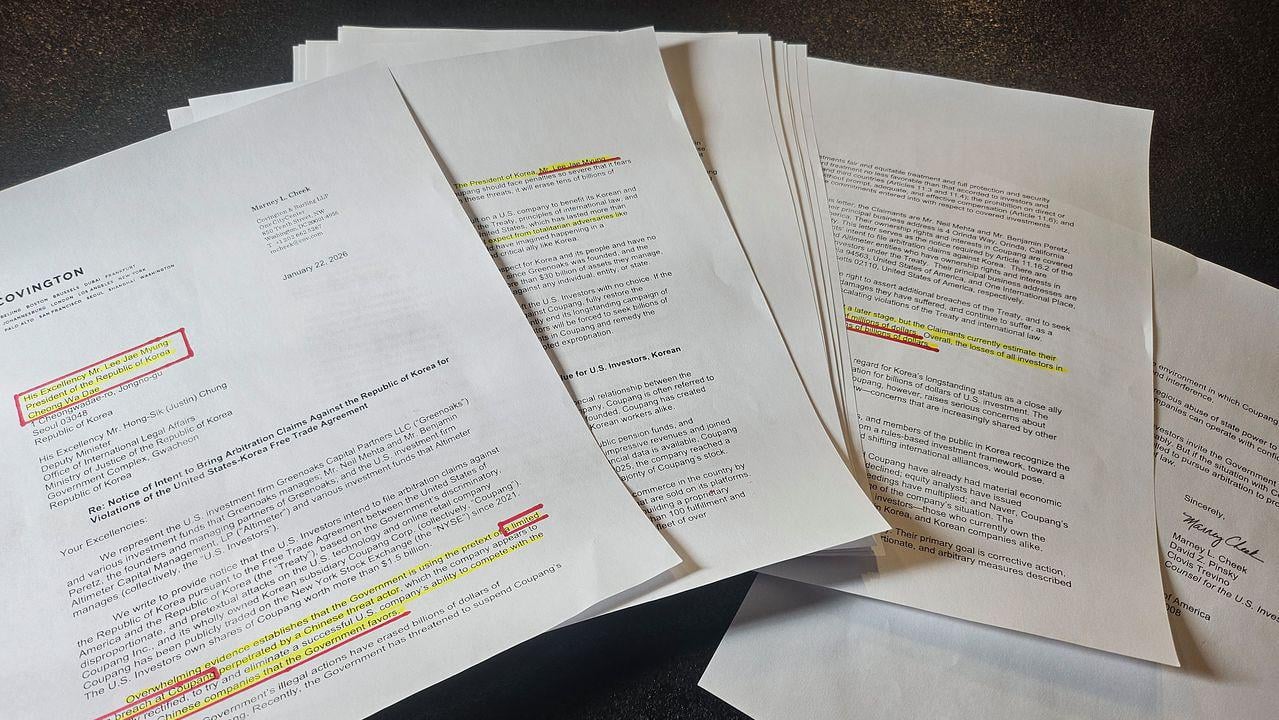
Two U.S. investment firms of Coupang, which caused a massive customer data breach, filed a petition on the 22nd (local time) requesting that the U.S. government investigate and take action, claiming that the South Korean government is discriminating against the U.S. company Coupang.
They characterized President Lee Jae-myung and the ruling Democratic Party as pro-China and anti-U.S., and claimed that the Korean government’s measures to investigate the truth behind Coupang’s data breach were an act of “weaponizing administrative power after it became clear that Coupang threatened the long-standing market dominance of Korean and Chinese competitors.”
The petition specifically named President Lee as the recipient and described the Korean government’s actions as “the kind of conduct one would expect only in totalitarian adversary states such as Venezuela or Russia.” The Trump administration recently used military force to capture Venezuelan President Nicolás Maduro.
According to documents obtained by JoongAng Ilbo, Coupang’s investors Greenoaks and Altimeter sent a “notice of intent to arbitrate” simultaneously to the U.S. Department of Justice and the South Korean government in preparation for initiating an Investor-State Dispute Settlement (ISDS) proceeding. The recipients listed in the notice were President Lee Jae-myung and Jung Hong-sik, Director-General of the Ministry of Justice’s International Legal Affairs Bureau.
According to documents obtained by JoongAng Ilbo, Coupang’s investors Greenoaks and Altimeter sent a “notice of intent to arbitrate” simultaneously to the U.S. Department of Justice and the South Korean government in preparation for initiating an Investor-State Dispute Settlement (ISDS) proceeding. The recipients listed in the notice were President Lee Jae-myung and Jung Hong-sik, Director-General of the Ministry of Justice’s International Legal Affairs Bureau.
Despite growing criticism that Coupang has failed to cooperate with the investigation into last November’s massive data breach, the investors instead signaled their intent to demand large-scale compensation from the Korean government. They again described the government’s investigation as something that “would only happen in places like Venezuela,” explicitly naming a country where U.S. troops were recently deployed to arrest a sitting president.
Coupang is a U.S. company whose Korean subsidiary is 100% owned by Coupang Inc., a U.S.-listed parent company. More than 70% of Coupang Inc.’s voting rights are held by U.S. citizen and board chairman Bom Kim. Neil Mehta, founder and partner of Greenoaks, is also a board member of Coupang Inc.
Coupang’s side labeled President Lee and the Democratic Party as “pro-U.S. and anti-China.” They stated that “President Lee referred to U.S. forces stationed in Korea as an ‘occupation army’ and criticized the U.S. for ‘maintaining Japan’s colonial rule,’” claiming that such remarks align with what they describe as the Democratic Party’s increasingly anti-American and pro-China stance.
They argued that President Lee’s election “marked the turning point at which Coupang’s survival became threatened.”
They further alleged that President Lee appointed individuals with ties to Coupang’s competitors—such as former Naver executive Han Sung-sook (Minister of SMEs and Startups), Choi Hwi-young (Minister of Culture, Sports and Tourism), and Ha Jung-woo (Senior Presidential Secretary for AI and Future Planning)—thereby creating pretexts to attack Coupang. They also claimed that the government exploited the data breach allegedly caused by a former Chinese employee residing in China as an opportunity to pursue an “illegal effort to destroy Coupang.”
They stated that calls for the National Assembly appearance of Chairman Kim Beom-seok, a U.S. citizen, amounted to “threats against Coupang’s existence and against Chairman Kim himself.” They further claimed that the government’s actions had “no legitimate purpose other than fundamentally disrupting Coupang’s operations to prevent it from effectively competing with Naver and Korean and Chinese rivals.”
Coupang also disputed the scale of the data breach, claiming—based on its own investigation—that only “3,000 cases” were involved, not 33.7 million. They asserted that while a (Chinese) threat actor accessed 33 million accounts, only about 3,000 data records were retained, that all data was later deleted, and that no data was ever transmitted to third parties.
Regarding Coupang’s expression of regret issued on the 28th of last month after ignoring domestic criticism, they claimed it was released “in response to the Korean government’s relentless offensive.” They emphasized that although there was a possibility of data leakage, no actual leakage occurred for 33 million users, and that Coupang provided each with a USD 34 voucher, totaling more than USD 1 billion.
They added that under Korean law, fines of up to 3% of a company’s average annual revenue over three years can be imposed for data breaches, meaning Coupang could face a fine exceeding USD 800 million (KRW 1.1 trillion), the largest in Korean history. They argued that compared to cases involving Korean and Chinese companies that caused far more serious harm, the response to Coupang is “punitive, disproportionate, and discriminatory.”
They concluded by signaling plans to demand astronomical compensation from the Korean government, stating that current damages amount to hundreds of millions of dollars and future investor losses could reach tens of billions of dollars.
Coupang’s move is widely interpreted as an attempt to turn the incident into an international trade dispute. Following the incident, Coupang has actively lobbied U.S. political and business circles. The petition to the U.S. Trade Representative (USTR) represents a different level of escalation from prior lobbying efforts.
The USTR must decide within 45 days whether to initiate an investigation, which could force direct involvement by the Trump administration, which has thus far refrained from direct intervention. If the U.S. government determines that U.S. corporate rights were violated, the USTR could retaliate against Korea through tariffs or other import restrictions.
Given that the Trump administration has already expressed concerns about Korea’s proposed Online Platform Act and the recently enacted Anti-Disinformation Law (amendment to the Information and Communications Network Act), there is speculation that broader Korean digital regulations could come under scrutiny.
\\\*\\\*However, while Coupang claims that Korea violated the Korea–U.S. FTA, critics point out that the agreement has effectively been rendered defunct by the Trump administration’s across-the-board reciprocal tariffs. As such, arguing an FTA violation under these circumstances is itself viewed as absurd\\\*\\\*.
Posted by Freewhale98
2 Comments
[Submission text]
1. Summary
U.S. investment firms Greenoaks and Altimeter, major investors in Coupang, have petitioned the U.S. government to investigate South Korea, alleging that the Korean government is politically targeting Coupang under the pretext of a large-scale customer data breach investigation. The investors argue that Seoul’s actions violate international law and the Korea–U.S. Free Trade Agreement, and have signaled plans to initiate Investor–State Dispute Settlement (ISDS) proceedings seeking billions of dollars in damages.
In their filings, the investors characterize President Lee Jae-myung and the ruling Democratic Party as pro-China and anti-American, liken South Korea’s regulatory actions to those of authoritarian states such as Venezuela, and claim the probe is intended to weaken a successful U.S. company in favor of Korean and Chinese competitors. They dispute the scale of the data breach, asserting that only a limited number of records were actually compromised despite the fact that the private information of 37 million Koreans were leaked.
2. How is this related to the sub
(1) What went wrong with contemporary trade relations
This case reflects a deeper structural problem in contemporary trade relations. Large U.S. technology firms and their investors increasingly react with hostility whenever foreign governments attempt to hold them legally accountable. Rather than engaging with regulatory scrutiny on its merits, they frame enforcement as political persecution.
The Trump administration’s willingness to adopt overtly ideological language, casting regulation as “anti-American,” “pro-China,” or “authoritarian”, functions as a tool to shield corporate interests from legal consequences abroad. This approach erodes established norms of international trade and dispute resolution, replacing rules-based governance with power-based retaliation and political coercion.
3. My opinion
Reading the petition submitted by Coupang and its investors was genuinely unsettling. What stood out was not merely the legal argument, but the degree of political radicalization embedded in the language. Routine regulatory enforcement by a foreign government is portrayed as existential oppression, while any refusal to grant special treatment is framed as evidence of authoritarianism.
When their commercial interests are challenged, these actors resort to ideologically charged buzzwords, “pro-China,” “totalitarian,” “communism,” “woke”, as rhetorical weapons. This is striking given that such language comes not from political activists, but from business elites claiming to defend free markets.
At its core, this reveals a deeply distorted expectation among Americans: that U.S. firms should enjoy immunity from foreign law, and that accountability itself constitutes discrimination.
The South Korean right runs on copium