
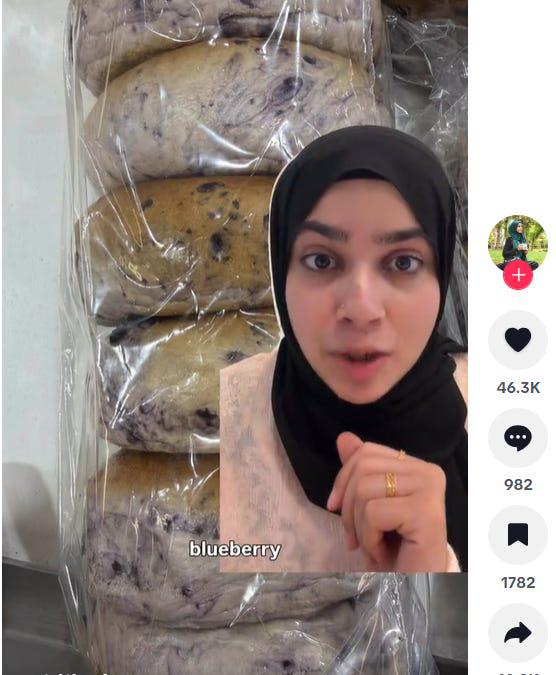
AKA "Why I'm Crashing Out About Simulated Blueberries"
This week I received a flood of DM’s asking me to review a video of a person being surprised and upset about “simulated blueberries” in a blueberry bagel product. You can watch the video here.
In the video, this person is shocked and alarmed that a package of bagels states that they use “simulated blueberries”, and the ingredients list doesn’t have any blueberries listed.
You might be like – WTF is a “simulated blueberry”, and unfortunately, “simulated blueberries” aren’t as cool they sound (this is not akin to the holographic meatloaf that Plankton ate). Instead, in the video, the person complains that there are no real blueberries in the item, and it’s all “simulated blueberries”: flavor pellets made out of a slurry of food dyes, palm oil, cornstarch, and corn syrup. After this video went viral, many people tagged me in this video and sent me separate DMs asking for an explanation. And it led me to one, cynical question –
**I’m sorry, but, do I really have to make a video to confirm that these are not real blueberries?**
The package explicitly claims they are simulated and not real. The ingredient label discloses all ingredients (and is upheld by a strict legal standard). There is literally nothing on here that could “trick” you into thinking these are blueberries. The word “simulated” comes before “blueberries”.
And yet, the person in the video is upset that food companies have been “lying” to us.
So before I launch into a cynical rant, let me provide some explanations:
**The Science of Simulated Blueberries**
To get the science out of the way, replacing berries with other ingredients is nothing new. Anyone who grew up in the muffin craze of the 2000s knows these imitation berries very well. Packaged breads like bagels, muffins, and frozen Eggo waffles commonly have these little pellets of flavor for two key reasons:
-
It’s cheaper. Have you seen how much a pint of raspberries costs? Even if you were to bring in frozen berries for cheaper, frozen storage costs $$$.
-
Food companies have small margins and want to make a fat profit
“Simulated berries” are less likely to have food safety issues than real blueberries.
Berries are like avocados in their fragility; you blink and your avocado turns brown, you look the other way and your entire pint of strawberries becomes moldy. If you’re storing berries at room temperature (especially in the application of a moist bagel/muffin), there’s a possibility that if the water activity is not low enough from adding more sugar/drying the berries out more, they will turn moldy.
This is especially true if they’re stored at room temperature/in a plastic bag where they can harbor more moisture. We’ve all seen bread get moldy after seeing condensation in the bag.
**Why Videos Like These Make Me Spiral**
In my time doing this weird combination of food science and media communication, I’ve noticed a strange paradox; the more you disclose on the label, the more people will be upset about it. And I see why there is uproar about this – real food should be made of real food. I think we all want a food system that is made of “real food”, but I’m also observant at how quickly outrage can be stirred up when everything is disclosed to a T.
This label has made it evident that this is not made of “real blueberries”. It’s about as honest it can get, and people still feel like they are lied to. In a weird way, the more a food item discloses, the more people feel like they are being lied to. The less a food item discloses, the more likely people will have faith in it, especially if the marketing is strong (see: the entire supplements industry).
In my most cynical moments, I can’t help but feel like people would rather be sold to than educated.
It also makes me wonder if label disclosures are actually shooting food education in the foot rather than promoting it. I see this type of reaction with a ton of other label disclosures, here’s a few examples:
Remember when everyone thought Campbell’s Soup was made with 3D printed meat because that Exec crashed out? This rumor was drummed up because the can has a label that says “Made with Bioengineered Food Ingredients”. This was part of the National Bioengineered (BE) Food Disclosure Standard published in 2018 – food companies must label retail items that contain BE ingredients. The assumption was that the bioengineered ingredient was the chicken, but as I’ve stated in many, many videos, we will not be seeing bioengineered meat for a very long time, let alone in a mass produced, canned soup item. The bioengineered ingredient in this is likely the corn.
On the flip side of “being sold to rather than being educated”, the label “Natural” is completely unregulated. People would rather buy a food product with the label “Natural”, something that promises absolutely nothing, than be told that what they’re buying is somehow not natural since that’s actually required by law. Natural foods get a free health halo and free marketing from using an unregulated term. People like buying false security.
This also makes me wonder if this is why so many Americans believe the myth that the EU has banned all food dyes, because the EU uses something called “E numbers” for food additives on their labels. Instead of having to list out “Red 40”, their labels can state “E129”. The absence of the words “Red 40” might automatically register to someone that there’s no artificial dyes in this, even though they’re there, they’re just listed under a generic code. Even if the item is bright red, if the label doesn’t disclose it outright, people will just believe it’s natural.
**We Are Really Disconnected From Our Food**
I’ll be blunt with you all – I am not a good cook. Yes I know I’m food scientist, but I’m no stranger to making my own bowlslop at home. I’m not someone who wakes up early on Saturdays eager to prepare a hollandaise sauce. And I didn’t grow up in a super “We Love Cooking” family. I had two working parents. I remember talking to a coworker whose family was really into cooking growing up and they were like “after a long day of work, I think anyone can cut up some garlic – my mom always did. I’ve never even tried garlic from a jar before”, and I was like….okay buddy, maybe for you, but that jarred garlic has saved me so many times when I’ve had to make food on the fly. (I cut my own garlic more often now, but come on dude)
All this is to say is that, I’ve seen what real blueberries look like when they’re added to pancakes or muffins. I know that when I bite into a baked good with real blueberries, there’s usually a gush of fruit juice, there’s texture from the skin of the blueberries, the color from the berries can stain your hands/tablecloth, etc. When I eat a blueberry Eggo, I don’t get any of that. So I know from my sensory (sensorial?) observations, that those are not real blueberries. What is really scaring me is that so many people are asking me to confirm if that’s real or not. In my head all I’m thinking is: “Of course that’s not a blueberry. It looks like a blueberry’s shadow. It looks like a pellet of flavor. It looks like if a blueberry left its butt sweat on something. There’s no texture. There’s no globular-ness. There’s nothing that would signal that that’s a blueberry. It’s not even allowed on the label.”
I don’t want this post to come off as “I’m so smart and everyone is so dumb”, because I’m not even sure if this is an issue of education, it’s an issue of observation. I know someone with a Doctorate who left a bunch of peaches in the produce plastic bag for over a week. When I asked him if he checked if there was mold, he said he didn’t look and just kept eating them because “they were just really juicy” (We all have our blind spots, I guess). I know I can teach people about food science, but the real difficult climb comes from teaching people media literacy and observational skills.
To end on maybe a better note, I feel like the label “simulated” does a lot of the fear-mongering heavy-lifting in this scenario. “Simulated” sounds like a scary, tech-induced process. I think the words “Imitation” or “Artificial” are more commonly accepted in the food industry. And I’m gonna leave a couple of open-ended questions if you’d like to answer for my own personal research purposes:
Have there been any food labels that have changed your life for the better?
How often do you look at food labels?
Are there any labels you wish we had?
Okay thank you for letting me crash out. Until next time, when I talk about the “Imitation” in “imitation crab” (no, it’s not plant-based meat).
Posted by Loves_a_big_tongue
5 Comments
Submission statement:
This is related to misinformation in the golden age of click baits and rage posts based on half truths and misunderstandings. Specifically misinformation about clearly defined food labeling from ignorance of the food supply.
The article explores a viral Tik Tok about a person upset at being sold “simulated blueberries” and how the article comes to a conclusion that people don’t want to be told the truth (stated vs revealed preference striking again). Which leads to advertising of “natural” even though that isn’t as heavily regulated as “simulated” is.
Hoping this could be used here as a discussion about labelling and if there’s a point where transparency hurts a cause more than it helps. Topics touched upon is how American and European regulations slightly differ on food dyes, advertising buzzwords trump legally required distinctions on labels (natural vs artificial), requiring GE on labels results in confusion of what exactly was genetically engineered, and how in the end people don’t want to know how sausage is made
The problem is this article presume happiness is a supreme good, ie better for people to be ignorant swine vs a depressed human
Is there a difference between ‘simulated blueberries’ and something like a powdered blueberry or blueberry puree mixed in? To me, ‘simulated blueberry’ would mean something that tastes like blueberry, but has no actual blueberry in it. Whereas something like eggo waffles DOES have blueberries in it, it’s just heavily processed to avoid the problems you mentioned (molding immediately, inconsistent taste is another big one).
If a label says ‘blueberry muffin,’ I would expect some sort of actual blueberry in it. If it says ‘blueberry flavored muffin,’ I wouldn’t be surprised if there was no blueberry.
Edit – I watched the video and it showed no blueberry, but also the package was clearly labeled as simulated so idk what the issue is.
I like food labels because there was a time I delved pretty deep into nutrition science while doing keto.
Was fun to learn how nutrition science is probably the most contentious field out there. Nobody agrees with each other so you really just have to go off the generally accepted studies because the experts are all looking so kneecap each other.
Idk, I’ve kind of become much more misanthropic over time. It’s kind of hard not to when you just observe other people and how they act. But I am probably someone else’s example for that as well.
Humans are just humans at the end of the day and that’s all I think we can really say with all this stuff. So much of this stuff is sensationalized probably because we want life to be more exciting than it really is.
I do find it funny how most Americans think that the FDA is this institution tasked with poisoning food and the EU equivalent of the FDA is a beacon of truth that will do no wrong