
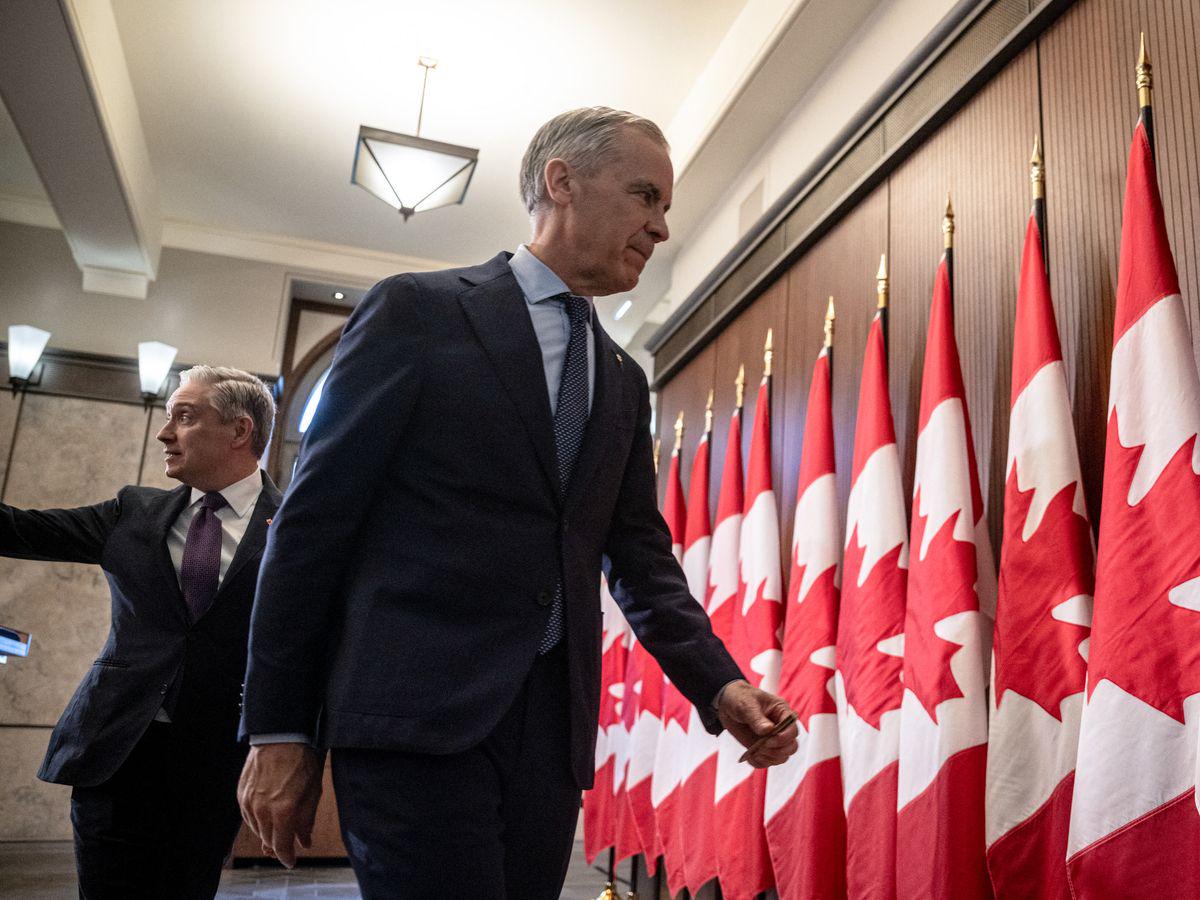
The International Monetary Fund lauded Canada’s fiscal position relative to its peers as Prime Minister Mark Carney prepares to give an update on his government’s finances.
“Across the Group of Seven, Canada’s probably in the strongest position fiscally,” Nigel Chalk, director of the IMF’s Western Hemisphere Department, said in an interview in Washington.
Finance Minister Francois-Philippe Champagne will release a mini-budget outlining the country’s finances on April 28. The government has estimated a $65.4 billion deficit for the current fiscal year, as Carney aims to spend heavily on defence and infrastructure while cutting taxes. In the November budget, the government said the outlays would push its net debt-to-gross domestic product ratio to 43 per cent.
By that metric, Canada has a stronger financial position than other G7 countries, many of which carry net debt levels near or above 100 per cent of the size of their economies. That dynamic has at times led economists to describe Canada as simply the “cleanest dirty shirt.”
Still, Chalk reiterated the IMF’s view that the northern nation has room to spend more to boost the productive capacity of the economy and to build out infrastructure that supports the growth of its energy sector and other strategic industries.
“In the current circumstances, if you have fiscal space, it’s the time to use it,” he said. “Over a medium-term horizon, the government’s super committed to making sure the debt stays low and the fiscal policy is managed responsibly.”
The comments contrast with some domestic views of the Carney government’s fiscal trajectory. Champagne dropped the previous administration’s pledge to maintain a falling net debt-to-GDP ratio, sparking criticism from a parliamentary budget watchdog. Conservative Leader Pierre Poilievre has also accused the government of fuelling inflation through its deficits.
In December, the IMF recommended that the Canadian government “elevate” the debt-to-GDP ratio to be a clear fiscal guidepost.
Still, Chalk argued the government still has a “very strong focus on the debt path.” He added: “That approach is the most valuable in times like now when you get hit by these shocks and you need some space.”
Chalk also praised some of Carney’s changes to Canada’s tax framework — including expanding write-offs for capital expenditures — calling it “quite competitive internationally,” especially at the corporate level.
“The environment to invest in Canada is very persuasive,” he said, though he added that case would be strengthened if the uncertainty posed by US tariffs went away.
While Canada’s federal debt remains AAA rated, the country’s provinces and territories are adding more debt, and the credit rating of British Columbia was recently downgraded.
The IMF doesn’t see those higher regional debt burdens as an “immediate acute risk,” but Chalk added that better transparency and discipline around provincial budgeting would be an improvement. Higher growth across the country would help alleviate some pressures on provinces too, he said.
At the end of last year, Statistics Canada revised the size of the country’s economy higher, pushing up the level of nominal GDP. That’s likely to help many key fiscal metrics, including debt-to-GDP and deficit-to-GDP, according to Randall Bartlett, deputy chief economist with Desjardins Group.
“With rating agencies looking to this data when assessing creditworthiness, that reinforces the government of Canada’s strong credit rating,” he wrote in a report.
Champagne said in a statement that his government’s priorities are to improve affordability, invite investment and grow the strongest economy in the G7.
The IMF also sees Canada’s economy growing 1.5 per cent in 2026, higher than the 1.1 per cent estimate in a Bloomberg survey of economists. That’s the second-fastest pace of growth among advanced countries, after the United States.
“Sometimes I find Canadians don’t actually realize how good they have it,” Chalk said.
Posted by IHateTrains123
1 Comment
What the hell is going on in the rest of the G7