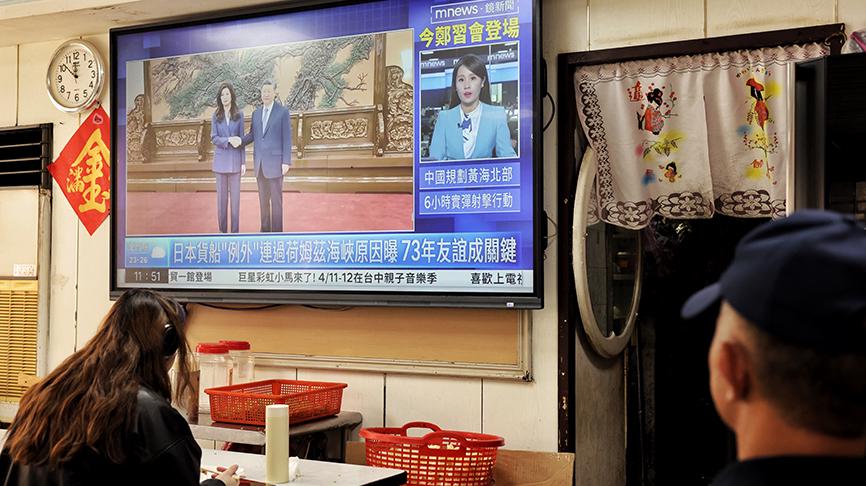
>When Xi Jinping met Cheng Li-wun, the chairperson of Taiwan’s main opposition party, the Kuomintang (KMT), in Beijing on 10 April, it was the first meeting between China’s president and a KMT leader since 2016. The two leaders pledged to further the ‘peaceful development of cross-strait relations’ on the basis of upholding the 1992 consensus and ‘opposing Taiwanese independence’. Two days later China announced ‘ten policy measures to promote cross-strait exchanges and cooperation’ (subsequently referred to as the ‘ten measures’). This may be interpreted as a political move aimed at turning Taiwanese public opinion against the Democratic Progressive Party (DPP) government – which accused Cheng of being ‘subservient’ to Beijing – and its stance on China.
>More significantly, however, these measures reaffirmed the Chinese Communist Party (CCP) leadership’s continued pursuit of a strategy aimed at securing ‘reunification’ without large-scale military action. First outlined in 2023, with the announcement of Fujian province as a ‘demonstration zone for integrated development’, this strategy seeks to increase cross-strait economic, legal and societal exchanges. This built on previous efforts to create similar cross-strait demonstration zones and the 2022 Taiwan White Paper, which instructed party officials to make ‘innovative efforts towards peaceful reunification’. It aims to align legal and regulatory standards with Taiwan while positively shaping public opinion and attracting more Taiwanese businesses to China. These measures do not exclude military action, and they serve a dual purpose in that they also lay the legal groundwork for a justification of any future action against Taiwan.
>The ten measures are part of this wider strategy and, along with other recent signals, suggest the strategy still has top-level support within the CCP. In addition, local officials in Fujian and other provinces have continued implementing cross-strait integration measures since 2023. This is despite such measures having been unsuccessful thus far: Taiwanese investment in China remains at historic lows and support in Taiwan for ‘unification’ has not grown. The CCP’s perseverance could indicate a belief among its leadership that the policies – alongside more coercive actions – may be capable of eventually changing Taiwanese public opinion. Or, instead, it may indicate that the strategy’s primary target is Kinmen – the Taiwanese island group just ten kilometres from the coast of Fujian province, where public opinion is more positive towards cross-strait integration policies.
seems like a renewed push towards fujian-taiwan economic integration following cheng’s visit to the mainland. it certainly seems to indicate, something

1 Comment
>When Xi Jinping met Cheng Li-wun, the chairperson of Taiwan’s main opposition party, the Kuomintang (KMT), in Beijing on 10 April, it was the first meeting between China’s president and a KMT leader since 2016. The two leaders pledged to further the ‘peaceful development of cross-strait relations’ on the basis of upholding the 1992 consensus and ‘opposing Taiwanese independence’. Two days later China announced ‘ten policy measures to promote cross-strait exchanges and cooperation’ (subsequently referred to as the ‘ten measures’). This may be interpreted as a political move aimed at turning Taiwanese public opinion against the Democratic Progressive Party (DPP) government – which accused Cheng of being ‘subservient’ to Beijing – and its stance on China.
>More significantly, however, these measures reaffirmed the Chinese Communist Party (CCP) leadership’s continued pursuit of a strategy aimed at securing ‘reunification’ without large-scale military action. First outlined in 2023, with the announcement of Fujian province as a ‘demonstration zone for integrated development’, this strategy seeks to increase cross-strait economic, legal and societal exchanges. This built on previous efforts to create similar cross-strait demonstration zones and the 2022 Taiwan White Paper, which instructed party officials to make ‘innovative efforts towards peaceful reunification’. It aims to align legal and regulatory standards with Taiwan while positively shaping public opinion and attracting more Taiwanese businesses to China. These measures do not exclude military action, and they serve a dual purpose in that they also lay the legal groundwork for a justification of any future action against Taiwan.
>The ten measures are part of this wider strategy and, along with other recent signals, suggest the strategy still has top-level support within the CCP. In addition, local officials in Fujian and other provinces have continued implementing cross-strait integration measures since 2023. This is despite such measures having been unsuccessful thus far: Taiwanese investment in China remains at historic lows and support in Taiwan for ‘unification’ has not grown. The CCP’s perseverance could indicate a belief among its leadership that the policies – alongside more coercive actions – may be capable of eventually changing Taiwanese public opinion. Or, instead, it may indicate that the strategy’s primary target is Kinmen – the Taiwanese island group just ten kilometres from the coast of Fujian province, where public opinion is more positive towards cross-strait integration policies.
seems like a renewed push towards fujian-taiwan economic integration following cheng’s visit to the mainland. it certainly seems to indicate, something