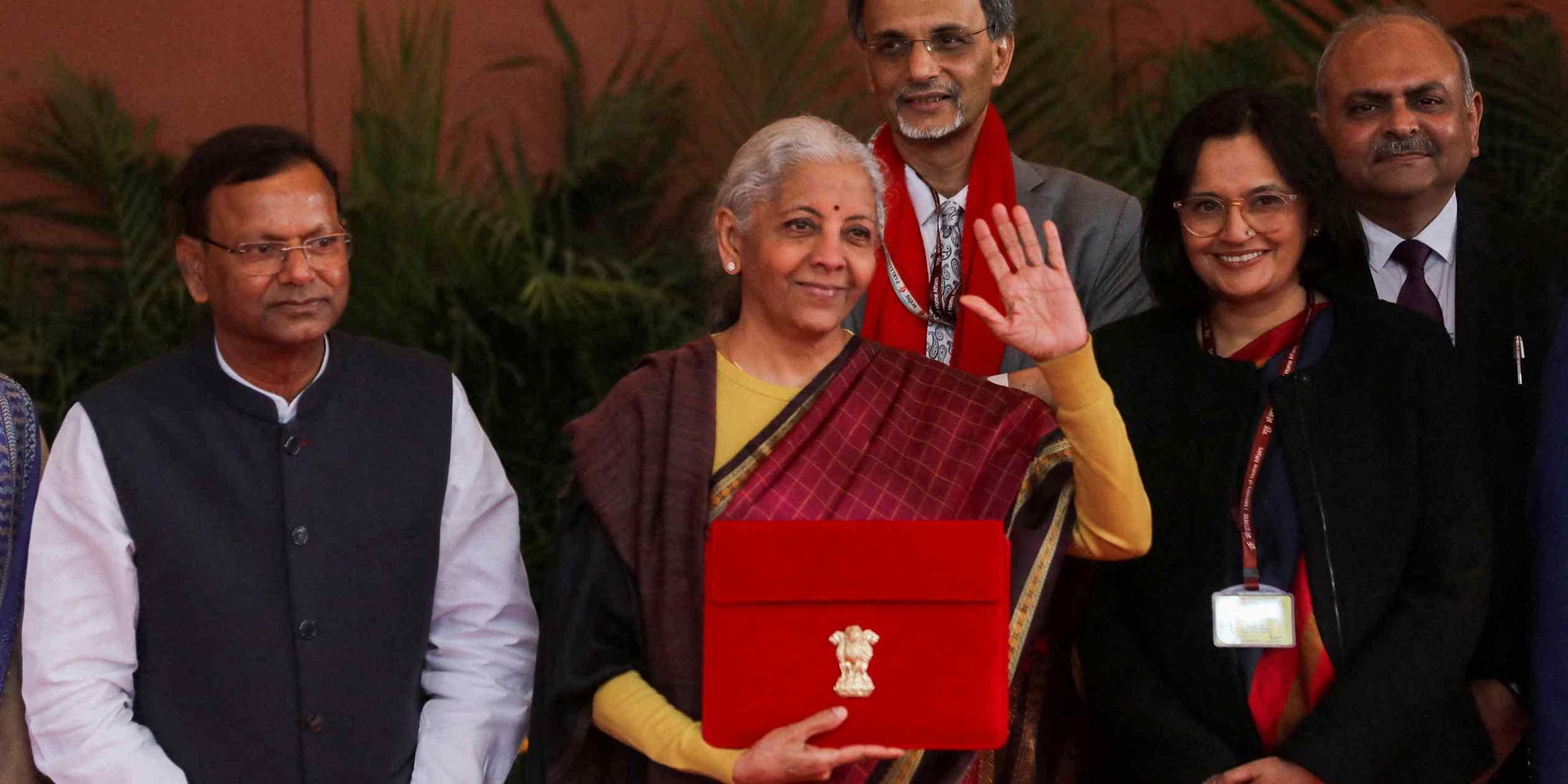
Prime Minister Narendra Modi’s government on Sunday presented India’s budget for the fiscal year starting in April, raising infrastructure spending by 11.5% to a record 12.2 trillion rupees ($133 billion) and pushing for the manufacturing sector to spur growth at a time when Asia’s third-largest economy faces punishing U.S. tariffs.
“Today, we face an external environment in which trade and multilateralism are imperiled and access to resources and supply chains are disrupted,” Finance Minister Nirmala Sitharaman said in her budget speech in Parliament. “New technologies are transforming production systems while sharply increasing demands on water, energy and critical minerals.”
Her remarks came against the backdrop of U.S. President Donald Trump imposing harsh 50% tariffs on Indian goods in August, including a 25% penalty for New Delhi’s purchases of Russian oil. India, however, is maintaining strong growth momentum, with the government estimating an expansion in gross domestic product of 7.4% in the current fiscal year ending on March 31, up from 6.5% in the previous one. The government’s annual economic survey, released on Thursday, projects GDP growth of 6.8% to 7.2% in the coming fiscal year.
Modi, in a video message posted on his X account, said the budget strengthens the foundation of what he described as India’s bright future, adding that it will also boost India’s efforts to become a developed nation by 2047. “India is currently riding on a reform express [train] which will get a new energy and speed with this budget.”
This budgetary allocation is focused on cutting the fiscal deficit and controlling inflation along with the coordination of “high capex and high growth,” Modi said.
On the budget’s infrastructure push, he referred to measures such as dedicated freight corridors, expansion of waterways nationwide, high-speed rail corridors and a special focus on development of tier-2 and tier-3 cities.
Sitharaman, in her budget speech, said that the government is committed to the welfare of the “poor, underprivileged and the disadvantaged,” and is inspired by three duties in this regard. She said those are to accelerate and sustain economic growth, to fulfill the aspirations of the people and build their capacity, and to ensure that every family, community, region and sector has access to resources, amenities and opportunities.
She proposed scaling up manufacturing in sectors such as biopharma, semiconductors, electronics components and rare earths. In April last year, an electronics components manufacturing scheme was launched with an outlay of 229.19 billion rupees, which will be increased to 400 billion rupees in the coming fiscal year.
Sitharaman also called for establishing dedicated rare earth corridors in the mineral-rich Indian states of Odisha, Kerala, Andhra Pradesh and Tamil Nadu to promote mining, processing, research and manufacturing — a move which is expected to reduce dependence on imports from China.
Speaking about the government’s fiscal commitments, she said that India’s debt-to-GDP ratio is estimated to be 55.6% for the next fiscal year starting from April, compared to a revised 56.1% in the current year. The fiscal deficit is targeted at 4.3% of GDP in the coming fiscal, which compares to 4.4% in the current one.
To finance the fiscal deficit, she said net market borrowings from dated securities are estimated at 11.7 trillion rupees. Gross market borrowings are estimated at 17.2 trillion rupees, she added.
Total expenditure for the coming fiscal year is projected at 53.5 trillion rupees — higher than the revised estimate of 49.6 trillion rupees for the current fiscal year — with the federal government’s net tax receipts estimated at 28.7 trillion rupees.
The spending package is subject to parliamentary approval but is expected to pass intact.
Reacting to the budget announcements, Shailesh Chandra, president of the Society of Indian Automobile Manufacturers (SIAM) and CEO of Tata Motors Passenger Vehicles, said the move to raise the capital expenditure target to 12.2 trillion rupees in the coming fiscal year “will provide a strong impetus” to the creation of demand and for industrial activity, including in the automobile sector.
“Enhanced support for electronic components manufacturing, setting up dedicated corridors for mining and processing of rare earth, along with initiatives to establish high-tech tool rooms and supporting container manufacturing, will develop supply chain resilience and help in streamlining exports,” he said in a statement.
In another announcement aimed at boosting India’s nuclear power manufacturing, Sitharaman presented an extension of the existing basic customs duty exemption on imports of goods required for atomic power projects until 2035, covering all such facilities irrespective of their capacity.
Touching on emerging technologies, including artificial intelligence, the finance minister stressed that the Modi government has taken several steps to support new technologies through its various initiatives, including the AI Mission and the National Quantum Mission.
She proposed setting up of a high-powered “education to employment and enterprise” committee to recommend measures that focus on the services sector as a core driver of a developed India. “This will make us a global leader in services, with a 10% global share by 2047,” she said, adding the panel will prioritize areas to optimize the potential for growth, employment and exports.
“They will also assess the impact of emerging technologies, including AI, on jobs and skill requirements and propose measures thereof,” she said.
Sameer Gupta, partner and national tax leader at EY India, said in a statement that the government’s “bold step in introducing a tax holiday” for data centers serving foreign customers until March 31, 2047, is a move that recognizes “the opportunities of centrality of AI-based technology and [is aimed] to position India as a competitive hub for cloud and AI infrastructure.”
Christian de Guzman, senior vice president at Moody’s Ratings, said in a note that apart from the continued spending on infrastructure, the budget provides “tactical support for the economy against the backdrop of prevailing external uncertainties, including the unresolved issues around U.S. tariffs, and despite the proven resilience of economic growth over the past year.”
Indian stock markets, which opened for a special trading session on Sunday, ended in the red, with benchmark indices BSE Sensex and NSE Nifty 50 sliding after Sitharaman announced an increase in the securities transaction tax (STT) on futures and options. The Sensex fell 1.88% to close at 80,722.94 while the Nifty 50 finished at 24,825.45, down 1.96%.
“While the absence of stronger near-term consumption stimulus and the increase in STT on futures and options remain areas of concern, the budget’s balanced approach strengthens the foundation for sustainable growth in an uncertain global environment,” Dabur India CEO Mohit Malhotra said in a statement.
Creative_soja on
Good info, but it’s an old article, from Feb 1, 2026.

2 Comments
Prime Minister Narendra Modi’s government on Sunday presented India’s budget for the fiscal year starting in April, raising infrastructure spending by 11.5% to a record 12.2 trillion rupees ($133 billion) and pushing for the manufacturing sector to spur growth at a time when Asia’s third-largest economy faces punishing U.S. tariffs.
“Today, we face an external environment in which trade and multilateralism are imperiled and access to resources and supply chains are disrupted,” Finance Minister Nirmala Sitharaman said in her budget speech in Parliament. “New technologies are transforming production systems while sharply increasing demands on water, energy and critical minerals.”
Her remarks came against the backdrop of U.S. President Donald Trump imposing harsh 50% tariffs on Indian goods in August, including a 25% penalty for New Delhi’s purchases of Russian oil. India, however, is maintaining strong growth momentum, with the government estimating an expansion in gross domestic product of 7.4% in the current fiscal year ending on March 31, up from 6.5% in the previous one. The government’s annual economic survey, released on Thursday, projects GDP growth of 6.8% to 7.2% in the coming fiscal year.
Modi, in a video message posted on his X account, said the budget strengthens the foundation of what he described as India’s bright future, adding that it will also boost India’s efforts to become a developed nation by 2047. “India is currently riding on a reform express [train] which will get a new energy and speed with this budget.”
This budgetary allocation is focused on cutting the fiscal deficit and controlling inflation along with the coordination of “high capex and high growth,” Modi said.
On the budget’s infrastructure push, he referred to measures such as dedicated freight corridors, expansion of waterways nationwide, high-speed rail corridors and a special focus on development of tier-2 and tier-3 cities.
Sitharaman, in her budget speech, said that the government is committed to the welfare of the “poor, underprivileged and the disadvantaged,” and is inspired by three duties in this regard. She said those are to accelerate and sustain economic growth, to fulfill the aspirations of the people and build their capacity, and to ensure that every family, community, region and sector has access to resources, amenities and opportunities.
She proposed scaling up manufacturing in sectors such as biopharma, semiconductors, electronics components and rare earths. In April last year, an electronics components manufacturing scheme was launched with an outlay of 229.19 billion rupees, which will be increased to 400 billion rupees in the coming fiscal year.
Sitharaman also called for establishing dedicated rare earth corridors in the mineral-rich Indian states of Odisha, Kerala, Andhra Pradesh and Tamil Nadu to promote mining, processing, research and manufacturing — a move which is expected to reduce dependence on imports from China.
Speaking about the government’s fiscal commitments, she said that India’s debt-to-GDP ratio is estimated to be 55.6% for the next fiscal year starting from April, compared to a revised 56.1% in the current year. The fiscal deficit is targeted at 4.3% of GDP in the coming fiscal, which compares to 4.4% in the current one.
To finance the fiscal deficit, she said net market borrowings from dated securities are estimated at 11.7 trillion rupees. Gross market borrowings are estimated at 17.2 trillion rupees, she added.
Total expenditure for the coming fiscal year is projected at 53.5 trillion rupees — higher than the revised estimate of 49.6 trillion rupees for the current fiscal year — with the federal government’s net tax receipts estimated at 28.7 trillion rupees.
The spending package is subject to parliamentary approval but is expected to pass intact.
Reacting to the budget announcements, Shailesh Chandra, president of the Society of Indian Automobile Manufacturers (SIAM) and CEO of Tata Motors Passenger Vehicles, said the move to raise the capital expenditure target to 12.2 trillion rupees in the coming fiscal year “will provide a strong impetus” to the creation of demand and for industrial activity, including in the automobile sector.
“Enhanced support for electronic components manufacturing, setting up dedicated corridors for mining and processing of rare earth, along with initiatives to establish high-tech tool rooms and supporting container manufacturing, will develop supply chain resilience and help in streamlining exports,” he said in a statement.
In another announcement aimed at boosting India’s nuclear power manufacturing, Sitharaman presented an extension of the existing basic customs duty exemption on imports of goods required for atomic power projects until 2035, covering all such facilities irrespective of their capacity.
Touching on emerging technologies, including artificial intelligence, the finance minister stressed that the Modi government has taken several steps to support new technologies through its various initiatives, including the AI Mission and the National Quantum Mission.
She proposed setting up of a high-powered “education to employment and enterprise” committee to recommend measures that focus on the services sector as a core driver of a developed India. “This will make us a global leader in services, with a 10% global share by 2047,” she said, adding the panel will prioritize areas to optimize the potential for growth, employment and exports.
“They will also assess the impact of emerging technologies, including AI, on jobs and skill requirements and propose measures thereof,” she said.
Sameer Gupta, partner and national tax leader at EY India, said in a statement that the government’s “bold step in introducing a tax holiday” for data centers serving foreign customers until March 31, 2047, is a move that recognizes “the opportunities of centrality of AI-based technology and [is aimed] to position India as a competitive hub for cloud and AI infrastructure.”
Christian de Guzman, senior vice president at Moody’s Ratings, said in a note that apart from the continued spending on infrastructure, the budget provides “tactical support for the economy against the backdrop of prevailing external uncertainties, including the unresolved issues around U.S. tariffs, and despite the proven resilience of economic growth over the past year.”
Indian stock markets, which opened for a special trading session on Sunday, ended in the red, with benchmark indices BSE Sensex and NSE Nifty 50 sliding after Sitharaman announced an increase in the securities transaction tax (STT) on futures and options. The Sensex fell 1.88% to close at 80,722.94 while the Nifty 50 finished at 24,825.45, down 1.96%.
“While the absence of stronger near-term consumption stimulus and the increase in STT on futures and options remain areas of concern, the budget’s balanced approach strengthens the foundation for sustainable growth in an uncertain global environment,” Dabur India CEO Mohit Malhotra said in a statement.
Good info, but it’s an old article, from Feb 1, 2026.