
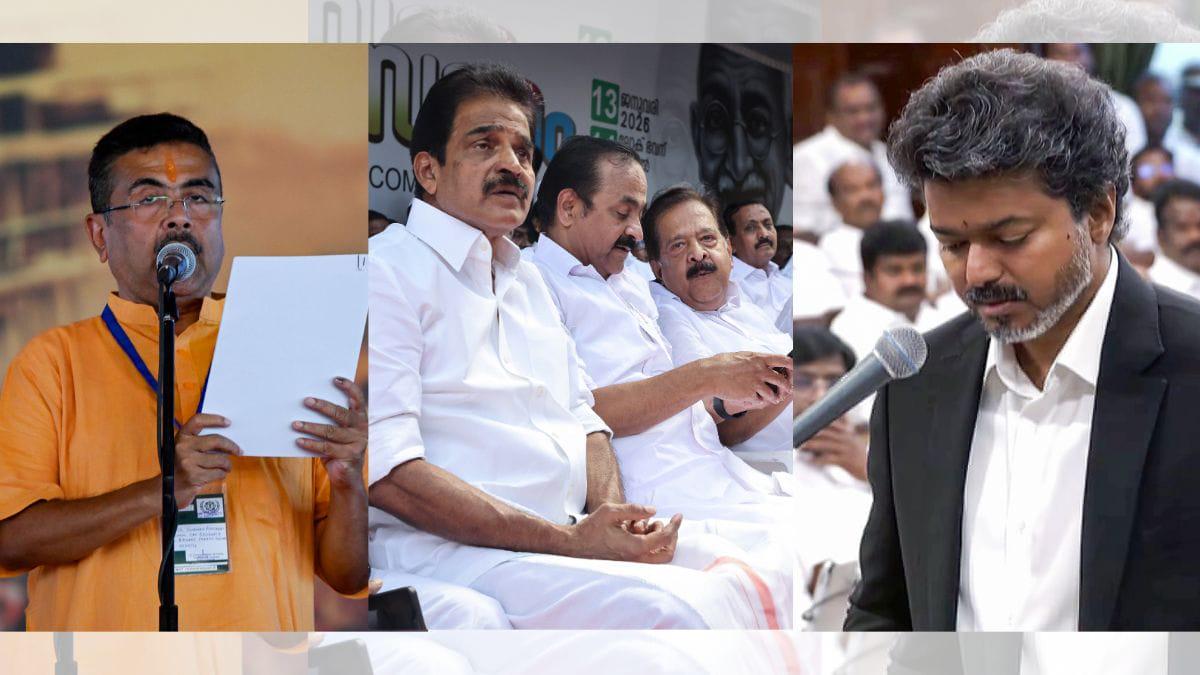
Why is this important? because the debt of indian states is an increasing problem and the change in regime in three states all undergirded by generous promises of subisdies (especially Vijay in TN) so having an idea of the states finances their debt is something this sub should keep an eye out on.
Posted by ewatta200
3 Comments
In West Bengal, the electorate concluded Mamata Banerjee’s fifteen-year tenure, delivering a decisive victory to the Bharatiya Janata Party, a result that political analysts had largely deemed unlikely until the final stages of the election. In Tamil Nadu, Vijay, a film star with no prior political experience, led the Tamilaga Vettri Kazhagam, a party established less than five years ago, to a sweeping victory, thereby displacing the Dravida Munnetra Kazhagam and disrupting the Dravidian political dominance that has persisted for six decades. In Kerala, the Congress-led United Democratic Front decisively defeated the Left Democratic Front, delivering a potentially irreversible symbolic setback to Indian communism: For the first time in independent India, no state is governed by a Left party.
Collectively, these electoral outcomes represent one of the most dramatic weeks in recent Indian political history. Analysts are likely to spend months examining these results, such as anti-incumbency sentiment, identity consolidation, the allure of celebrity, and the waning influence of ideological politics. However, there exists another set of questions that often remain overshadowed by immediate electoral discourse, questions that the newly elected governments must address once the celebratory fervour subsides. These questions, not dictated by electoral mandates but rather by budget documents, pertain to fiscal sustainability, structural economic transformation, and the viability of the distinct developmental models pursued by these states. The data, it appears, offers insights that the electorate, understandably, may not have fully perceived.
# An economy is not an election
The chart below reveals insights that the election results alone cannot convey. Tamil Nadu’s real per capita income has nearly doubled since 2011-12, reaching approximately 210 on an index where all three states commence at 100. In contrast, Kerala has experienced growth at a more moderate rate, broadly aligning with the national average. West Bengal has exhibited the slowest growth, with its catch-up growth being the least dynamic among the three states.
[](https://staticprintenglish.theprint.in/wp-content/uploads/2026/05/three-states-gfx-1.png)
Graphic: Shruti Naithani | ThePrint
These figures are not abstract; they represent the cumulative outcomes of decisions made over a decade. These decisions pertain to the type of economy each state aspired to develop, the allocation of government expenditures, and crucially, whether such expenditures would create the productive capacity to sustain themselves over time.
All three states share a common fiscal characteristic: they engage in substantial borrowing, have progressively increased their borrowing, and carry significant debt. Thus, the comparison among them is not one of fiscal prudence versus fiscal irresponsibility. Rather, it is a comparison of what the borrowing has been for.
***Also read:*** [*Full-page WB BJP oath-taking ad in CPM mouthpiece Ganashakti, editor says ideology remains unchanged*](https://theprint.in/india/full-page-wb-bjp-oath-taking-ad-in-cpm-mouthpiece-ganashakti-editor-says-ideology-remains-unchanged/2927262/)
# The quality of debt
This chart serves as the analytical core of the discussion, and it is worth careful examination.
[](https://staticprintenglish.theprint.in/wp-content/uploads/2026/05/three-states-gfx-2.png)
Graphic: Shruti Naithani | ThePrint
The dashed lines depict capital expenditure as a proportion of Gross State Domestic Product (GSDP), specifically the segment of public spending allocated to infrastructure, such as roads, ports, industrial corridors, power infrastructure, and urban systems and the solid lines represent each state’s debt-to-GSDP ratio.
Tamil Nadu’s debt ratio has increased but has stabilised around 29-30 per cent. Notably, its capital expenditure has also increased, with the two metrics exhibiting a broadly parallel trajectory. This indicates that the state is simultaneously increasing its borrowing and infrastructure development. In contrast, West Bengal begins the period with an already substantially high debt burden, exceeding 40 per cent of GSDP, and has progressively expanded its capital expenditure, although from a lower baseline. Kerala presents a more concerning scenario: its debt has escalated to nearly 37-38 per cent of GSDP, while capital expenditure, although present, has not increased proportionately with the fiscal expansion.
In the context of development economics, this analysis is straightforward. Tamil Nadu has engaged significantly in productive borrowing, wherein debt finances assets capable of generating future economic returns. Conversely, Kerala’s borrowing has been predominantly directed toward committed expenditures, such as salaries, pensions, welfare transfers, and increasingly, interest payments on the debt itself. West Bengal occupies an intermediate position, with rising capital spending that has yet to generate the private investment response necessary to amplify its impact.
Vijay and VC Satheesan will single-handedly fuck up their state’s economies and drive up their debts even faster. However, Suvendu Adhikari, while doing freebies such as 3000 rupees to both women and youth, will gradually drive more government revenue for it as the economy grows because his government (I hope) will place a bigger emphasis on industry and infrastructure in West Bengal.
Tamil nadu need not worry much. They have manufacturing to survive.
Kerala might actually be finished if the govt isnt smart
West bengal, bjp from center will take care of it