
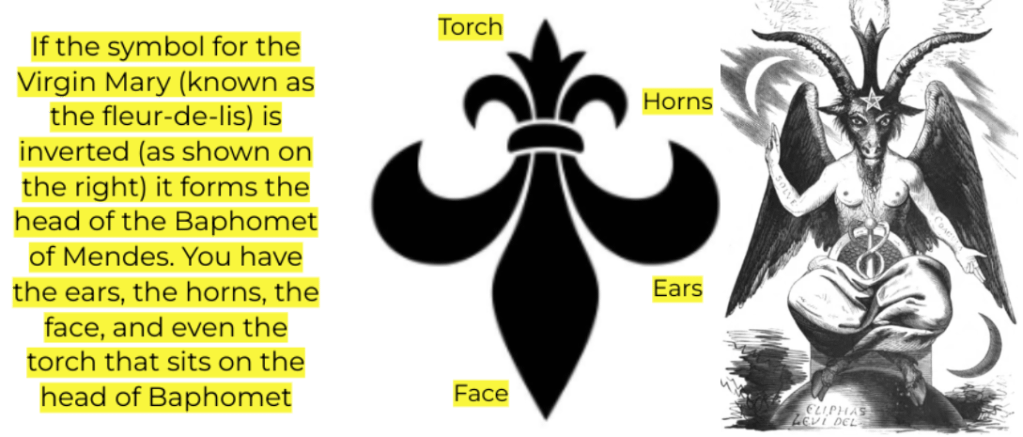
The Wikipedia Japanese Baphomet page explains that when the fleur–de–lis is inverted it forms the “head of the Baphomet of Mendes” (as shown above). The English translation of “fleur–de–lis” is “flower of the lily”. The symbol, depicting a stylized lily or lotus flower, has many meanings. The fleur–de–lis has long been associated with the Virgin Mary in Christian symbolism, especially from the Medieval period onward. The Virgin Mary has long been associated with Sophia. If the symbol is inverted to form Baphomet’s head it might represent the shadow side or darker aspect of Sophia. Kathleen Granville Damiani authored the 1998 dissertation titled “Sophia: Exile and Return” and characterizes Sophia as the “Mother of Exiles” and notes that Sophia’s “other faces”, her darker side, include Lilith. When we consider that the fleur–de–lis represents the Holy Trinity (by most accounts) and when inverted forms the head of Baphomet, one wonders if the symbol is meant to represent a shadow of the Holy Trinity when inverted (one possible interpretation is that it represents an Unholy Trinity).
One interpretation of the fleur–de–lis is that it symbolically represents the birth of Christ. This idea has been suggested by James David Holloway in his 1991 book ‘The Last Gospel’ and in related discussions. In various traditions, the fleur–de–lis is associated with the Virgin Mary and so the form of the symbol might be interpreted as representing Mary herself. This is because from a purely visual perspective, the outline of the fleur–de–lis resembles a human–like figure, with a central torso–like shape, two side extensions that resemble arms and legs, and a lower section from which another form appears to emerge. This arrangement invites a symbolic reading of Mary giving birth to Christ. The form that appears to emerge from the lower part of the fleur–de–lis — when the symbol is rotated 180 degrees — resembles a cross and can also appear somewhat similar to the head of the king piece in the game chess. The Christian cross is the primary symbol of Christ and the head of Christ in old paintings is usually superimposed over a cross. When the fleur–de–lis is symbol inverted, this cross–like symbol becomes upright, producing an outline resembling the head of Baphomet, which in this speculative interpretation symbolically connects Baphomet with Christ.
Another connection to Christ is Baphomet’s “flame of intelligence” above his head — which some suggest might be interpreted as symbolically giving birth to light — bears a striking resemblance to Greco–Egyptian images of Harpocrates (Younger Horus; sometimes said to be a “god of light”, and probably a precursor to Christ) emerging from a lotus flower (the fleur–de–lis is also sometimes said to be a lotus flower); a symbol of rebirth, transformation, and resurrection. The key point is that the three petals visible in the images here — on Baphomet’s torch and on the lotus flower beneath Harpocrates — are identical and might suggest a symbolic reference to Harpocrates’s triune nature. Horus was linked to the scarab beetle as a symbol of rebirth, resurrection, and spontaneous creation, which is a symbol said to be linked to Baphomet. The Egyptian xpr (𓆣), the scarab beetle sign, means to become, come into being, rise, or transform.
Posted by -Joel-Snapes-