
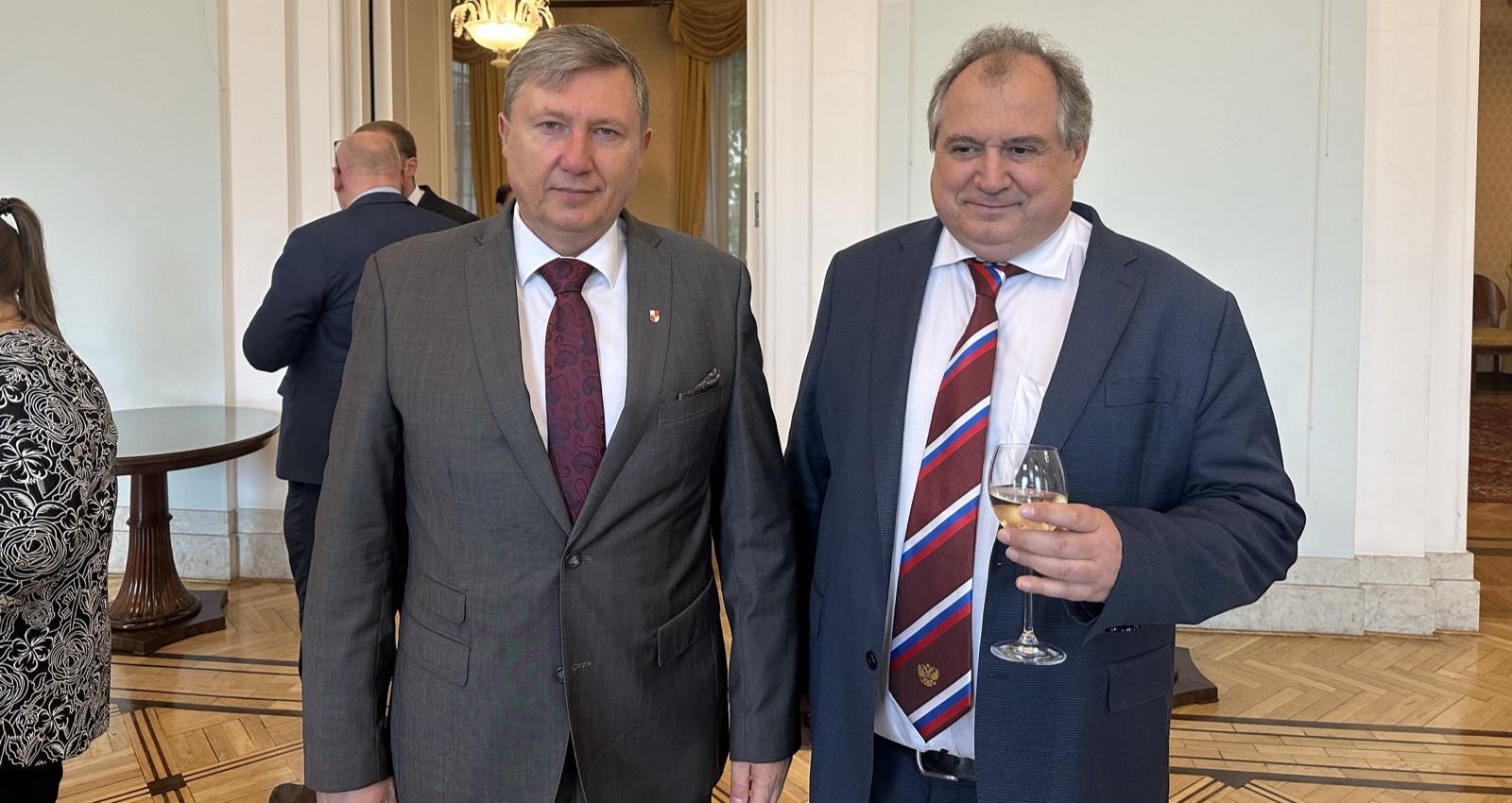
Two figures associated with Polish far-right leader Grzegorz Braun have attended a celebration of Russia Day at the Russian embassy in Warsaw.
They presented the ambassador Georgy Mikhno with a letter on behalf of Braun’s Confederation of the Polish Crown (KKP) party praising Russia’s “path of development”, blaming the West and “globalist forces” for the war in Ukraine, and calling for a “normalisation” of Polish-Russian relations.
Braun, who is currently on trial in Warsaw for a 2023 attack on a Jewish religious celebration in Poland’s parliament, has seen support for his KKP party surge since he finished a surprise fourth at last year’s presidential elections, with 6.3% of the vote. KKP is currently polling around 8%.
The party and its leader are known for their anti-Jewish, anti-Ukrainian, anti-LGBT, anti-EU and anti-American rhetoric, and also for taking positions that align with Russia’s. Braun himself has previously called for a “normalisation in Polish-Russian relations”.
On Friday this week, Russia celebrated its national day, marking the anniversary of the Russian Soviet Federative Socialist Republic, then still part of the Soviet Union, declaring its sovereignty on 12 June 1990.
Among those to attend celebrations of Russia Day at the Russian embassy in Warsaw were Piotr Heszen, the director of KKP’s parliamentary caucus, and Mateusz Piskorski, a proposed KKP candidate in next year’s parliamentary elections. Piskorski is currently on trial for alleged espionage on behalf of Russia.
In a letter addressed to the Russian ambassador on behalf of KKP, Heszen praised Russia for developing “conservatism under the leadership of a strong leader” since the fall of communism. “I support this direction of development,” he wrote.
By contrast, Poland has “gone too far” in seeking to imitate the West during its post-communist development, added Heszen, saying that his party “desires the normalisation of relations with our Russian neighbour”.
Regarding the war in Ukraine, Heszen said that the West and “globalist forces” played a “decisive role…in the emergence and perpetuation of this conflict”. He made no mention of Russia’s invasion of Ukraine nor any condemnation of its actions there.
Piskorski, meanwhile, wrote on social media that the presence of Heszen at the embassy was “an extremely important signal that there are forces in the Polish parliament advocating for a civilisation of which dialogue is a part”.
Speaking later to news website Interia, Heszen confirmed that the embassy visit “was agreed with and recommended by Grzegorz Braun”.
Last November, Braun and his three fellow KKP members of parliament jointly addressed letters to the Russian and Polish foreign ministers, Sergey Lavrov and Radosław Sikorski, calling for a “de-escalation and normalisation in Polish-Russian relations”.
Two months earlier, Braun echoed Kremlin propaganda by claiming that an incursion of Russian drones into Polish airspace was in fact faked as part of a conspiracy, involving Poland’s own government, to drag the country into the war in Ukraine. That prompted Sikorski to call Braun a “Russian lackey”.
In March this year, Heszen asked on social media, “How can you not love Putin?” after the Russian president expressed opposition to the adoption of children by same-sex couples.
Given KKP’s continued strong performance in polls, there is a chance that Braun could become a potential kingmaker after next year’s parliamentary elections, with neither the current centrist ruling coalition nor the right-wing opposition able to form a majority without him.
However, both the ruling coalition and the main opposition party, Law and Justice (PiS), have ruled out inviting Braun to join government due to his radical views and Russian sympathies. Braun is facing multiple charges for alleged crimes, including Holocaust denial, assault and vandalism.
Polish society as a whole remains strongly anti-Russian. State research agency CBOS this year found that 74% of Poles expressed dislike towards Russians, the highest figure for any ethnic or national group, and 91% distrust Putin, a higher figure than for any other world leader.
In recent years, Russia has led a campaign of so-called “hybrid warfare” against Poland, including sabotage, arson, disinformation and cyberattacks, as well as last year’s drone incursions.
Daniel Tilles is editor-in-chief of Notes from Poland. He has written on Polish affairs for a wide range of publications, including Foreign Policy, POLITICO Europe, EUobserver and Dziennik Gazeta Prawna.
Posted by BubsyFanboy