
The AfD leadership is calling for a halt to the selection of candidates in North Rhine-Westphalia, yet the process there is continuing unabated. The conflict with the party's most powerful state branch is becoming a risk for Weidel as well.
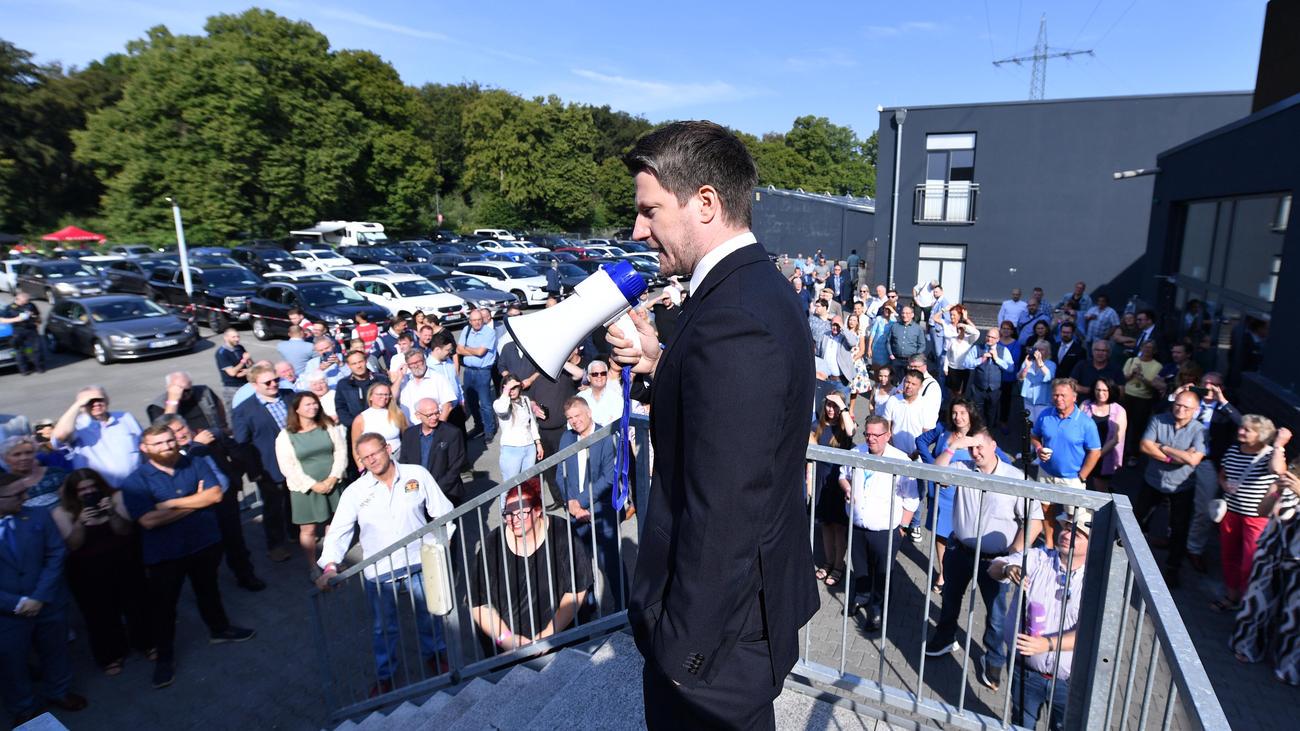
Around eleven o’clock on this Friday morning, a group of AfD members stands in the parking lot of the event center in Marl [a town in NRW], listening intently to their spokesperson. The mood is animated. Sven Tritschler says that a full explanation is now needed regarding what has just unfolded at the party’s North Rhine-Westphalia election assembly. The state parliament member concludes his speech with a piece of well-intentioned advice: "Spend the weekend with people who are more normal than the ones in there." Applause follows; the sun is beating down, and the first beer bottles are being cracked open.
By "those people in there," Tritschler refers to the opposing camp—NRW state chairman Martin Vincentz and his faction—who, just minutes earlier, had handed him and his supporters a bitter defeat. Tritschler’s camp sought to have the delegates' meeting—where candidates for the upcoming NRW state election were to be selected—called off, and to have the votes held so far, in which Tritschler’s people had been largely sidelined, annulled.
Just as the AfD federal executive board had demanded of Vincentz in a letter sent from Berlin following a crisis meeting on Thursday evening.
But it never comes to that. In a three-page letter to the federal executive board, he first rejects their proposal, only to then vigorously rally his supporters via megaphone outside the hall in Marl: "Together, we will ensure that we contest this election as North Rhine-Westphalia," he shouts from the entrance steps shortly before the proceedings begin. "And now, all together: Let's head into the hall."
Inside, things heat up briefly once more. Bundestag member Christian Zaum calls out "Party conference of shame" to the hall and moves to adjourn the meeting. Vincentz delivers a fiery rebuttal, arguing for the proceedings to continue—"even if it costs me my head as state chairman." Applause and shouts follow. Zaum’s motion is rejected.
Just like at the 2015 party conference in Essen
The party conference in Marl, which was suspended last Sunday following a chaotic turn of events, is resuming. The Tritschler camp is leaving the hall almost en masse in protest. Some delegates are wearing T-shirts bearing the slogan "Fck the Clique"—produced specifically for the occasion. This leaves the selection of state election candidates entirely in the hands of their opponents.
However, the question of who or what is still "normal" here—or not—is one that outsiders can hardly answer. What has been unfolding over the past week in the party’s largest and most powerful state branch—boasting more than 12,000 members—is something even the scandal-plagued AfD has never experienced before. One person compares the atmosphere to the 2015 federal party conference in Essen—when AfD founding leader Bernd Lucke had established a rival organization, was voted out of office amidst the cheers of his opponents, and had to leave the venue under police protection. "The fermenting rabble is back," says another. That mocking self-description comes from Alexander Gauland—the man who once spoke of a "speck of bird shit" [in German history] and is now the AfD’s honorary chairman.
It is a historic uproar—one that will reverberate and is likely far from over, even though Tritschler and his camp have given up for the moment, washing down their frustration with beer in a parking lot in Marl under the blazing sun. It is a scandal with the potential to shake the power structure of the federal party in Berlin. There is talk of a "revolt against Alice Weidel" that cannot go unanswered. And the federal leader herself has campaigned so vehemently against Vincentz that she, too, could now suffer political damage.
To understand what has happened, one must first familiarize oneself with the generals of this open battle. On one side is Martin Vincentz—a physician, the party leader in North Rhine-Westphalia (NRW) since 2022, and a close ally of federal co-chair Tino Chrupalla. Within the party, he is described as a representative of the moderate or conservative-bourgeois camp—a characterization that, upon closer inspection, is undoubtedly a sugar-coated oversimplification. On the other side stands Matthias Helferich: a Bundestag MP from Dortmund, an adherent of *völkisch* ideology, a close associate of Björn Höcke, a proponent of hardline right-wing doctrine, and the figurehead of the new AfD youth organization, "Generation Deutschland."
At his side is Sven Tritschler, an MP in the NRW state parliament; like Helferich, he is a close ally of Weidel and was recently elected to the party’s federal executive board with her support. Together, he and his network have for some time been pursuing a plan to strip Vincentz of power, undermine Chrupalla, and transform the NRW branch into a state organization loyal to Weidel. To date, however, all these attempts have failed for lack of the necessary majority—most recently a few months ago, at the very same venue here in Marl, during a regular state party conference. Because Helferich’s push to oust the leadership failed, Vincentz was re-elected; that event, too, was marked by uproar and chaos, and the state executive board has been divided ever since, with the balance clearly tipped in Vincentz’s favor.
Backroom talks fail
Then, last weekend—during the selection of candidates for the state election—the so-called Helferich-Tritschler-Weidel faction made another attempt. However, the circumstances had shifted somewhat: with the election of the new federal executive board two weeks earlier, Weidel had significantly expanded her power base; alongside Tritschler, other loyalists of hers had risen to the party’s top ranks. Co-leader Chrupalla returned home with a significantly diminished mandate, having secured only 70 percent of the vote. Vincentz did not even show up.
Buoyed by this momentum, Helferich and Tritschler entered into backroom negotiations with the North Rhine-Westphalia state leader regarding the composition of the state candidate list. Vincentz rejected their demand for half of the 80 available spots. In return, he offered to support the election of one candidate from the opposing camp for every seven slots—a proposal that the Tritschler-Helferich faction, in turn, viewed as a humiliation.
Then, last Sunday, a total breakdown occurred: Vincentz’s associates allegedly pressured, threatened, physically assaulted, and even blackmailed delegates to secure votes for their candidates. "Complete nonsense," claimed sources close to the NRW party leader. Both sides filed criminal complaints. Insults were exchanged in chat groups.
After Vincentz’s allies had prevailed in almost every vote over the course of the three days, Tritschler launched "Operation Filibuster" via smartphone chats with his confidants. He flooded the elections for the state party list with dozens of candidates—apparently including complete strangers. For list position 22 alone, 95 people ran, each entitled to deliver an eight-minute campaign speech. The party conference descended into chaos and was finally suspended around midnight on Sunday.
The maneuver had evidently been meticulously planned. Other state chapters had reportedly also sent dozens of people to Marl to provide support and position them against Vincentz.
Orchestrated by influential figures behind the scenes?
Since then, the AfD has been in crisis mode. Sources close to Weidel report that Vincentz is planning something akin to a party-within-a-party. Together with a faction from Lower Saxony—also friendly toward Chrupalla and no stranger to scandal—he reportedly aims to forge an alliance to ultimately topple the party leader. The ostensibly milder justification for this scheme is a desire to shed radical elements and make the party more palatable to potential allies. Other narratives veer into conspiracy theories; some claim Vincentz’s move is orchestrated by influential, wealthy power brokers seeking to steer the party from the shadows according to their own agenda. Others even suspect the involvement of the Office for the Protection of the Constitution—arguing that the agency is always looking for new ways to exert influence over the AfD.
In the Vincentz camp, such theories are met with little more than a smile. "I hold Alice Weidel in high regard," Vincentz said in an interview with *Die Zeit* on Friday. "Our chancellor candidate is doing excellent political work at the federal level. However, regarding North Rhine-Westphalia, she was definitely ill-advised." These remarks, however, sound more like strategic cordiality; just two days earlier, he had accused Weidel in writing of tolerating—or even actively encouraging—"Antifa" tactics to sabotage the party conference in Marl.
Vincentz rejects the notion of a revolt against Weidel. He insists he will not be pressured and maintains that his concern is fairness. A party conference cannot simply be called off on a whim, he argues: hotels have been booked, people have taken time off work, and some candidates have already been selected. He also sees no fault with the existing state party list, asserting that it is legally sound. The party leader and the federal executive board, however, take a different view. Weidel had written to him that, due to the allegations of intimidation, there was a risk the list might not be legally sound and could fail to be approved for the state election—a "debacle" that had to be prevented.
Weidel draws her next weapon.
Then, early that Friday morning—shortly before the party conference in Marl was set to resume—the federal executive committee convened a conference call with state party leaders to gauge their views. Dissatisfaction arose from the fact that Vincentz himself did not attend, sending a substitute instead. The outcome: according to *Die Zeit*, every state branch present—with the exception of North Rhine-Westphalia—advocated for halting the proceedings (only Lower Saxony, Saarland, and Saxony were absent). The branches from Berlin, Saxony-Anhalt, and Mecklenburg-Western Pomerania—states facing elections this autumn—essentially argued: stop the process, yes, but avoid another filibuster. A fresh uproar could inflict serious damage on the party beyond just North Rhine-Westphalia; at a time when they are reaching for power, such headlines are the last thing they need. Tritschler evidently heeded this advice—even though his "shadow army" (as he internally dubbed the candidates he had recruited) was reportedly standing by once again to disrupt the conference, according to sources in his camp.
The question now is: what happens next, given that the Vincentz camp ignored the recommendation of the federal executive and most state leaders, proceeding blithely on Friday to vote on candidates beyond the fiftieth spot on the list? According to *Die Zeit*, Weidel had a legal opinion hastily prepared for this contingency to weigh her options. The most confrontational approach: the federal executive could declare itself in charge of the proceedings, issue a directive declaring the list invalid, and oust the state executive board led by Vincentz.
The Vincentz camp appears completely unfazed by this scenario. After all, were Weidel to strip Vincentz of his power, another party conference would have to be convened quickly—where Vincentz could simply get himself re-elected with the support of his majority. For Weidel, this would be the ultimate humiliation, observers say. The "Battle of Marl" is likely to go down in the party's history as the moment the chairwoman clashed with the most powerful state branch—and failed to prevail. The power struggle with the North Rhine-Westphalia chapter, it is said, could well mark the beginning of the end of her career as party leader and chancellor candidate.
For now, however, Weidel must simply shrug off such gloomy predictions. On Saturday, she is expected in Magdeburg for the launch of the Saxony-Anhalt election campaign, where she is slated to speak alongside lead candidate Ulrich Siegmund before thousands of flag-waving supporters. There, one thing above all is called for: high spirits.
Posted by IHateTrains123
4 Comments
!ping Germany&Extremism
>AfD 2 groups infighting
https://preview.redd.it/5cghrpg66udh1.jpeg?width=720&format=pjpg&auto=webp&s=1a2433b986909e30787d69c5a93f779ea4728026
>Generation Deutschland
More like AI generated if I look on google
Uhhhh…..let them fight?