
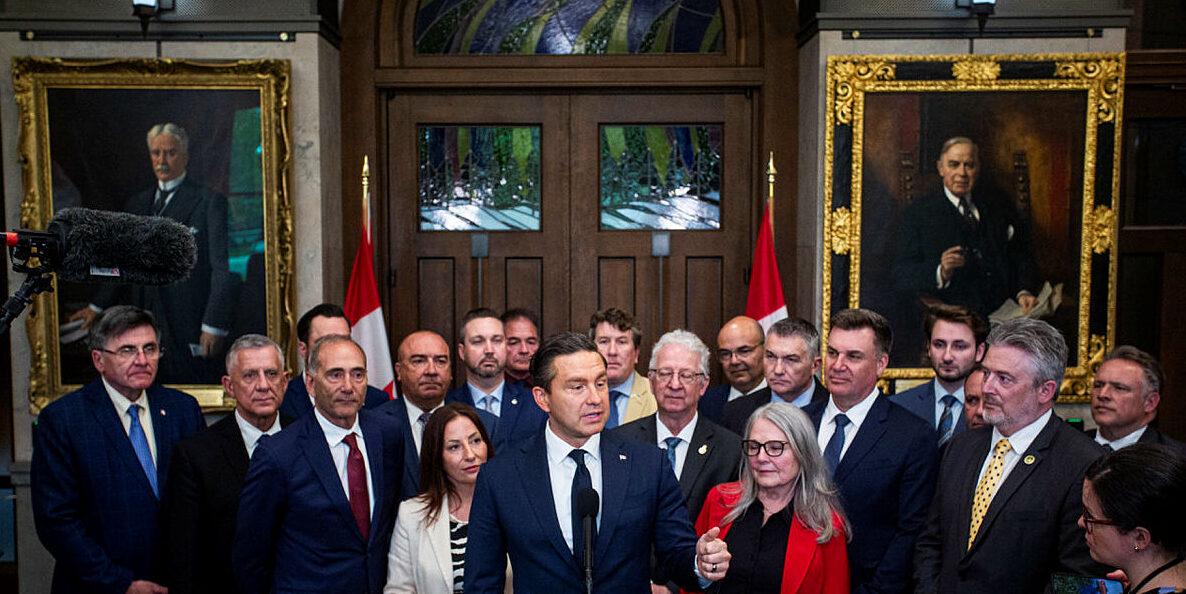
Some Conservatives are hoping the infighting between Leader Pierre Poilievre and prominent party members will 'die in the high temperatures of July and the slow broil of summer,' but others think it’s too deep and could be damaging for the leader.
Persistent internal squabbles amongst senior Conservatives have dampened the morale of caucus members, staff, and party volunteers who devote countless hours to helping the party succeed and win elections, raising concerns that the infighting could hurt the party’s prospects going forward and ultimately jeopardize Leader Pierre Poilievre’s political future.
“The morale is in the absolute shitter, completely,” said a Conservative MP.
“It’s very, very unproductive, and it’s going to hurt us,” said another Conservative MP, a staunch supporter of the leader, who spoke to The Hill Times on a not-for-attribution basis to offer their candid views.
“It’s destructive to our movement. [For] lots of people who help on campaigns and put the little free time they have towards political victory, it’s a big turn-off and that’s why it’s destructive.”
The start of the current round of infighting can be traced back to the 2025 federal election campaign, when veteran Conservative strategist Kory Teneycke repeatedly urged Poilievre’s (Battle River-Crowfoot, Alta.) campaign to pivot its messaging toward United States President Donald Trump’s tariff threats rather than focusing primarily on affordability and law-and-order issues. Teneycke argued that the Canada-U.S. trade dispute had become the top issue for many Canadians, but Poilievre largely maintained his emphasis on the cost of living and crime during the campaign.
Poilievre and his senior campaign officials believed Teneycke’s repeated public interventions distracted from the campaign’s core message and dominated media coverage, creating the perception of divisions within the Conservative caucus.
Until early January 2025, the Conservatives held a lead of more than 20 percentage points in national public opinion polls, and many polling aggregators’ seat projections predicted Poilievre would win a landslide majority government with more than 200 seats.
Instead, the party finished with 144 seats following the Liberal leadership change where now-Prime Minister Mark Carney (Nepean, Ont.) took over from the deeply unpopular Justin Trudeau, who announced his resignation on Jan. 6, 2025.
Despite spending close to $100-million in 2025, the Conservative Party still ended up in second place. Pundits and political insiders say that one of the key reasons for the loss was the campaign’s failure to devote sufficient attention to the escalating trade dispute between Canada and the U.S., whose economic relationship accounts for $1-trillion of annual trade in goods and services, and hundreds of thousands of jobs on both sides of the border.
Fast forward to the Calgary Stampede earlier this month, and new tensions came to the fore when Poilievre introduced British Columbia Conservative leadership winner Kerry-Lynne Findlay, a former federal MP, at an event by saying, “The future premier of British Columbia, Kerry-Lynne Findlay, fresh off a big win against Liberal lobbyists from out east.”
This was seen as a jab at Teneycke, who managed the campaign of Findlay’s rival, Caroline Elliott, who placed a close second in the provincial leadership election. Before managing Elliott’s campaign, Teneycke had run Ontario Premier Doug Ford’s three consecutive Ontario election victories. Before that, he served as then-prime minister Stephen Harper’s director of communications.
Poilievre’s comment triggered a wave of reaction from veteran Conservatives, starting with Elliott who, in a social media video, expressed her disappointment with the federal leader’s comments. Elliott said that she had supported Poilievre, including during his leadership review in January, and accused him of dividing the party when he should be working to unite it.
Several people who previously worked with Poilievre either during his leadership campaign or in the opposition leader’s office had joined Elliott’s campaign, including Anthony Koch, a senior adviser during Poilievre’s own leadership race in 2022, and Ben Woodfinden, who served as Poilievre’s chief spokesperson in the opposition leader’s office. Poilievre’s former communications director, Katy Merrifield, is also a close friend of Elliott’s.
On July 9, Koch wrote an article with the headline, “I’m a Conservative who wants to win! That doesn’t make me a Liberal,” to offer his reaction to Poilievre’s comment at the Stampede.
“I am sick to death of being told that wanting Conservatives to win elections somehow makes me a Liberal. It’s one of the stupidest ideas ever to infect the Canadian political right (and there have been some doozies in recent years), and it has become an excuse for failure,” Koch wrote in his National Post op-ed.
“Apparently, if you care whether Conservatives can actually form government, you’re a ‘fake Conservative.’ If you think candidates should avoid obvious own goals, you’re a sell-out. If you think messaging matters, you’re weak. If you suggest that screaming into the void isn’t a political strategy, you’re accused of wanting Liberal-lite.”
In the popular Curse of Politics podcast last week, Teneycke offered his own reaction:
“When you elect leaders who are completely and utterly unaccomplished prior to entering politics and who have entered politics in their 20s, you are going to be very vulnerable to running against somebody who has actually done something with their life.”
“And why [Andrew] Scheer is still sitting in the caucus is the same reason why Poilievre will end up sitting in the caucus after he’s done being leader: because he is unemployable in any other job,” Teneycke added.
Nick Kouvalis, a top Progressive Conservative strategist in Ontario, blasted Poilievre on X for more than a week after the Conservative leader made his comments at the Stampede.
“@PierrePoilievre can go fuck himself,” wrote Kouvalis on X on July 6. “I’ve gone from being a big supporter, to being disappointed, but still a supporter. Now, he’s gone out of his way to make me his opponent. Idiot.”
In addition to infighting amongst Conservative strategists, the lack of message discipline on policy issues among caucus members is also raising concerns within the party. The most recent example came when Ontario Conservative MP Leslyn Lewis (Haldimand-Norfolk, Ont.) criticized a $13-billion data centre in Alberta that Premier Danielle Smith celebrated because it would create 300 jobs and 3,000 people would be employed during the construction process. Alberta is also set to collect hundreds of millions of dollars in taxes and royalties.
“Before the [federal] government celebrates another AI announcement, Canadians deserve to know how this data centre will actually be built when Canada is already facing serious constraints in energy infrastructure, grid capacity, engineering capacity, and skilled labour,” Lewis wrote on X.
“AI data centres require enormous amounts of reliable power, specialized construction, advanced cooling, transmission infrastructure, cybersecurity, and technical expertise. After eleven years of failing to build the energy infrastructure Canada needs, the government must explain whether this project is truly viable and who will ultimately own, control, and benefit from the infrastructure if it proceeds.”
Conservative MP Michelle Rempel Garner (Calgary Nose Hill, Alta.) shot back in response to Lewis’ post: “It’s a great investment in Alberta, and is squarely in their jurisdiction. We have some of the best minds on grid management and capacity in the country. I’m sure any of our colleagues in the provincial government will be happy to sit down with you and walk through the project.”
‘This is terrible for us, and people recognize that,’ says one Tory MP
Conservative sources told The Hill Times that another factor negatively affecting the morale of caucus members, staffers, and the party’s grassroots is the ongoing floor crossings of Conservative MPs joining the Liberals. So far, four Conservative MPs have left their party to join the Liberals, and one has accepted a Senate appointment.
The four MPs are Chris d’Entremont (Acadie-Annapolis, N.S.), Michael Ma (Markham-Unionville, Ont.), Matt Jeneroux (Edmonton Riverbend, Alta.), and Marilyn Gladu (Sarnia-Lambton-Bkejwanong, Ont.). Richard Martel, most recently a Quebec Conservative MP, resigned from his seat on July 7 after accepting a Senate appointment to sit as an independent. With this departure, the Conservatives’ seats in the House are now reduced to 139 MPs. Rumours still persist about more Conservative MPs leaving the caucus to join the Liberals or accept Senate appointments.
Referring to the party’s polling numbers in 2023 and early 2025, when the Conservatives held a lead of more than 20 percentage points, Conservative MPs and senior party officials told The Hill Times there was once widespread enthusiasm within the party for Poilievre. However, after the 2025 election loss and events since then—including the most recent infighting and floor crossings—much of that momentum and excitement has faded. Instead of fighting amongst themselves, sources said, Conservatives should be focused on Carney, who, despite having been in office for about 17 months, continues to enjoy strong public approval.
These sources said that many caucus members are frustrated by the ongoing infighting and are concerned about the party’s polling numbers, but few are prepared to voice those concerns publicly. That, however, could change in the coming weeks or months, sources added. They said the ongoing infighting may not significantly affect the party’s standing with the broader public at this time, but is damaging to the Conservative movement internally.
“This is terrible for us, and people recognize that. … It never ends,” said a Conservative MP. “It’s constant. It’s a combination of one versus the other as well [as] whatever’s expedient. People are grifters and they will go to wherever the power is. This isn’t over. It’s too deep for it to be over.”
But others hope the infighting will end in the coming days as people take vacation and enjoy the summer recess.
“[I hope] the story dies in the high temperatures of July and the slow broil of summer,” said a Conservative MP.
A senior Conservative interviewed for this article said they generally support Poilievre’s style of politics, but believe he showed poor political judgment in his comment at the Stampede. The source said it’s always difficult for a party leader to navigate the aftermath of an election defeat, pointing to former prime minister Stephen Harper after the Conservatives lost the 2004 federal election.
At the time, many believed Harper was unlikely to lead the party to victory, but just two years later, he did. The source argued that one of Poilievre’s biggest challenges in taking on Carney is that the prime minister is a Red Tory, and occupies much of the Conservative Party’s traditional political ground. They said Carney has embraced a number of policies Conservatives have put forward for years, making it more difficult for Poilievre to draw sharp policy contrasts.
“Carney is essentially a progressive conservative, which causes us all sorts of problems,” said the senior Conservative. “Because we’re not well designed to [fight] against a progressive conservative.”
At the same time, the source said that although the NDP elected a new leader more than 100 days ago, the party has yet to gain meaningful traction with Canadians. Traditionally, they said, when NDP support increases, Liberal support tends to decline, a dynamic that often benefits the Conservatives by improving their chances of winning additional seats.
Posted by IHateTrains123
1 Comment
May the Reform scourge continue to inflict itself upon the Tories.