
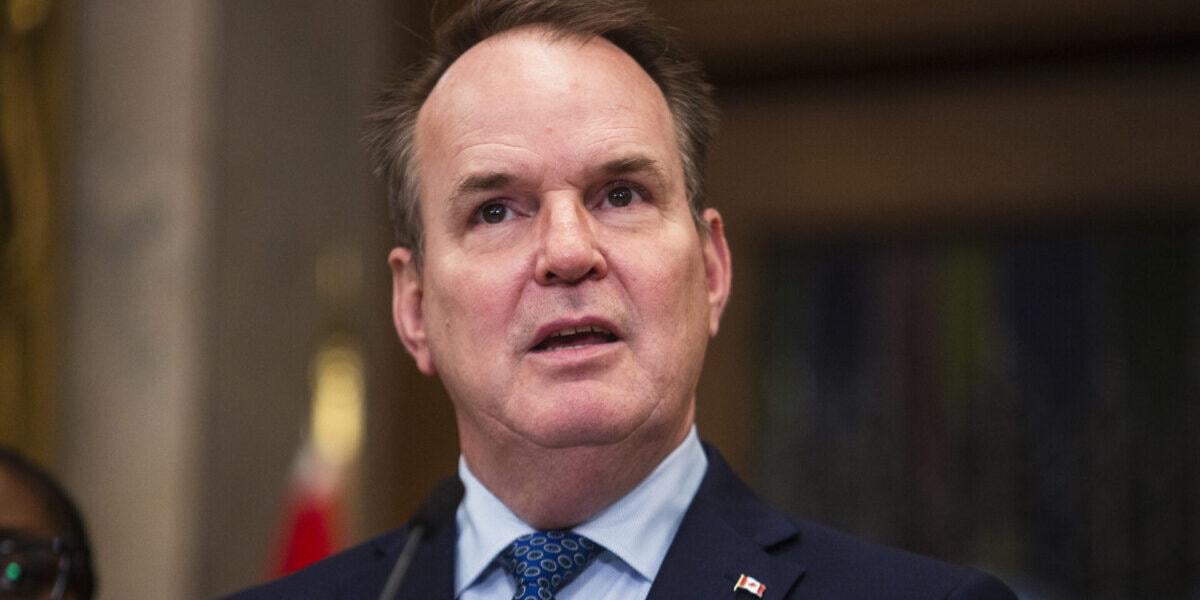
Bill C-25 clarifies or expands some of the existing prohibitions already in the Canada Elections Act, including certain types of false claims with the intent to undermine elections, according to political scientist Chris Tenove.
Measures included in recently passed legislation intended to safeguard federal elections and combat disinformation are a good start, but this “security patch” may need further steps to protect public confidence in the electoral system, according to experts.
“[Measures in Bill C-25] do deal with some clear and pressing issues, but there are some bigger picture trends or risks that it doesn’t fully address,” said Chris Tenove, a political scientist and assistant director of the University of British Columbia’s Centre for the Study of Democratic Institutions.
“Broadly, I think that we’re better off after C-25 than before, but there are more things to be done, including some where it’s not really clear what the best approach is going to be.”
The Canada Elections Act was modernized on June 18 with the royal assent of Bill C-25, the Strong and Free Elections Act. The bill, introduced back in March by Government House Leader Steven MacKinnon (Gatineau, Que.) contained measures intended to combat foreign interference which include prohibiting political parties, candidates, riding associations, leadership candidates, and third-party advertisers from accepting or using cryptocurrency for any election-related activities.
To help stem the spread of disinformation, the legislation also prohibits the creation and sharing of artificial intelligence (AI) deepfakes of political figures, with the intent to mislead, although the legislation allows a defence for these imitations created for the purpose of parody or satire.
Tenove told The Hill Times that the legislation clarifies or expands some of the existing prohibitions already in the Canada Elections Act, including those related to certain types of false claims with the intent to undermine elections. Section 482 of the act has been amended to make it an offence if someone knowingly publishes certain false statements with the intention of affecting the results or disrupting the conduct of an election. Examples include issuing statements known to be false about who may vote in an election, the process by which an individual may register to vote, or where or when someone may cast a vote.
This past May, Chief Electoral Officer Stéphane Perrault told MPs on the Procedure and House Affairs Committee that, while he was generally supportive of Bill C-25, he felt the legislation could go further in addressing disinformation that seeks to cast doubt in the electoral system. As an example, he mentioned the creation of falsified videos purporting to show stolen or destroyed ballots.
“Such behaviour supporting false claims that an election may have been stolen has nothing to do with criticism of the process or criticism of its administration. The standard for such an offence should be high, as I have proposed. I believe that a line must be drawn to protect our democracy against deliberate acts of destabilization,” Perrault told the committee at the time.
“In contrast, criticism of the process or of its administration is a normal part of democratic debate and should be tolerated, even though its premise may be factually false or even if it is made by conveying falsehoods. It is fundamentally distinct from attempts to overturn an election or undermine its results through the deliberate publication of false narratives.”
Tenove told The Hill Times that he considers public trust in elections, both federally and provincially, to be high in Canada, but added that distrust is still a growing problem. He described the issue as a “yellow warning light,” as opposed to a “blinking red light.”
“The changes in C-25, to a large extent, were dealing with, how do you reduce the supply of certain types of pretty narrow problems of false claims and impersonating claims in elections? But that’s only a small part of the puzzle,” he said.
When it comes to addressing disinformation intended to undermine confidence in electoral integrity, Tenove said, “It’s tricky.”
“On the one hand, I think it’s certainly true that if you look at disinformation efforts by foreign actors and also by undemocratic domestic actors, you do see efforts to promote distrust about [future] elections … and [past] elections … that don’t necessarily fall into the narrow categories about the mechanics of how the election works or the impersonation categories that are in the existing amended Canadian election act,” he said.
Tenove argued that, in some ways, the election system “works on organized distrust.”
“There are lots of parts of how we run elections that ensure transparency and observation by parties and other interested actors just to make sure things that are happening correctly, [but] we want to be able to have people voice strong criticisms about how elections are likely to happen, or elections-past,” he said.
“There might have been some challenges in finding a wording around this issue—around the intent to delegitimize elections that wasn’t vulnerable to being too expansive and possibly to being tossed out by a court saying that ‘this is too risky to freedom of expression.’”
Tenove said Canada must ensure there is a “high supply of good information” to encourage high participation rates of informed voters.
“Like a lot of information systems in Canada, we’re seeing things that are more influencer-led, algorithmically shaped, and often polluted with low-quality information. … How do you make sure that we have an information system that’s getting high-quality information to everyone around democratic issues?” he said.
‘Any level of disinformation should preoccupy us’: Jean-Pierre Kingsley
In May, Tenove told members of the Procedure and House Affairs Committee that Bill C-25 resembles a security patch for electoral software. In terms of remaining issues, he said that citizens are increasingly obtaining civic information from general-use chatbots, such as ChatGPT, AI companions, and AI search tools.
“However, these models sometimes give incorrect information regarding elections. For instance, Demos, a U.K.-based think tank, tested several AI services during the Scottish parliamentary election and found that 34 per cent of responses contained factual errors, including wrong dates and hallucinated candidates. Such errors could harm election participation,” Tenove told MPs in May.
Aaron Shull, research director of digitalization, security, and democracy at the Centre for International Governance Innovation, told The Hill Times that he thinks disinformation hasn’t yet “impacted elections in a material way,” but added that “we need to be vigilant.”
“The entire notion of electoral integrity is that you believe and that I believe, right? It need not be perfect, but we both have to agree on the outcome—the rules of the road and the game before we play—and then we agree that whoever has the most votes at the end of the thing gets to govern,” said Shull.
“The disinformation stuff … is a long-term erosion of shared values, and that’s really what’s concerning here, is that the slow drip, drip, drip of these campaigns [is] basically changing people’s views of the world based on lying, obfuscation, and cheating.”
Jean-Pierre Kingsley, who served as Elections Canada’s chief electoral officer from 1990 to 2007, told The Hill Times that he doesn’t think public distrust in election results is at an alarming level in Canada, “but any level should preoccupy us.”
“Deepfake images of the chief electoral officer [is] also something that should be covered. Messages emanating from his office, supposedly from his office—this should all be vetted. This should all be genuine, and there should be penalties if that is not the case,” Kingsley said.
“What is essential in the process is that people have credibility in the integrity of the system—the information that’s being provided to them.”
Duff Conacher, co-founder of Democracy Watch, told The Hill Times that he disagrees with Perrault’s position that the legislation doesn’t address the spread of disinformation with the goal of undermining trust in an election or its results. Conacher argued that issue would be covered under Bill C-25’s, section 482.01(f), which states it is an offence to knowingly make or publish a false statement pertaining to the “process by which votes at an election are counted or the results are validated,” with the intention of affecting the results or disrupting the conduct of an election.
The legislation also amended the act to similarly disseminate false information about the “preliminary, validated, or official results of an election.”
“One of the good things about the bill is fines have been increased, from $1,500 for individuals violating these provisions, to $25,000. And for any business or other type of entity, it’s been increased from 25,000 to $100,000 fines,” Conacher said.
“They don’t have to go to a judge. It’s just an administrative penalty that the commissioner [of Elections Canada] themselves can impose. I’m just not quite sure what [Perrault’s] saying when he says it’s not addressed at all.”
But Conacher does have other concerns, telling the Procedure and House Affairs Committee on May 26 that Bill C-25 included major loopholes that allowed undue influence in elections.
Conacher told the committee that Bill C-25 still allowed most disinformation posts on social media because it applies only to some false claims that a person knowingly posts with an intent to affect the outcome of the election or by-election.
In his interview with The Hill Times, Conacher said, “You can say all sorts of things about a candidate or party leader that are false, which [are] still not covered by this bill or the act. All sorts of derogatory things.”
Conacher pointed out that Bill C-76 (the Elections Modernization Act), which received royal assent in 2018, amended the Canada Elections Act with a more specific prohibition on certain categories of false statements made during an election period. More specifically, the new provision stated that during an election period, no one, with the intention of affecting the results of an election, may make or publish false statements about a political candidate’s citizenship, place of birth, education, professional qualifications, or false statements about them committing a crime.
“You can say someone’s racist. You could make up anything about them; they’re just pretty wide open. Why you would just narrow it to these things about education, whether they have a criminal record and what their professional qualifications are?” said Conacher.
Posted by IHateTrains123
1 Comment
The long and short of it is that Bill C-25 introduces several new measures intended to beef up the Canada Elections Act. Parliament introduced a ban on cryptocurrencies as campaign funds, a ban on AI deepfakes of opponents and tightens the rules on lying during campaign about the electoral process. All in all a positive development, but as Chris Tenove, PoliSci prof at UBC, says one major problem not addressed is the manner in how people receive information; in this case using AI to obtain civic information.
!ping Can&Extremism