Adam Tooze on the China shock to the German automotive industry. He looks into why the industry was vulnerable to such a shock. Relevant to this sub as it focuses on industrial policy as well as West/China relations.
> “The European car industry riding high, leading the world in sophisticated manufacturing, earning record profits, paying out huge dividends.
>No, I am not dreaming.
>I have not had a European summer stroke induced by a lack of air conditioning.
>This was the state of play in 2019, when according to no lesser authority than McKinsey, the European car industry was the dominant player in the world.
>Seven years later, the situation is transformed.
>Today, it is China’s exports that are hogging the headlines. Europe’s industry is described as being in the grips of an existential crisis. One third of European car-making capacity is declared surplus to requirement. Policy elites are debating elaborate instruments to support and protect the industry.
>China shock 2.0 is more than the European car industry. But without the crisis in the European car industry, China shock 2.0 would hardly be making the headlines that it is. The European car industry is not just “another case”. It is a flagship industry for Europe. Not for nothing it was highlighted by the Draghi report as the heart of Europe’s industrial R&D complex. Directly and indirectly it employs 13 million people.
>To sharpen the China shock discussion to the European car industry is not to diminish its significance but to underline it.
>What has happened?
>One obvious framing is China-centric: China’s industrial policy; the undervaluation of China’s currency; China’s inadequate domestic demand’; China’s contribution to global imbalances.
>But looking back to 2019 forces us to ask questions about the other side. What happened to the European producers? How did this once dominant industry, so suddenly become a victim?
>Not only do we need to tell both sides of this story so as to better understand what is going on. But, more urgently, understanding the European failure is also crucial to thinking through the best way to respond to the China shock.
>Crucially, we need to abandon the framing that one-sidedly pathologizes China whilst normalizing the rest of the world; the kind of framing that treats the European car industry as a fundamentally healthy sector that just needs a bit of protection to continue its, otherwise, normal development. The China shock is diagnostic. The fact that Europe’s car industry can be overrun in the way that it is being overrun, should be telling. It reveals things that are deeply wrong at the heart of the European economy. And this in turn means that if we really want to find a way out of the impasse, advocacy for protection and support should be tied to demands for systematic reform.
>To see the full force of this argument we need to go beyond the narrow focus on production and industrial employment that is framed by the “China shock” narrative. After all, over the long-run the broader issue for Europe, has been the mercantilism of German economic strategy and the suppression of the standard of living that follows. Most recently this was compounded by the “cost of living crisis”, which was diagnosed by many in progressive circles as the result of profiteering and price gouging. To this aggravation of Europe’s social bargain by the aggression of European capital, an influx of affordable, high-quality Chinese imports might actually appear as a cure.
>To put it in a nutshell, the challenge is not just how to respond to the China shock, but how to do so without exacerbating the damaging trends in Europe’s political economy that have produced the cost of living crisis. In the aftermath of the COVID price shock these were discussed controversially under the headline of “greedflation”. It would be hard to think of an industry for which this question is more pressing than the European car industry.
Otherwise_Young52201 on
>**In meeting the current urgency, Europe should not, therefore, focus only on China’s pathologies, but needs to examine what is going on at home**. After all, Europe is nominally committed to the energy transition. Europe boasts of itself as a competitive social market economy. It presumably favors an affordable cost of living for its population. It does not generally favor a world of over-priced, over-powered, polluting SUVs. Europe does not explicitly endorse profit-taking and financialization as desirable social and economic developments. But all of those were trends that were being deliberately promoted by its leading industrial firms, notably in the car industry.
Many people are saying.
Really glad that the recent academic conversations in this space are finally focusing on what Europe can do for itself rather than just focusing on what *China can do for Europe.* Because at the end of the day whatever China does to level the playing field to make competition fair ultimately won’t erase the competitive advantages they have over European producers.
Like I said in another thread, there’s a good chance that even if China appreciated it’s currency, removed all industrial subsidies, removed all tax rebates on exports, and raised wages, Chinese industry’s cost and technological advantages would still remain dominant compared to OECD industry.
-Maestral- on
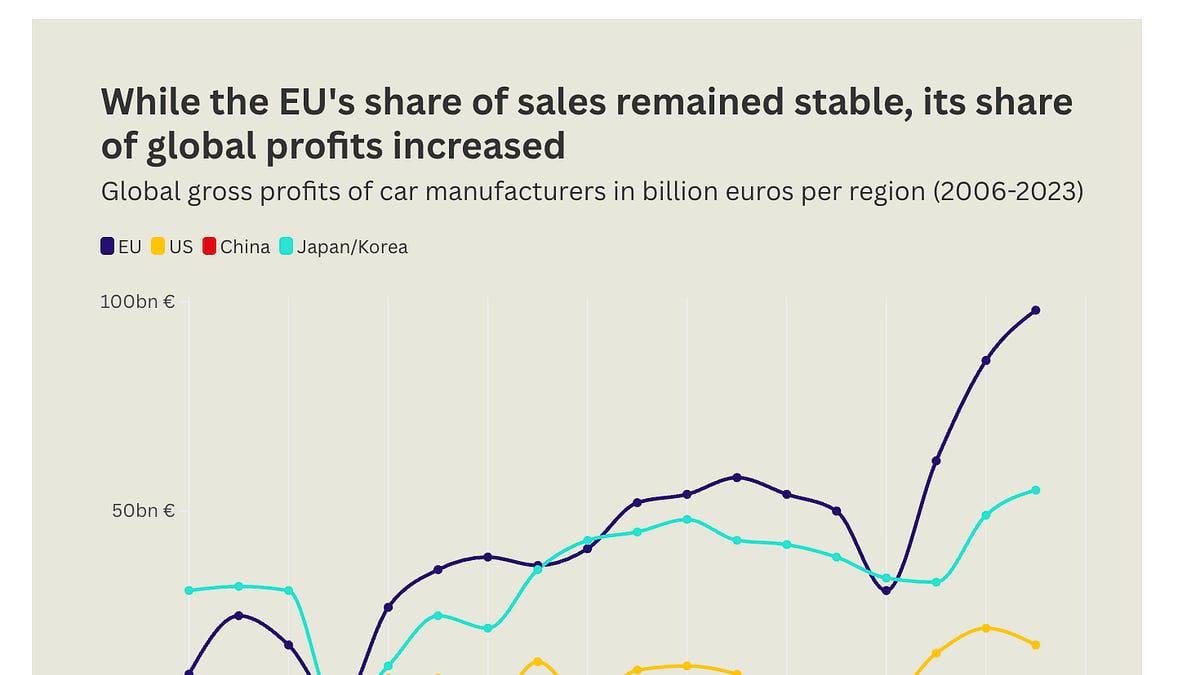
The article contrasts ‘the successfull past’ with ‘existential crisis at the moment’, but we see no data of that existentional crisis at the moment. Only data provided are up to 2023 of surging company profits, new car prices and dividends/financial reserves? I would like to see the data that underpins this crisis.
European car makers have held their sales share in Europe while growth of Chinese imports has come at the expense of imports from rest of the world As much as I’m aware this is the case in general with European goods trade (EU having 2nd highest goods trade suficit (or as it’s fashionable now overcapacity) after China).
The author also remarks that german automakers have been building financial reserves while asking for protection from Chinese imports. If I’m not wrong, it was French and Italian car makers that were pro protectionism while Spanish and German were against.
Article that kind of goes into this: https://www.ft.com/content/5817f869-7b5d-4260-87b3-1500750172e0?syn-25a6b1a6=1

3 Comments
Submission statement:
Adam Tooze on the China shock to the German automotive industry. He looks into why the industry was vulnerable to such a shock. Relevant to this sub as it focuses on industrial policy as well as West/China relations.
> “The European car industry riding high, leading the world in sophisticated manufacturing, earning record profits, paying out huge dividends.
>No, I am not dreaming.
>I have not had a European summer stroke induced by a lack of air conditioning.
>This was the state of play in 2019, when according to no lesser authority than McKinsey, the European car industry was the dominant player in the world.
>Seven years later, the situation is transformed.
>Today, it is China’s exports that are hogging the headlines. Europe’s industry is described as being in the grips of an existential crisis. One third of European car-making capacity is declared surplus to requirement. Policy elites are debating elaborate instruments to support and protect the industry.
>China shock 2.0 is more than the European car industry. But without the crisis in the European car industry, China shock 2.0 would hardly be making the headlines that it is. The European car industry is not just “another case”. It is a flagship industry for Europe. Not for nothing it was highlighted by the Draghi report as the heart of Europe’s industrial R&D complex. Directly and indirectly it employs 13 million people.
>To sharpen the China shock discussion to the European car industry is not to diminish its significance but to underline it.
>What has happened?
>One obvious framing is China-centric: China’s industrial policy; the undervaluation of China’s currency; China’s inadequate domestic demand’; China’s contribution to global imbalances.
>But looking back to 2019 forces us to ask questions about the other side. What happened to the European producers? How did this once dominant industry, so suddenly become a victim?
>Not only do we need to tell both sides of this story so as to better understand what is going on. But, more urgently, understanding the European failure is also crucial to thinking through the best way to respond to the China shock.
>Crucially, we need to abandon the framing that one-sidedly pathologizes China whilst normalizing the rest of the world; the kind of framing that treats the European car industry as a fundamentally healthy sector that just needs a bit of protection to continue its, otherwise, normal development. The China shock is diagnostic. The fact that Europe’s car industry can be overrun in the way that it is being overrun, should be telling. It reveals things that are deeply wrong at the heart of the European economy. And this in turn means that if we really want to find a way out of the impasse, advocacy for protection and support should be tied to demands for systematic reform.
>To see the full force of this argument we need to go beyond the narrow focus on production and industrial employment that is framed by the “China shock” narrative. After all, over the long-run the broader issue for Europe, has been the mercantilism of German economic strategy and the suppression of the standard of living that follows. Most recently this was compounded by the “cost of living crisis”, which was diagnosed by many in progressive circles as the result of profiteering and price gouging. To this aggravation of Europe’s social bargain by the aggression of European capital, an influx of affordable, high-quality Chinese imports might actually appear as a cure.
>To put it in a nutshell, the challenge is not just how to respond to the China shock, but how to do so without exacerbating the damaging trends in Europe’s political economy that have produced the cost of living crisis. In the aftermath of the COVID price shock these were discussed controversially under the headline of “greedflation”. It would be hard to think of an industry for which this question is more pressing than the European car industry.
>**In meeting the current urgency, Europe should not, therefore, focus only on China’s pathologies, but needs to examine what is going on at home**. After all, Europe is nominally committed to the energy transition. Europe boasts of itself as a competitive social market economy. It presumably favors an affordable cost of living for its population. It does not generally favor a world of over-priced, over-powered, polluting SUVs. Europe does not explicitly endorse profit-taking and financialization as desirable social and economic developments. But all of those were trends that were being deliberately promoted by its leading industrial firms, notably in the car industry.
Many people are saying.
Really glad that the recent academic conversations in this space are finally focusing on what Europe can do for itself rather than just focusing on what *China can do for Europe.* Because at the end of the day whatever China does to level the playing field to make competition fair ultimately won’t erase the competitive advantages they have over European producers.
Like I said in another thread, there’s a good chance that even if China appreciated it’s currency, removed all industrial subsidies, removed all tax rebates on exports, and raised wages, Chinese industry’s cost and technological advantages would still remain dominant compared to OECD industry.
The article contrasts ‘the successfull past’ with ‘existential crisis at the moment’, but we see no data of that existentional crisis at the moment. Only data provided are up to 2023 of surging company profits, new car prices and dividends/financial reserves? I would like to see the data that underpins this crisis.
European car makers have held their sales share in Europe while growth of Chinese imports has come at the expense of imports from rest of the world As much as I’m aware this is the case in general with European goods trade (EU having 2nd highest goods trade suficit (or as it’s fashionable now overcapacity) after China).
The author also remarks that german automakers have been building financial reserves while asking for protection from Chinese imports. If I’m not wrong, it was French and Italian car makers that were pro protectionism while Spanish and German were against.
Article that kind of goes into this: https://www.ft.com/content/5817f869-7b5d-4260-87b3-1500750172e0?syn-25a6b1a6=1