
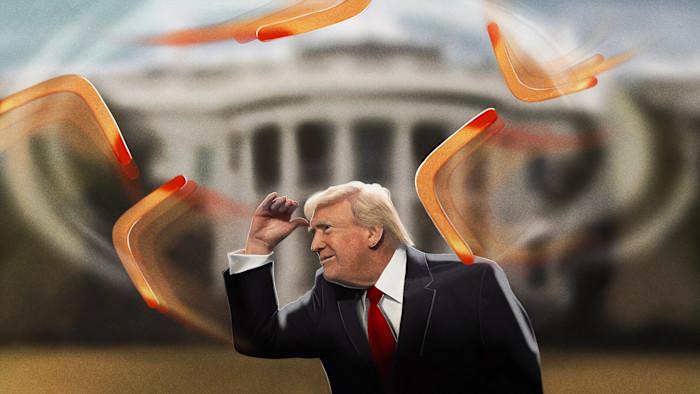
A movement that admires belligerence and confrontation will turn on its own in the end
That bit in The Life of Brian, where the People’s Front of Judea resent being mistaken for the Judaean People’s Front: do young viewers get the joke? It was meant as a satire of the left. Socialists in the 1970s were forever splintering into obscure factions or “tendencies”. Watched again now, the scene remains clever. It does not remain entirely relevant.
For fragmentation in 2026, look right. In Poland, the ultra-conservative Law and Justice Party (PiS) cannot agree whether to become still more hardline or to woo a different sort of voter. The result is an increasingly formal split. Mateusz Morawiecki — the relative moderate in this saga, as much as that spooks western European liberals who remember him as prime minister — leads a grouping within PiS with the reassuringly bland name of Development Plus.
Where Poland goes, Britain has already gone. Nigel Farage’s Reform UK is losing voters to the same-sounding but more extreme Restore Britain. The leader of the first is a “coward and a viper”, says the leader of the second, a former colleague.
The US Republicans have more internal discipline. Shared worship of Donald Trump glues together people who would otherwise squabble. But the post-Trump battleground is forming. JD Vance, a sceptic of far-off wars, and Marco Rubio, a comparative hawk, are already conducting a debate through code and insinuation. Foreign affairs might not even be the main philosophical rift in the primaries of 2028. A larger question is whether the GOP should be explicitly Christianist or, as it did when it embraced the playboy Trump, think better of scaring a secularising electorate.
In Italy, meanwhile, a former army general who set up a party in February to outflank the rightwing League already outpolls it. In France, the best chance of averting the hard-right presidency that has been threatening to happen all century is a schism between the movement’s two figureheads.
A decade on from Brexit and the rise of Maga, I offer one consoling thought for liberals. Populism will eat itself. More than that, populism must eat itself. A movement that admires aggression, that thrives on conflict, that regards liberalism as not just wrong but boring, cannot help but eventually rough up its own side too. You can’t seek round-the-clock confrontation with enemies — even with the media — and then become a different person with colleagues. Belligerence is just too difficult a trait to psychologically compartmentalise.
(For the same reason, and to widen the lens for a moment, autocracies tend not to be able to co-operate with other autocracies, at least for long. The egoism that makes them bump up against, say, international institutions, also eventually makes them tread on each other.)
Not only are the right the “splitters” now, the problem should get worse quite soon. The one thing that holds these movements together is the leader’s charisma, which smooths over otherwise irreconcilable ideas and interests. I have come to suspect that populists embrace strongmen for the sake of internal cohesion, and only then retrofit the idea that it is the best form of rule for the wider country. Either way, without their common submission to Trump, Maga would be a fiasco of contradictions. Without Farage, British populism would have splintered much more, much earlier. As a reminder of its underlying flakiness, Reform’s home affairs spokesman once quit and then un-quit within 48 hours.
Well, Trump turned 80 last month. The sun might be setting on Farage too, if his erratic judgment of late and Reform’s polling dip are clues. The prospect that Anglo-American populism disintegrates once these men leave the scene is underrated. (How telling that PiS, which is fracturing, has never had a Trump-style charismatic in charge.) For all that liberals mock the personality cult of Trump, it at least keeps the GOP away from divisive questions of doctrine and strategy. He saves them having to think. Après lui, le déluge. Also, political fragmentation in Italy is one thing. In the UK and the US, where the voting system so rewards cohesion, it can be unsurvivable.
There is no more effective strategy against populists than waiting for them to split. I realise how discouraging this sounds. A great amount of harm can be done to a country or to the world during the wait. But the returns on campaigning harder, “listening” more or even governing better are what, exactly? (Populism broke through during a time of low inflation and falling crime, remember.) At most, liberals can tease out the cracks in populism with well-put questions. Is Russia a mortal enemy or a misunderstood conservative Shangri-La? If Muslim immigration is a threat, what is it a threat to: Christian traditions or secular freedoms? Shouldn’t a non-American populist leader fight Trump, insult for insult, tariff for tariff, instead of crawling to him?
In the end, it is the very thing that populism despises about liberals — their compromising natures, their wateriness — that makes them such formidable enemies. For it stops them splitting. Even when a rupture occurs, such as the putsch against Sir Keir Starmer this summer, it is contained within a party. By my count, Rupert Lowe, Restore’s leader, is in his fourth party. Such is the eternal dilemma of the radical. You can’t revere aggression most of the time and then switch it off among friends.
Posted by IHateTrains123