
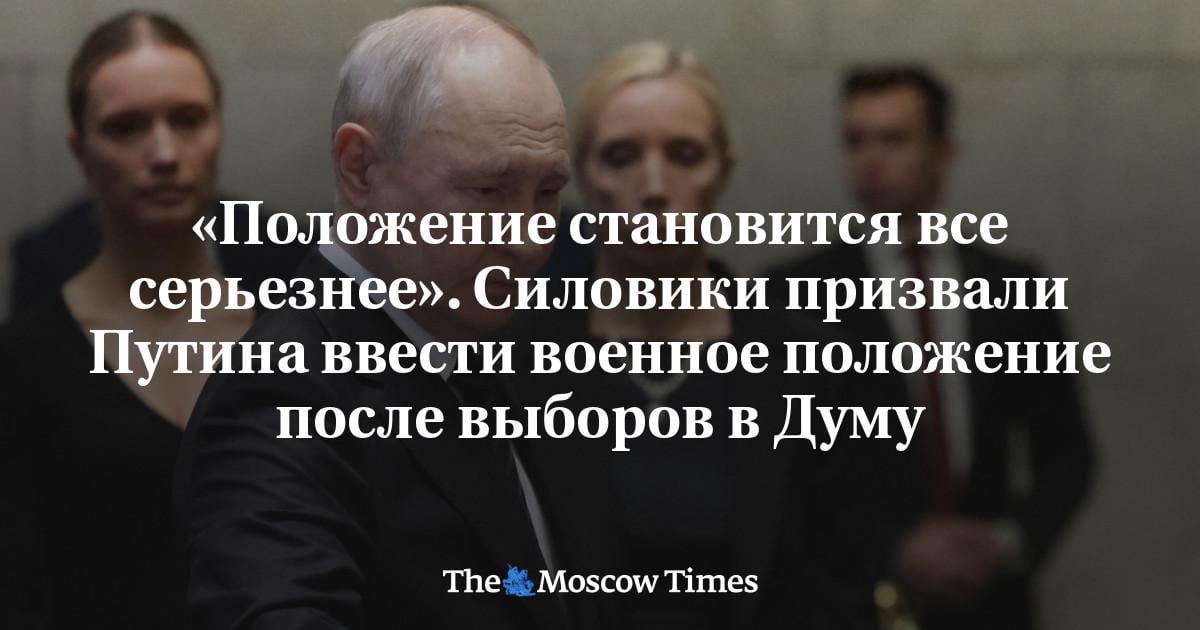
Russian officials do not rule out the introduction of martial law in the country following the State Duma elections in September, reports Verstka, citing sources within federal and regional government bodies, the State Duma, and individuals close to the Kremlin.
According to the publication's sources, the shift to martial law is supported by certain representatives of the security establishment, who believe it is time for the authorities to "stop coddling" the population and start "waging war as a whole nation."
"The country's situation is becoming increasingly critical, and it may prove impossible to stabilize it without extreme measures," said one of Verstka’s sources. Under current legislation, martial law is imposed by presidential decree (de facto for an indefinite period) and allows for curfews, restrictions on freedom of movement, the compulsory assignment of individuals to defense-industry jobs, the requisitioning of property for defense needs, the cancellation of elections, and total censorship.
According to sources cited by Verstka, the imposition of martial law could be triggered by a major failure at the front or a sharp drop in recruitment rates for the war—rates that had already fallen to a three-year low earlier this year.
In addition to the imposition of martial law, sources cited by Verstka indicate that mobilization—rumors of which have been circulating for months—cannot be ruled out, nor can further restrictions such as the tightening of currency regulations and bans on foreign travel for specific categories of citizens (e.g., employees of strategic enterprises). Regional sources also consider it possible that a portion of citizens' savings could be forcibly converted into war bonds to finance the budget deficit, which reached nearly 6 trillion rubles between January and June.
Amendments regulating the activities of Rosgvardia (the Russian National Guard) point to Kremlin preparations for potential mobilization and the imposition of martial law, according to experts at the U.S.-based Institute for the Study of War (ISW). Under the proposed changes—published on July 20—the mandate of Rosgvardia, which is controlled by Putin, now includes the advance preparation of personnel, facilities, and assets to guard against threats arising during mobilization, martial law, and wartime. Russian authorities likely anticipate public discontent should large numbers of people be sent to the front, and are laying the groundwork for the potential implementation of wartime laws, the ISW notes.
Some European officials do not rule out the possibility of mobilization in Russia this autumn, sources previously told The Washington Post. According to them, the Kremlin might take such a step if high casualty rates at the front persist. The alternative for Putin, the sources said, is to pause the war, as continuing it is becoming increasingly burdensome for the budget and the economy.
Translated by Google Translate, mistakes are my own.
Posted by IHateTrains123
2 Comments
99% of authoritarians escalate their wars right before they should have given up.
How prosperous and powerful could Russia be if they stopped waging war, stopped their corruption. If they had an actual representative democracy? If they didn’t funnel their resource wealth directly to oligarchs?
I’m trying to imagine Russias size and population, but with a government like Norways and the excess resource wealth going into a sovereign wealth fund or something.
Competent Russia sounds like it would actually be a scary geopolitical rival.