
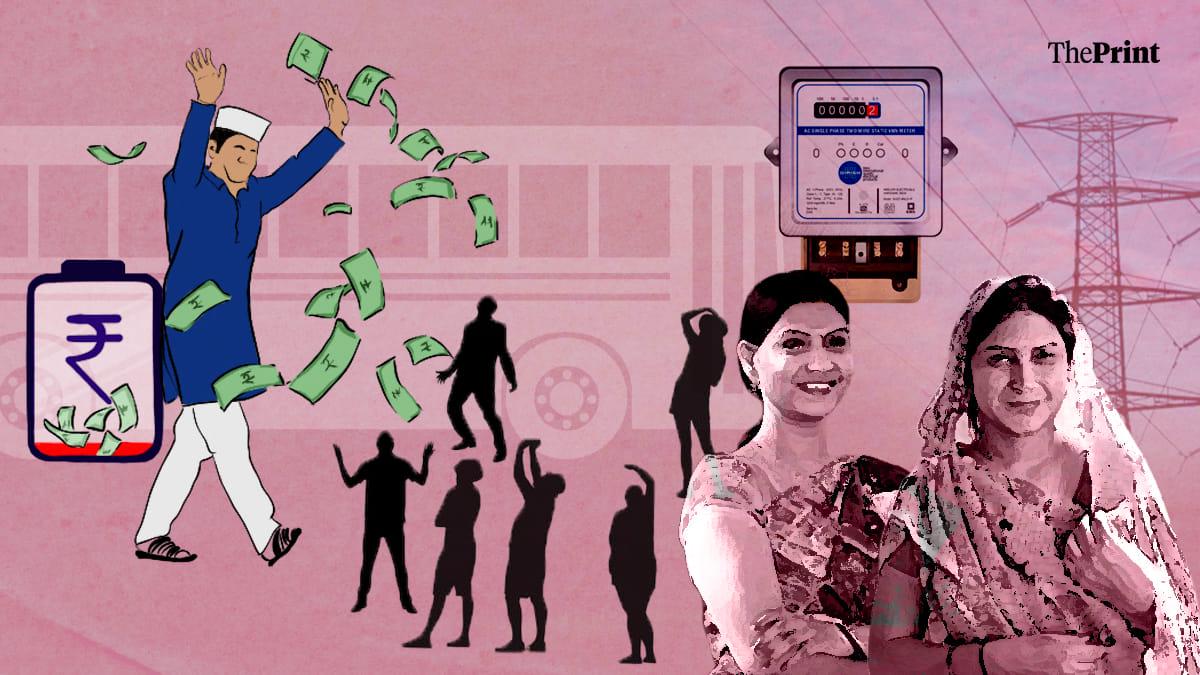
Every election in India the moon , the sun, and the stars are promised to the voters. Then comes election time, and whoever wins has to account for those promises
So whats a government to do ? Well, it can add hoops and kind of try to say "conditions apply," such as adding restrictions and limitations so that actually they dont have to pay as much. They can just try to welch on it (untill the next election where they recall it exists) or, worse of all they can actually pay it.
This is very bad for development because money spent or promised on handing goodies out isn't money for actual infrastructure.
now there is a limit. Himachal Pradesh going into a financial meltdown is probably a big warning sign. There is also a provision in the Indian Constitution, Article 360, under which the Centre can step in to fix things. Personally speaking, Article 360 is a bit like german Bundeszwang/article 37. I don't think its been used yet but when it does its gonna be very interesting
Posted by ewatta200
1 Comment
**New Delhi:** When the 2025 Delhi Assembly elections were announced, all the contesting parties knew that the key to power in the National Capital rested with its women voters. And so, all parties rushed to woo them, with promises of monthly cash benefits, free bus rides and dedicated pension schemes. [](https://theprint.in/world/two-die-as-firefighting-helicopters-collide-in-greece-french-blaze-changes-course/3003740/?utm_campaign=theprint&utm_medium=ticker&utm_source=vdoai_ticker)
Over 1.5 years later, the BJP government in Delhi is set to roll out one such promise, but with the quintessential ‘conditions apply’.
The Delhi Lakshmi Yojana, which offers a monthly assistance of Rs 2,500 to women from Economically Weaker Sections (EWS), is a series of eligibility and disqualification hoops, and even guidelines on how this money should be used. The benefit, which is expected to reach about 17 lakh women, according to officials, will cover women between 21 and 60 years of age whose family income is up to Rs 2.5 lakh per annum, and has been living in Delhi for at least 10 years.
But a woman who has more than three children, or who pays income tax or files GST returns, or whose family owns a four-wheeler, or whose family consumes more than 2,400 units of electricity, or who has a criminal record will not be eligible.
Those applying will also have to submit an endorsement letter from the MP or MLA of their constituency. Every application will go through a four-stage verification process.
And once a woman does succeed in jumping through all of these hoops to qualify for the scheme, she is still not entitled to receive the money directly in her bank account. Instead, she is given two ways to receive the benefit— she can either choose to have the entire sum of Rs 2,500 invested in a Recurring Deposit (RD) or Fixed Deposit (FD), or receive Rs 1,000 through a Central Bank Digital Currency (CBDC) wallet and have the remaining Rs 1,500 deposited into an RD or an FD account.
And if she picks the second option, she still doesn’t get to choose what she would spend this money on. The CBDC wallet comes with its own list of goods and services that the money cannot be used for—including alcoholic beverages, tobacco products, and lottery tickets.
The destiny of election-linked freebies goes through a similar lifecycle in most states—a broad, open-ended announcement right before the elections to woo voters, a harsh reality check owing to financial constraints once the party actually comes to power, a realisation that the promise in its entirety may be unsustainable, and then a scheme that is just a faint shadow of the promise that birthed it.
In Maharashtra as well, in a bid to retain power, the BJP-led ruling Mahayuti promised cash handouts of Rs 1,500 to women under the Mukhyamantri Majhi Ladki Bahin Yojana in 2024. To bolster its commitment, over 2.3 crore beneficiaries received monthly installments of the Rs 1,500 payout for months before the polls.
However, since then, the number of beneficiaries under the scheme has fallen from to 1.66 crore, with around 81 lakh registered beneficiaries being removed from the scheme following an e-KYC verification drive, citing non-eligibility. Ineligible beneficiaries included over-age women, vehicle owners, government employees and even 14,000 men.
Similarly, the Mukhyamantri Mahila Rojgar Yojana, a Bihar government initiative, was launched by Prime Minister Narendra Modi a month before the polls in November 2025, to transfer R. 10,000 each into the bank accounts of 75 lakh women across Bihar.
The scheme promised the “possibility” of additional financial support of up to Rs 2 lakh in subsequent phases. But these installments haven’t reached the women so far.
Then Bihar Chief Minister Nitish Kumar had announced in January that action to release the second installment under the scheme had been initiated, but Opposition in the state has alleged that the state’s coffers are empty and the installments haven’t come through.
While the schemes are often credited by analysts and even parties themselves for bringing them into power, their implementation is often a far cry from the promises that are made during elections, no matter the party in question— whether it is the Mahayuti government in Maharashtra, the BJP government in Delhi and Haryana, the Aam Aadmi Party government in Punjab, or the Congress government in Karnataka and Himachal Pradesh.
For a state government, the implementation of broad-based election promises also often turns out to be a double edged sword. For instance, non-implementation of its promise of Rs 1,000 for women continued to harm the AAP government’s credibility not just in Punjab but even in Delhi.
But implementation of the five promised guarantees in Karnataka led to then Deputy Chief Minister DK Shivakumar admitting that the state did not have funds for development. The guarantee schemes also had a direct impact on development in the state, with a 2025 Comptroller and Auditor General (CAG) report saying that they reduced capital expenditure towards infrastructure by around Rs 5,229 crore in 2023-24.
Madan Sabnavis, Chief Economist at CARE Ratings, explains that whenever elections are being held, there is always a tendency for these policies to be spoken about, but at the end of the day, all governments have to function according to the Fiscal Responsibility and Budget Management (FRBM) rules and the fiscal space available to them.
“I think we have to take (such announcements) with a pinch of salt because these are only announcements which are made. Finally, at the end of the day, if you see what is delivered, it’s all based on what can be accommodated given the budgetary numbers. States have to go according to their fiscal deficit ratios,” he explains.