
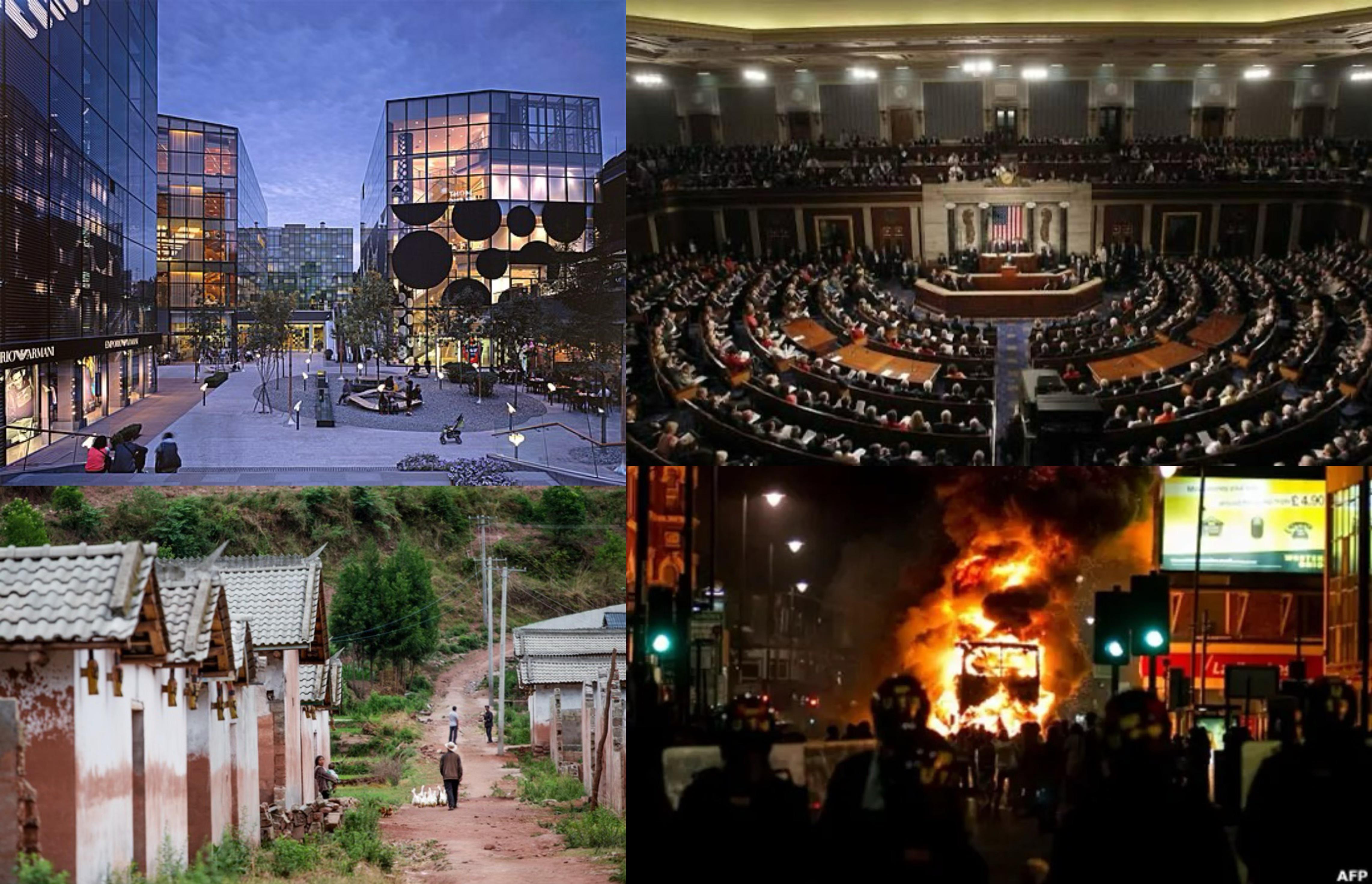
Many Chinese People’s Idealized Expectations of the West, Their Cognitive Biases, and the Reasons Behind Them: Disappointment with Domestic Reality, the Search for an Alternative to China’s Traditions and Present Conditions, Rebellion Against Official Narratives and Anti-Western Propaganda, and Limited or Superficial Knowledge of Distant Foreign Countries 2
The Limitations and Dual Nature of Western Democratic Societies: Freedom and Democracy Are Not a Panacea; the Complexity of Legal Rights Protection; the Limited Effectiveness and Practical Constraints of Public Opinion and Protest; Barriers to Speaking Out and Being Heard; Media Bias; the Widespread Existence of Social Injustice; and the Seriousness of Racial Issues and the Challenges They Pose to Chinese People 4
Some Westerners’ Excessive Praise and Idealization of China and the Motivations Behind It: Likewise Dissatisfied with Their Own Countries and Emotionally Investing in a Distant Foreign Land, with the Far Left and Far Right Showing Particular Favor Toward China for Their Own Reasons 7
China’s Dual Nature and Complexity: Achievements and Problems Coexist; Uneven Distribution of the Benefits of Economic Growth; Improved Living Standards Alongside Class Polarization and Entrenchment; High Efficiency and Good Public Security Come at a Cost; Voices Against Injustice Are Easily Suppressed; Excellent Infrastructure but Serious Corruption and Waste; Anti-Corruption as a Tool for Political Struggle and Power Reshuffling; the Fragility and Latent Risks of Superficially Harmonious Ethnic Relations Under High Pressure; the Far Left and Far Right in the West Misjudge China and Project Their Aspirations onto It; Foreigners’ Favorable Treatment Leads to Partially Distorted Perceptions 8
Social Problems, Economic Hardship, Political Struggles, and Partisan Polarization Within the West, Together with the Extension of Domestic Competition Between Pro-China and Anti-China Forces, Have Led Some Individuals and Political Groups to Idealize China as the “Other” 13
From the European Enlightenment to China’s Transformations in the Late Qing Dynasty and the Early Republic: The Tradition of Chinese and Westerners Viewing Each Other as an Idealized “Distant Paradise,” Using the Idealization of the Other to Express Dissatisfaction with Their Own Societies, and the Gap Between These Perceptions and Reality 14
Neither China nor the West Is Perfect; Both Have Their Strengths and Weaknesses. Each Can Learn from the Other, but Neither Should Be Idolized. The Human Tendency to Believe That “What Is Far Away Is Better,” Together with the Idealization and Emotional Projection onto the “Other,” Is Understandable, Yet Distorted Perceptions Depart from Reality and Can Easily Lead to Misjudgment and Misguided Action. What Is Needed Is an Objective and Balanced Perspective 16
For a long time, there have been profound differences and barriers between China and the Western world, represented primarily by Europe and the United States. The vast geographical distance, different political systems, racial and cultural differences have all made these divisions deeply entrenched. These differences have not only generated conflict and hostility between the two sides, but have also led some people on each side to develop excessively idealized images of the other as an exotic “Other.” Some have even come to regard this “Other” as a kind of utopian land that they long for above all else.
Much has already been written about the conflicts and hostility between China and the West. This article instead focuses on the idealized perceptions and emotional projections that some Chinese and Western people have toward each other, the gap between these perceptions and reality, and the motivations and consequences of romanticizing the “Other.”
Many Chinese People’s Idealized Expectations of the West, Their Cognitive Biases, and the Reasons Behind Them: Disappointment with Domestic Reality, the Search for an Alternative to China’s Traditions and Present Conditions, Rebellion Against Official Narratives and Anti-Western Propaganda, and Limited or Superficial Knowledge of Distant Foreign Countries
Since China’s Reform and Opening-up, many people, both within and outside the political establishment, have held favorable views of, or even admired, the Western world. As China gradually emerged from the poverty and isolation of the Mao era and once again “opened its eyes to the world,” many Chinese were struck by the enormous gap between China and the West in terms of material prosperity and cultural appeal. It was only natural that this shock gave rise to admiration for the West. Not only Europe and the United States, but also developed Japan as well as Hong Kong and Taiwan came to serve as a kind of special “West” and “Other,” becoming objects of admiration and aspiration for many people in mainland China.
The Chinese government’s policies shifted from being relatively pro-Western in the 1980s to becoming increasingly critical of the West after the 1990s, causing many Chinese people to change their attitudes toward the West. Those who supported the government actively criticized Europe and the United States, while anti-establishment individuals, driven by a rebellious mindset and ideological convictions, came to admire the West even more than before. Disappointed with China’s politics, history, and contemporary society, they turned outward in search of alternatives, hoping to transform China by adopting Western models.
Many of these people have never gained a deep understanding of the West. Some have never been there, while others have only traveled briefly or lived within specific social circles. As a result, they possess only a superficial—or even nonexistent—understanding of Western societies. Their views are often shaped by their own limited experiences and particular objectives, making their perceptions markedly different from the full reality of Western society.
Pro-Western views are not confined to liberal intellectuals in China. Because of China’s long-standing poverty, political repression, and social tensions, many people from the lower and middle strata of society have experienced great hardship. Some choose to embrace the government’s narrative, making disparagement and criticism of the West their “spiritual sustenance.” Others, however, regard the West as an object of emotional longing—a place akin to a beautiful new life after reincarnation, something that provides psychological comfort much like the Chinese idiom “quenching one’s thirst by imagining plums.”
Many Chinese people, in particular, strongly admire and aspire to what they perceive as the West’s democratic and liberal political systems, Christian civilization, civic virtues, and social welfare. At the same time, they deliberately overlook or “filter out” the shortcomings and darker aspects of Western societies. They often dismiss information that exposes or criticizes problems in the West as merely “government brainwashing,” rejecting such views outright without examining the facts. In recent years, the increasingly vocal denigration of the West by the so-called “50-cent army” and “Little Pinks” (supporters of the Communist Party of China) has further reinforced the determination of government critics to praise Europe, the United States, Japan, Taiwan, and other Western countries or their allies that stand in opposition—or at least in conflict—with the Chinese government.
As a result, this group’s understanding of the broader “Western” world—including Europe, the United States, Japan, Hong Kong, and Taiwan—is a selectively constructed picture that mixes facts with subjective imagination and fantasy. It is an idealized image that differs substantially from the complexity of reality and the complete truth. The problem lies not only in factual misunderstandings, but also in excessive optimism regarding the extent and significance of the West’s perceived virtues.
For example, many Chinese people, especially intellectuals, have expressed excessive admiration for and confidence in Western political systems, particularly that of the United States. They believe that these systems fully safeguard democracy, guarantee broad freedoms for the people, function effectively according to institutional rules, and successfully constrain political leaders while encouraging them to respect constitutional norms and relinquish power when appropriate.
In reality, however, the operation of Western politics and the social realities of Western countries are far more complex. Power struggles can be just as ruthless, bureaucracy is equally pervasive, the voices of vulnerable and marginalized groups are often ignored, and even well-intentioned policies can become distorted or produce significant unintended consequences. In recent years, the return of Donald Trump to power twice, together with the rise of far-right populism across Europe, the United States, and Japan, has further shattered the idealized image of the West as a bastion of civilization.
Likewise, the belief that “Europeans, Americans, Japanese, or people from Hong Kong and Taiwan are of higher quality” departs from the full reality. Anyone who has genuinely interacted with people from different countries, ethnic groups, and social classes will discover that, whether in China or abroad, whether among Han Chinese or other ethnic groups, there are both good and bad people, people of high and low civic standards. Fraud, deception, and exploitation exist everywhere, and statistically speaking, there is no clear or significant difference in these traits between ethnic groups. Moreover, problems relating to public conduct and crime that arise from poverty, deprivation, or historical trauma should not be blamed on an entire ethnic group or used as grounds for excessively harsh judgments against any particular community.
There are also some Chinese people who understand Western societies quite well and recognize both their strengths and weaknesses. Yet, for ideological or political reasons, they choose either to demonize the West entirely or to idealize it completely, thereby misleading more Chinese people into making inaccurate judgments about Western societies. Such people are not ignorant; rather, they knowingly distort reality. Their conduct deserves condemnation.
The Limitations and Dual Nature of Western Democratic Societies: Freedom and Democracy Are Not a Panacea; the Complexity of Legal Rights Protection; the Limited Effectiveness and Practical Constraints of Public Opinion and Protest; Barriers to Speaking Out and Being Heard; Media Bias; the Widespread Existence of Social Injustice; and the Seriousness of Racial Issues and the Challenges They Pose to Chinese People
Regarding the political systems, social institutions, and welfare provisions of the Western world and other developed countries, it is true that, in several respects and from certain perspectives, they are superior to those of China. However, this does not mean that they are free of problems. On the contrary, they have many serious problems of their own.
1.The principles of popular sovereignty and broad civil liberties under Western democratic systems are certainly positive. However, freedom and democracy are not a panacea. Many social problems and darker aspects of human nature are not resolved or eliminated simply because a country is democratic. The same kinds of distressing problems exist in democratic countries as well, although they may manifest themselves differently. In some cases, even their outward forms are scarcely different from those found in China.
For example, disparities, injustices, and conflicts among different identities, ethnic groups, and social classes cannot be resolved merely through freedom and democracy. Sometimes democratic institutions help alleviate such tensions; at other times, they may even intensify conflict and social instability. Freedom and democracy merely provide different groups with opportunities to compete politically—they do not simultaneously solve everyone’s problems.
2.Even in developed democracies, there remain numerous injustices and human rights violations in the protection of individual rights and the distribution of benefits. Domestic violence, school bullying, workplace harassment, and sexual assault are all widespread. The process of defending one’s rights often involves complicated procedures, cumbersome legal requirements, high costs, bureaucratic obstacles, and intense struggles between individuals competing over interests and disputes.
For example, seeking justice through legal channels often requires substantial financial resources and emotional energy. Familiarity with legal procedures and the ability to hire skilled lawyers may sometimes have a greater impact on the outcome of a case than the actual merits of the dispute itself.
Fundamentally, the total amount of benefits available within society is limited. People seeking to protect their own interests or those of their own groups often do so at the relative expense of others or competing groups. Democracy and the rule of law cannot free society from the essentially zero-sum nature of many conflicts of interest.
3.Freedom of speech and freedom of assembly provide people with opportunities to express themselves, and protests are common throughout the West. However, many people’s voices are drowned out amid the overwhelming noise of countless competing voices or overshadowed by more influential ones. Even when someone succeeds in speaking out and attracting widespread attention, this does not necessarily mean that the underlying problem will be resolved or that unfavorable conditions will improve.
The rise of populism in Europe and the United States in recent years is itself partly attributable to the perceived ineffectiveness of traditional political establishments and conventional channels of political participation, leading many people to embrace populism or other “alternative choices”—even though such alternatives likewise fail to solve fundamental problems.
4.Defending one’s rights and making one’s voice heard also involve numerous barriers and obstacles. Government agencies and NGOs often attach conditions and review procedures to their support for civil rights activities. Businesses and private security personnel also have legitimate grounds to restrict political activities based on commercial interests or private property rights. Whether various actors choose to support or obstruct particular individuals, groups, or causes is likewise shaped by political positions, vested interests, and broader political struggles. Those who lack power or influence, those who have fallen from favor, or those regarded as “out of step with the times” are easily marginalized.
For example, American citizens hold thousands of different views on domestic and foreign policy, yet only a tiny fraction receive widespread public attention, and even fewer are ultimately adopted as actual government policy. Europe likewise has many contentious issues that have remained unresolved for decades. The discourse of justice, conscience, and human rights that fills various advocacy organizations and public opinion platforms often serves as a tool for specific purposes rather than reflecting a genuine commitment to treating every individual and every issue equally. Even malicious individuals or those seeking illegitimate benefits can exploit these ideals to pursue harmful objectives.
5.Whether valuable news is reported by the media is also shaped by editorial selection, political positions, and differing priorities, all of which reflect the interests and ideological orientations of different groups. For example, The New York Times is generally regarded as leaning to the left, while Fox News is generally regarded as leaning to the right. Similar patterns exist in other countries. Individuals or viewpoints disliked by all major camps, however, may simply be excluded from mainstream public discourse, effectively rendering them voiceless despite today’s highly developed media environment.
Stories that none of the major media organizations consider newsworthy—or are unwilling to report—may likewise remain unknown to the public. Individuals who speak through social media are often buried beneath the overwhelming volume of online information. Moreover, Western media platforms also maintain various systems of content moderation and censorship. Some restrictions may be reasonable, but others involve excessive limitations or double standards that suppress non-establishment, unconventional, or marginalized viewpoints.
6.From interpersonal relationships to international politics, Western countries are no less influenced by personal connections, favoritism, calculations of interests, and pragmatic considerations than other societies. Decisions are far from being based solely on principles of right and wrong. Opportunism, utilitarianism, and the tendency to bully the weak while yielding to the powerful are also widespread. Human rights, freedom, and democracy themselves are frequently instrumentalized for political purposes.
This can be seen in the fierce struggles between the Democratic and Republican parties in the United States, the shifting alliances among political forces across Europe, and the differing attitudes of the Western bloc—particularly the G7—toward similar issues involving pro-Western and anti-Western countries. Examples include Western responses to Palestine and the Russia–Ukraine war, as well as differing standards regarding the treatment of ethnic minorities in China and India, where the West has clearly displayed double standards.
7.The relatively strong human rights protections enjoyed within Western countries do not necessarily mean that Western societies are willing to extend those benefits universally to the rest of the world. Different political groups and individuals in the West hold differing views on whether global equality and balanced development should be promoted or whether freedom and democracy should be advanced internationally.
Although many people in the West support global development and progress, many are also unwilling to give up their own relative advantages or sense of superiority. Therefore, prosperity in Europe and North America does not necessarily mean that countries such as China and other developing nations can share in that prosperity. On the contrary, part of the West’s prosperity has been built upon the exploitation of developing countries, including China. Europe, the United States, Japan, South Korea, and other developed economies have all benefited substantially from China’s “low human rights advantage” under authoritarian rule. Many within these societies have little genuine desire to see China become democratic. Consequently, some Chinese people and other pro-Western individuals who assume that Western democracy will naturally bring democracy and prosperity to their own countries are drawing an incorrect conclusion.
8.Serious racial discrimination, together with linguistic and cultural differences and the conflicts arising from them, has also diminished the attractiveness of Western societies while creating new challenges rarely encountered within China itself for Chinese people living abroad. Racial discrimination, prejudice, and marginalization create visible and invisible obstacles for Chinese people in employment, education, and everyday life. Furthermore, amid the recent global rise of conservatism, populism, racism, and extreme nationalism, racial discrimination and related forms of exclusion and harm have become increasingly common, making life for Chinese communities overseas progressively more difficult.
It is increasingly evident that the democratic camp as a whole—including the West—and indeed the world at large are becoming more turbulent, more populist, and more extreme. Many genuinely universal ideals and aspirations for international justice that once existed are gradually collapsing. In recent years, the world has clearly been moving in a negative direction, the limitations and shortcomings of democracy have become increasingly apparent, and the gap between many Chinese liberals’ idealized praise of the West and the reality of Western societies has grown ever wider. This does not mean that “the East is rising while the West is declining,” but it does make it increasingly clear that the West is not the paradise that some people imagine it to be.
The problems discussed above are not intended to argue that the West is worse than China or that conditions in the West are identical to those in China. In terms of economic development, equality in distribution, civil rights, social vitality, and cultural life, Western societies as a whole remain superior to China. Nevertheless, they are clearly not the flawless, happy utopia that some Chinese people imagine or excessively praise.
It is also important to recognize that conditions differ substantially among Western countries themselves. Western Europe and Canada generally provide stronger social welfare systems, whereas the level of social protection in the United States is considerably lower. Moreover, Western societies are constantly changing, and they should not be judged by static assumptions. As noted earlier, the recent rise of conservatism, populism, and anti-immigrant sentiment across Europe and North America has made today’s West markedly different from the more inclusive and progressive West of previous decades.
Much of the admiration that many Chinese people express toward the West, and particularly toward the United States, Japan, and Europe, ultimately stems from dissatisfaction with the social problems they have personally experienced in China and resentment over the harm and losses they have suffered there. They project their hopes for a better future onto distant foreign lands, idealize the “Other,” and use it as an emotional refuge. In doing so, they indirectly express their resentment toward reality, their rejection of official narratives, and their own search for hope and an imagined utopia.
Some Westerners’ Excessive Praise and Idealization of China and the Motivations Behind It: Likewise Dissatisfied with Their Own Countries and Emotionally Investing in a Distant Foreign Land, with the Far Left and Far Right Showing Particular Favor Toward China for Their Own Reasons
Just as many Chinese people maintain idealized fantasies about the West and excessively praise it, a considerable number of people in the Western world likewise regard China as the embodiment of their ideal society—a kind of utopia.
In the eyes of some Westerners, China is characterized by rapid economic growth, advanced technology, an efficient government, strict anti-corruption efforts, well-functioning public services, affordable goods and services, good public security, excellent infrastructure, and a society that is both orderly and dynamic. They also view China as being free from the severe racial tensions that characterize many multiethnic Western societies.
These Westerners likewise dismiss criticism of China by Western governments and media as merely “anti-China propaganda” or “CIA manipulation.” The author has personally encountered several Western radical leftists who attributed all negative news and internal unrest in China to “CIA propaganda” or “CIA orchestration.” For some Westerners, favorable attitudes toward China likewise stem from dissatisfaction with their own countries and a rebellious reaction against their governments’ official positions.
Among more marginalized groups in Western societies—particularly the far left, which often embraces communism, and the far right, characterized by extreme nationalism—certain organizations and individuals display especially favorable attitudes toward China. This is partly because of their marginalized status within Western societies, partly because aspects of their ideologies and political agendas genuinely resemble those of the Communist Party of China, and partly because both they and the Chinese government perceive mutual benefits in cultivating closer ties and cooperation.
Some pro-Beijing far-left groups regard China as one of the world’s few remaining “socialist countries,” a stronghold against capitalism, and the most powerful force capable of challenging American imperialism. They also express admiration for China’s poverty alleviation efforts, development achievements, and various socialist symbols and propaganda. Some Western communist parties, such as the French Communist Party and the Japanese Communist Party, have maintained public and active exchanges and cooperation with the Communist Party of China.
Some members of the far right, on the other hand, regard what they perceive as China’s “single-ethnic nation” as their ideal model of society and sympathize with the narrative of the “great rejuvenation of the Chinese nation.” They also tend to approve of China’s tough approach to crime, its extensive use of the death penalty, and its relatively good public security. Rather than criticizing China’s restrictive policies toward immigrants, refugees, and Muslim communities, they often express explicit or implicit approval. At the same time, they generally show little concern for China’s human rights issues, thereby reducing obstacles to engaging with the Chinese government and China more broadly.
There are also some figures on the far right and within right-wing populist movements who appreciate China’s pragmatism and are willing to cooperate with it. Right-wing populist leaders and governments such as Donald Trump in the United States, Viktor Orbán in Hungary, and Javier Milei in Argentina are strongly anti-communist, yet they do not reject cooperation with China. Although they sometimes adopt a tough rhetorical stance toward China, they often choose in practice to establish close economic and trade relations with it.
Of course, many forces on both the far left and the far right, as well as various populist movements, hold negative views of the Communist Party of China and of China itself. Some are even more hostile toward China than mainstream establishment parties. Overall, however, the proportion of far-left and far-right groups that hold markedly favorable views of China is still greater than that among centrist establishment political forces.
China’s Dual Nature and Complexity: Achievements and Problems Coexist; Uneven Distribution of the Benefits of Economic Growth; Improved Living Standards Alongside Class Polarization and Entrenchment; High Efficiency and Good Public Security Come at a Cost; Voices Against Injustice Are Easily Suppressed; Excellent Infrastructure but Serious Corruption and Waste; Anti-Corruption as a Tool for Political Struggle and Power Reshuffling; the Fragility and Latent Risks of Superficially Harmonious Ethnic Relations Under High Pressure; the Far Left and Far Right in the West Misjudge China and Project Their Aspirations onto It; Foreigners’ Favorable Treatment Leads to Partially Distorted Perceptions
These Westerners who regard China as an ideal country are likewise viewing it through a filter of imagination. The picture they construct differs considerably from reality, mixing truth with illusion while simplifying and idealizing a country that is in fact highly complex and burdened with many difficult problems. Completely stigmatizing China is unjustifiable, but portraying it as an earthly paradise is equally inconsistent with reality. Such an image ignores the many problems and shortcomings that China possesses, some different from those of the West and others quite similar.
1.China has indeed experienced rapid economic growth over a considerable period of time. However, the benefits of that growth have been distributed very unevenly, leading to widening income inequality. Rapid development and rising wealth have also come at the cost of exhausting human and natural resources, while people have become trapped in increasingly intense “involution”-style competition. Excessive competition is widespread across Chinese industry, agriculture, manufacturing, and the service sector. Price wars undermine workers’ rights and are also detrimental to innovation and healthy market competition.
In recent years, China’s economic growth has entered a bottleneck. The COVID-19 pandemic, together with aggressive pandemic-control policies, dealt a severe blow to China’s economy and people’s livelihoods. Chinese society has also become increasingly stratified, its economic structure has developed significant weaknesses, and domestic consumer demand remains insufficient. China is unlikely to experience the extraordinary economic growth of previous decades again and instead is likely to face a prolonged period of slower and weaker economic development.
- China exhibits enormous regional disparities and sharp differences between urban and rural areas. Levels of economic development, social welfare, and living standards vary greatly across different regions. Likewise, people of different social identities and classes have experienced very different levels of benefit or loss from China’s economic development, resulting in markedly different qualities of life.
Civil servants and executives of state-owned enterprises in major cities such as Beijing, Shanghai, and Guangzhou live in circumstances almost entirely different from those of employees of private companies or farmers in China’s interior provinces. The lifestyles of China’s urban elite do not represent the living standards of ordinary Chinese people. Relative poverty, overwork, stress, anxiety, and both material and psychological hardship remain serious problems among China’s lower- and middle-income groups.
3.China’s scientific and technological capabilities have advanced considerably compared with the period before Reform and Opening-up, and the gap between China and the West has narrowed. The application and popularization of technology have also been relatively successful. However, much of China’s technological progress remains concentrated at lower levels, focusing primarily on adapting, utilizing, and integrating existing achievements rather than producing original breakthroughs. China has long struggled to win large numbers of Nobel Prize and other major awards recognizing scientific innovation. Academic corruption and research fraud also remain serious problems. China’s system of basic education provides a relatively solid academic foundation, but it often fails to cultivate creativity and innovation. High-pressure educational models, such as the “Hengshui model,” also have detrimental effects on the physical and mental well-being of young people.
4.The “efficiency” of China’s government and public services comes at a price. Policies implemented by the Communist Party of China and the Chinese government are often enforced in an inflexible, one-size-fits-all manner that disregards public opinion and infringes upon civil rights. Examples include forced demolitions during urban redevelopment, the one-child policy, the expulsion of so-called “low-end population” under the pretext of urban management or fire safety, and citywide lockdowns during the COVID-19 pandemic. In each case, restrictions on individual rights and freedoms were imposed in pursuit of particular policy objectives.
Bureaucracy, negligence, and official inaction are also widespread, especially regarding policies that receive little attention from higher authorities. Party and government institutions likewise lack sufficient oversight, checks and balances, and public scrutiny, making it more difficult to correct mistakes while leaving victims with limited avenues for defending their rights. Moreover, if good policies can be implemented efficiently, bad policies can also be implemented with equal efficiency, producing harmful consequences that are often difficult to reverse.
(To be continued)
(The author of this article is Wang Qingmin(王庆民), a Chinese writer based in Europe and an international politics researcher. Because the article is quite long and Reddit has a character limit, I have had to publish it in several parts.)
Posted by Slow-Property5895
1 Comment
Full English version of this article:
[Mutual Perceptions and Aspirations Between China and the West: Idealized Images of the “Other” and the Complexity of Reality](https://wangqingmin.medium.com/mutual-perceptions-and-aspirations-between-china-and-the-west-idealized-images-of-the-other-and-e8470fcbb4b9)