
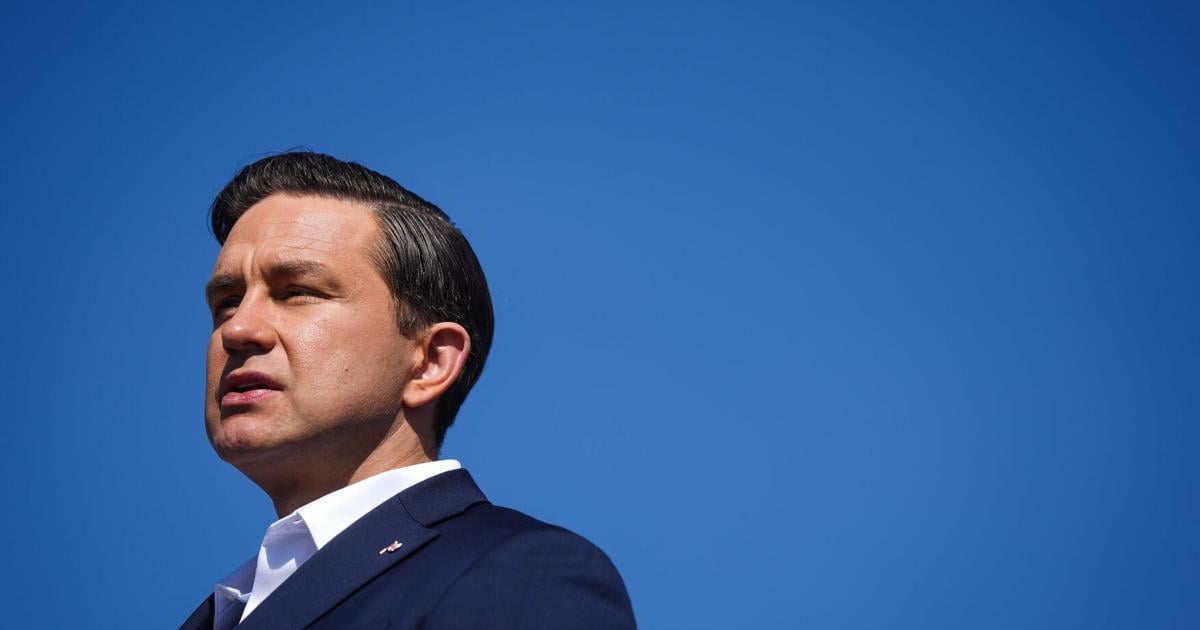
Tories both inside and outside caucus reveal concerns over low morale, lingering frustrations about the party’s loss in the last election and uncertainty about how they can close the gap with Liberals.
For Pierre Poilievre, this summer was meant to be one of reset.
Instead, it brought public infighting sparked by a remark Poilievre made about a prominent Conservative organizer, a tightening fundraising race and the loss of another caucus member, leaving some MPs and insiders worried more departures could follow.
“I think anyone that tells you that everyone’s feeling great right now is either lying to you or to themselves,” said Ben Woodfinden, who worked as Poilievre’s communications director until after last year’s election.
But conversations with Conservatives both inside and outside caucus reveal concerns that run deeper than a difficult few months.
“There is no plan,” one Conservative insider said.
To understand the state of the Conservative party after a turbulent summer, the Star spoke to more than a dozen sources from inside caucus, outside operatives, insiders and supporters, granting them the ability to speak on background to express themselves freely.
What emerged was a picture of a party struggling to define its path forward. MPs and insiders described low morale, lingering frustrations about the party’s loss in the last election and deep uncertainty about how Conservatives can close the gap with a Liberal government that continues to lead on the question of who Canadians trust to be prime minister.
“There’s a complete lack of enthusiasm for the future,” one caucus member said.
“There’s a lot of disenchantment,” they added. “Mr. Poilievre has to look in the mirror.”
Poilievre’s office did not respond to the Star’s request for comment.
Despite the grumbling about Poilievre, there are private debates over whether, given his popularity with the party, enough members would even be willing to sign a letter to successfully trigger the Reform Act, the mechanism that Conservative MPs used to oust their former leader, Erin O’Toole.
And caucus members are acutely aware of the gravitational pull Poilievre still holds over the party, with one member, who supports Poilievre, rejecting any notion there’s an appetite for a leadership change, saying more than once that constituents have informed them that, “If Pierre’s gone, so am I.”
“There’s no clear answer on how long people are going to give Mark Carney the benefit of the doubt for,” the person said.
“The one thing we can’t control as an opposition party is time,” they added.
Then comes another reality: the lack of a clear alternative — a common refrain from Poilievre’s supporters and party officials and something his critics know.
There also exists the risk that should the party descend into a leadership race, the ensuing contest could be highly divisive and potentially result in a successor that makes things worse.
“Lots of Mr. Poilievre’s critics would miss him quite quickly,” Woodfinden said of a hypothetical leadership change, noting that conservative parties tend to pick those who satisfy the base, which, for the federal party, finds itself increasingly distant from where the wider Canadian public stands on issues.
A third caucus member noted how without Poilievre, there is no guarantee the voters he attracted — more working-class Canadians, first-time voters and men under 40 — will stick around and the reality that, like leaders past, anyone new would be subject to the same public scrutiny and attacks from Liberals.
“Anyone that is thinking about anyone else for leader has to think about … can they win that leadership?” said Ginny Roth, who worked on Poilievre’s 2022 leadership campaign as his communications director.
Still, for others, where the frustration lies is not on whether Poilievre stays or goes, but what they perceive as a lack of direction.
“People are very perplexed about the strategic choices and vision for the future,” one Tory insider said.
While Conservative infighting marked the start of Poilievre’s summer, it did not begin that way.
He earned applause at the end of June for a critic shuffle that saw him place Michael Chong, a well-respected Ontario MP for his work on foreign affairs, into the high-profile finance portfolio, with Shuv Majumdar, a Calgary MP with a background in international relations and connections in Washington, taking the role of critiquing the Carney government on Canada-U.S. trade.
Other moves viewed positively included the promotion of newer MPs, such as Ontario’s Sandra Cobena.
Four days later, that praise evaporated when Poilievre made an unscripted remark during his annual speech at the Calgary Stampede directed at the campaign manager behind Caroline Elliott’s bid to become leader of the Conservative Party of British Columbia: Kory Teneycke.
Poilievre took aim by dismissing Elliott’s campaign as being run by “Liberal lobbyists from out east.” The rebuke landed with particular force because three of Poilievre’s former staffers, including Woodfinden, worked on the campaign. Elliott ultimately finished a close second to Kerry-Lynne Findlay.
That speech, billed as a call for unity, had the opposite effect for the Conservatives listening.
“I thought it was immature and unbecoming of a leader of a party,” said Dan Robertson, who worked as chief of strategy during the party’s 2021 campaign under O’Toole and for both the party and former prime minister Stephen Harper before that.
“The Conservative Party of Canada is a coalition,” he said, that is made up of “many different constituencies.”
“Your job as the leader is to hold that coalition together, it’s not to go to war with one faction of it, or one part of it.”
The jab spread among Conservatives at private dinners and those hitting the party circuit at other Stampede events, many of which were attended by lobbyists — including those who previously worked in conservative politics — and representatives from corporate Canada.
“Who’s going to be bringing their clients to fundraisers anymore?” asked one lobbyist, who has worked on Conservative campaigns in Ontario.
During Stampede, Poilievre also faced questions that brought the party’s struggle to define itself into sharper focus.
Some of Prime Minister Mark Carney’s policy moves, in stark contrast to those of his predecessor Justin Trudeau, have left Conservatives feeling boxed in. Indeed, members of the party’s national council wanted to know from Poilievre how he planned to respond to a Liberal government that appeared more supportive of pipeline development, including its proposal to advance a new million-barrel-a-day link to the West Coast from Alberta.
For his part, Poilievre has spent his summer on the road, attending his MPs’ barbecues and smaller-sized townhalls, filming videos highlighting local candidates.
In September, he is slated to huddle with his caucus for its annual pre-fall sitting in Penticton, B.C., located in one of the ridings Poilievre picked up in the last election. It’s listed as a “toss up” with the Liberals by the polling aggregator 338canada.com.
Before that, Conservatives are watching two key events that could tip the scales.
First is the Aug. 19 deadline when U.S. President Donald Trump’s latest tariffs on a range of Canadian goods are set to take effect unless a trade deal is reached.
Conservatives see vulnerability in what Canada may concede. They point to Carney’s handling of the opening of the Gordie Howe bridge — where he later admitted that he could have done a better job explaining the terms of the deal that will see toll revenue split with the U.S. — as an example of a prime minister who campaigned on standing up for Canada capitulating to Trump.
The other event is a byelection in the Quebec riding of Chicoutimi—Le Fjord, a seat vacated by Conservative MP Richard Martel after Carney appointed him to the Senate.
While Poilievre has been campaigning with the party’s candidate ahead of the Aug. 31 vote, Conservatives have downplayed the prospect of losing the seat, arguing it belonged more to Martel than to the party itself. They point to the former hockey coach’s personal popularity in the riding, which has been represented by all four major federal parties over the past 20 years.
The plan from the Conservatives for now is to make the case that Carney is failing to deliver the change he promised and show Canadians that they are focused on affordability, which remains a top-of-mind issue.
Robertson said the window for Poilievre to prove he can win is not closed, but warned that “it’s closing.”
“We’re sort of getting into the territory now where Conservatives have to start hoping that … certain things happen or go their way — and as the saying goes, hope is not a strategy.”
For Woodfinden, his advice is simpler.
“Move on from the summer as quickly as you can and get back to it in the fall.”
Posted by IHateTrains123
1 Comment
The thing is I don’t the think conservatives really hate their position. Like Pierre is minor celebrity in the right circles, if you are a party staffer,fundraising is great RN and you have jobs. MPs don’t have to do much and Pierre pretty much does the campaigning for you. Sure the MPs who lost are probably upset but they also don’t sit on parliament so who cares about them lol.