
Calls within the Democratic Party of Korea to abolish the National Court Administration and curtail the Chief Justice’s authority over judicial administration have resurfaced, following demands for Chief Justice Cho Hee-dae’s resignation and even his impeachment. What began as controversy over Cho’s written recommendation of a Supreme Court justice nominee now appears to be expanding beyond the question of the chief justice’s personal position into a broader push to overhaul the judicial administration system itself.
Rep. Kim Seung-won, the Democratic Party’s ranking member on the National Assembly’s Legislation and Judiciary Committee, referred in a radio interview on the 21st to Cho’s written recommendation of a Supreme Court justice nominee, saying, “In the end, I believe it was this imperial-style system centered on the chief justice that enabled such unreasonable and unlawful conduct.”
Kim argued that judicial reform was needed to disperse the chief justice’s administrative powers, calling for the establishment of a Judicial Administration Commission and the abolition of the National Court Administration.
Kim proposed abolishing the current National Court Administration and replacing it with a “Court Affairs Office” responsible primarily for executive and administrative functions. Under his proposal, major matters concerning the judiciary, including judicial personnel appointments, would instead be decided by a separate collegial body, thereby dispersing powers currently concentrated in the hands of a single chief justice.
The National Court Administration currently oversees judicial administrative affairs—including personnel, budgets and accounting—for courts nationwide under the direction of the chief justice. Its head is appointed by the chief justice from among the Supreme Court justices.
The abolition of the National Court Administration is not a proposal the Democratic Party has raised for the first time. In December last year, the party’s task force on overcoming public distrust of the judiciary and normalizing judicial administration introduced an amendment to the Court Organization Act that would abolish the National Court Administration and establish a collegial Judicial Administration Commission that would include outside members.
Under the bill, major matters of judicial administration—including judicial appointments, budgets and disciplinary actions—would be deliberated and decided by the commission, thereby dispersing the chief justice’s authority. The bill is currently pending before the Legislation and Judiciary Committee.
Although the proposal to abolish the National Court Administration did not move toward full-scale consideration at the time, the ruling party’s ranking member on the committee has now publicly revived it amid the recent controversy over Chief Justice Cho’s recommendation of a Supreme Court justice nominee.
Within the Democratic Party, calls have recently gone beyond demanding Cho’s voluntary resignation, with a growing number of lawmakers also raising the possibility of impeachment.
Supreme Council member Lee Sung-yoon said at a party leadership meeting held in Gangneung that day, “There are now sufficient grounds for impeachment,” and called on the party to consider pursuing Cho’s impeachment at the party level.
Kim also argued that Cho’s conduct could constitute dereliction of duty and abuse of authority and therefore provide grounds for impeachment. He added, however, that before any actual impeachment effort is launched, there should first be a process of informing the public about the relevant facts.
Pressure from the National Assembly is also mounting.
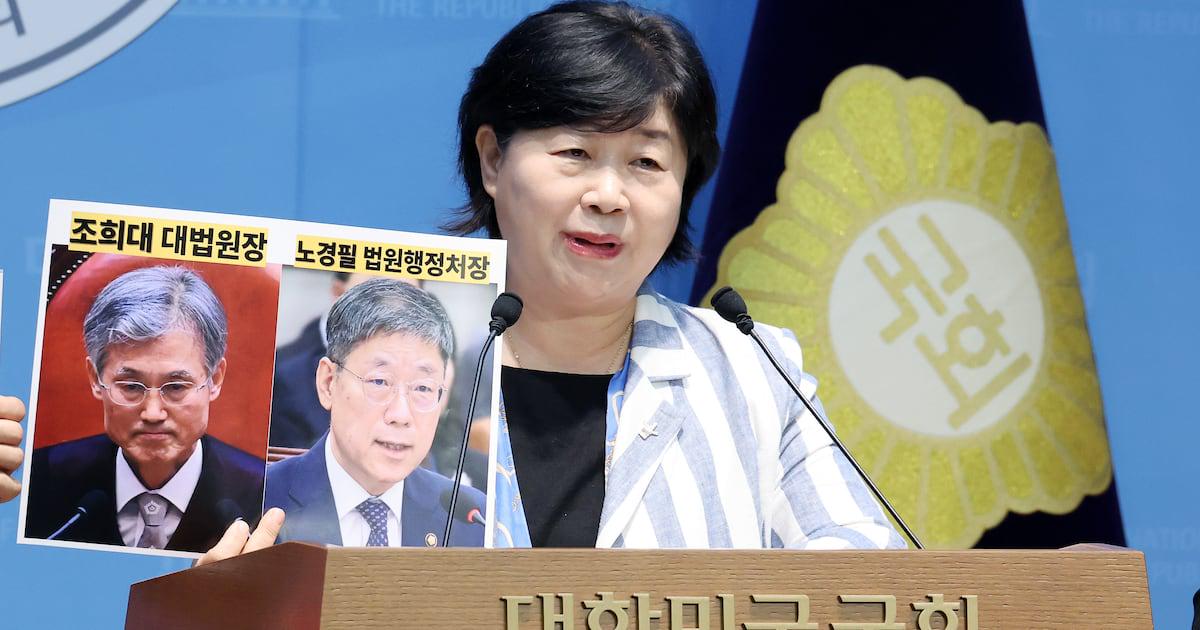
On the same day, the Legislation and Judiciary Committee, led by the Democratic Party and other parties aligned with the ruling bloc, selected Chief Justice Cho and National Court Administration head Noh Kyung-pil as witnesses for an emergency parliamentary inquiry scheduled for the 31st.
Three lawmakers, including the Democratic Party’s Kim Seung-won, proposed the motion requiring their attendance as witnesses. Lawmakers from the People Power Party walked out in protest.
The committee says it intends to question Cho and Noh about the process by which the Supreme Court justice nominee was recommended, the referral of cases to the Supreme Court’s full bench, and the National Court Administration’s procedures for recommending Supreme Court justice candidates.
The Democratic Party has taken issue with the fact that Cho delayed for an extended period the recommendation of a successor to former Supreme Court Justice Roh Tae-ak. It has also criticized Cho for submitting the names of candidates, including Presiding Judge Son Bong-gi, in writing without holding an in-person consultation with President Lee Jae-myung—contrasting this with Cho’s direct consultations with the president during the previous Yoon Suk Yeol administration.
The Supreme Court, however, maintains that no opportunity arose for the president and chief justice to meet and that Cho submitted the recommendation in writing only after continuing efforts to arrange consultations.
Noh, who appeared before the Legislation and Judiciary Committee on the 19th, also explained that the chief justice is not legally obligated to comply with a request to appear before the National Assembly.
A conflict between the Blue House and the Supreme Court that began over the manner in which a single Supreme Court justice nominee was recommended is now spreading to demands for Chief Justice Cho’s resignation and impeachment, calls for him to testify before the National Assembly, and even proposals to restructure the institutions responsible for judicial administration.
If the Democratic Party now moves in earnest to pass the bill it introduced last year to abolish the National Court Administration, the dispute over Cho’s future is likely to broaden into a confrontation between the ruling and opposition parties over the powers of the chief justice and the overall system by which the judiciary is governed.
Posted by Freewhale98